

One Day at a Time
You’re Out of Your Comfort Zone. What Can You Do About It?
Daily insights on life in the face of uncertainty, by psychiatrist and habit change specialist Dr. Jud Brewer
Did you know that your mindset has a big impact on how you deal with uncertainty, and may impact your reaction not just to the current crisis, but to any life challenge you face?
I suspect that you, like me, have observed a few clear patterns regarding yourself lately. In the face of fear and uncertainty, some people seem stuck, even paralyzed, by all of this — while others are stepping up. Some are even stepping out of their shells, surprising themselves and those around them by what they are capable of in the face of danger.
Why is that?
We have all been forced out of our comfort zone by this global challenge and huge break in our routine. The million-dollar question, is what happens when we’re out of our comfort zone? Do we run back toward it, seeking safety in the familiar? Do we freak out and accidentally run the other way, into the proverbial panic zone where our brains shut down? Or do we plant our feet firmly in our current reality and step up to the challenge of learning what this new experience has to teach us?
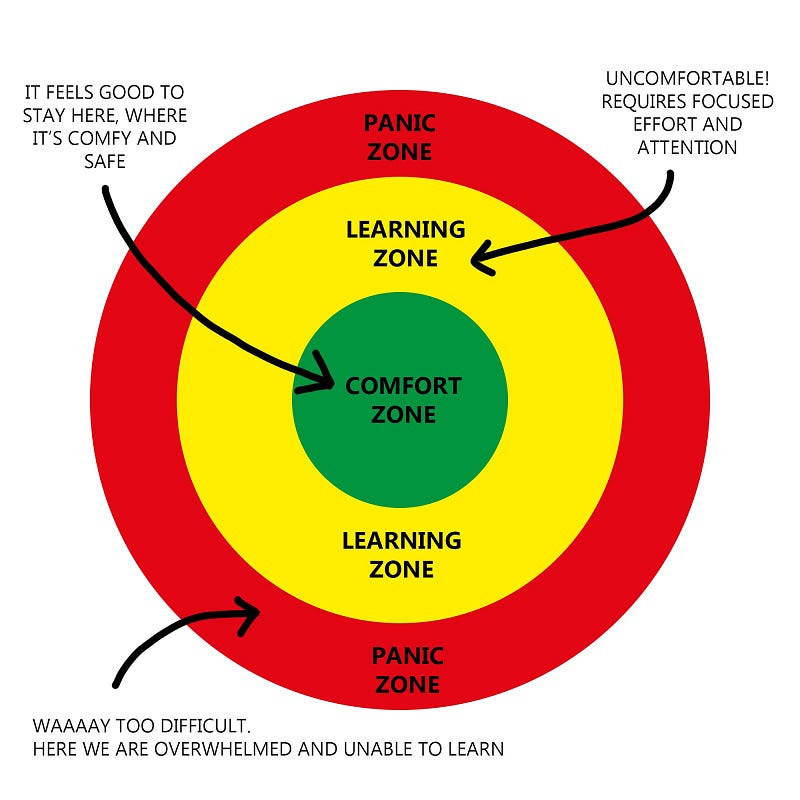
The zone you choose has a lot to do with your mindset.
Carol Dweck, PhD, is a Stanford researcher who coined the terms “fixed mindset” and “growth mindset” decades ago, based on her research into how kids and adults respond to challenges. Dweck describes a fixed mindset as the belief that your basic intelligence and abilities are unchangeable–you’ve got what you’ve got, and have to utilize them the best you can. Growth mindset, on the other hand, is a belief that your abilities can be developed and improved over time.
Dweck has been studying mindset for decades. According to one definition, a mindset is a set of assumptions, methods, or notations held by one or more people or groups of people. Or, simply put, a mindset is a person’s worldview. Our mindset can be so habitual that it colors how we interpret events and influences the choices we make and how we learn. It can even contribute to what is called mental inertia or group think when individuals with similar worldviews come together and start feeding off of each other. Think mob mentality.
How do we develop a particular mindset? Here’s a hint, it has to do with reward-based learning. Let’s use a simple example, say chocolate. If you get stressed (trigger), and you eat chocolate (behavior), and you feel a little better (reward), your brain learns something: If you are stressed, you should eat chocolate to feel better.
I think of this as learning to see the world a certain way. We put on chocolate-colored glasses, and walk around so that the next time we are stressed, our brains say, “Hey, eat some chocolate, you’ll feel better.” That’s where sayings like “she wears rose colored glasses” and “he wears dark colored glasses” come from. These are euphemisms for people who always see the world a certain way: Rosy suggests that we’re always seeing the world from a glass is half full perspective, and dark is the glass is half empty. And yes, you can learn to wear the chocolate (worry) or any other type of mindset glasses. The more you wear them, the more you forget that they are on your face — they become a part of your identity.
You learn to see the world a certain way based on your previous experiences. Each time you do something that reinforces your learning, the lenses of your worldview glasses get a bit thicker. Dweck has mostly studied mindset in education and school settings, but her work is pretty relevant for just about everything we do, because mindset colors how we see the world.
Our mindset can be so habitual that it colors how we interpret events and influences the choices we make and how we learn.
According to Dweck, individuals can be placed on a continuum according to their implicit views of where ability comes from. If you believe your success is based only on innate ability, basically what you were born with, you fit into the category of a fixed mindset. On the other hand, if you believe that progress is based on hard work, learning, and training, you have a growth mindset.
You might not even be aware of your habitual mindset. How you respond to failure is a good indicator. Fixed-mindset individuals dread failure because they consider it a negative statement about their basic abilities — a reminder of their inherent limitations. Growth mindset individuals, on the other hand, don’t mind or fear failure as much because they realize their performance can be improved and learning comes from failure.
Let’s use an example of walking down the sidewalk.
If you are in a fixed mindset and you trip on something and fall down, you might beat yourself up for being clumsy. In the same situation, if you are in a growth mindset, you might say to yourself, “hmmm I tripped, what can I learn from this?” Should I tie my shoes more securely, or pay closer attention to the sidewalk? In a growth mindset, you can even question the notion of failure itself a bit. What does it mean to fail? If you learn something from the experience, does that count as a failure?
Dweck even argues that a growth mindset will allow a person to live a less stressful and more successful life. This also makes sense, because in a growth mindset, you’re always learning and growing from your experiences. In her book, Mindset: The New Psychology of Success, Dweck advises, “If parents want to give their children a gift, the best thing they can do is to teach their children to love challenges, be intrigued by mistakes, enjoy effort, and keep on learning. That way, their children don’t have to be slaves of praise. They will have a lifelong way to build and repair their own confidence.”
I love her phrase “enjoy effort.” It’s pretty hard to enjoy what is happening as we try to force change, or beat our heads against the wall. But what happens when we start loving the challenge, and getting intrigued by the mistakes?
To get a sense of how to do this, let’s explore. What does your body feel like when you have a fixed view, or are closed to someone else’s ideas or feedback about your own ideas? You might notice that it literally feels closed down, like you are protecting yourself from different information getting in and thereby contaminating your worldview. As I talked about before, this feeling of closed-down-ness may have evolutionary parallels: When you are being chased and cornered by the proverbial saber-toothed tiger, your job is to close down into a tiny little ball to protect yourself.
What does it feel like when you are in a growth mindset? You are literally (and figuratively) open to new ideas. Can you feel that in your own experience? Growth mindset leaves you open to learning.
What happens when we start loving the challenge, and getting intrigued by the mistakes?
Give it a try today. Here are three steps to practice when you find yourself outside of your comfort zone:
Step 1: Check to see if you are closing down in fear or discomfort with difference. Take a moment to make sure you are not actually in danger.
Step 2: See if you can feel a little more deeply into that closed-down, restless-feeling urge to act (run, avoid, shut down). Can you get curious right in that moment? Check in with your body and mind. “Oh, this is discomfort!” You can even use the trick I wrote about in an earlier column and open your eyes really wide. “Oh, I’m out of my comfort zone.”
Step 3: Remind yourself that this is an opportunity to learn. Remind yourself of the best teachers, mentors, and coaches you’ve had in your life, and how you’ve grown when they encouraged you to step up to challenge. Bow to this opportunity as a sign of respect. Bow to it as a teacher, and ask, “What can I learn from this?” Can you expand your boundaries and grow your comfort zone here?
I’ll end with a quote to remember.
“There are no great people in this world, only great challenges which ordinary people rise to meet.”
So, let’s all rise to meet today’s challenges, in their many forms. If you’re interested in a video recording of this material, I’ve created one here.
Onward, together.