You’re Not A Visual Learner: Learning Styles Don’t Exist.
Let’s lay this piece of psychology folklore to rest

“Are you an auditory learner, a visual learner, a reading/writing learner, or a kinesthetic learner?”
It’s a trick question. There’s one correct answer and it’s a nuanced combination of all of the above. And it depends on what you’re learning.
You don’t have a “learning style” because they don’t exist.
There’s zero scientific evidence to support the existence of “learning styles”. Don’t buy it? I was surprised when I learned this too, but here’s what numerous research studies have found:
“To date, there has been no evidence that matching or meshing instruction to someone’s self-reported learning style positively affects their ability to learn new information.” — American Psychological Association, 2019
That article cites over 20 studies all amounting to the same conclusion. There’s no evidence learning styles exist, but there is evidence that believing in them can be harmful.
Learning styles are an essentialist belief. If you endorse essentialist beliefs, you think your skills and traits are set at birth and can’t be altered through experience. You think we have some sort of “true nature” that is set at birth and pre-determines the course of our lives. If you think this way, it’s not great for your motivation. Students who hold essentialist beliefs about intelligence have lower self-esteem and a helpless response to challenges.
According to the American Psychological Association, the learning styles model can also undermine education. It takes away valuable time and resources teachers could be spending on strategies that actually work.
Some teacher certification programs and academic support centers still include a focus on learning styles, which ensures the myth gets passed down to more and more children. Here’s what the author of a recent study on learning styles has to say about it:
“My biggest concern is that time is being spent teaching young children maladaptive strategies for learning. It is important that children from a very young age are taught with the best practices so they will succeed.” — Shaylene Nancekivell, PhD
Teaching someone to unlearn a maladaptive strategy is legions more difficult than teaching them something new. Kids come into the classroom with deeply engrained misconceptions. One of the hardest things to do as a teacher is to help students unlearn misconceptions.
Do teachers everywhere a favor and stop telling kids that learning styles are a thing, because it’s just one more misconception they’ll latch onto and some teacher down the road will have to pry away from them.
When you Google the term “learning styles” the first thing that pops up is this infographic displaying non-scientific, false information on how teachers can recognize different “types” of learners in their classroom.
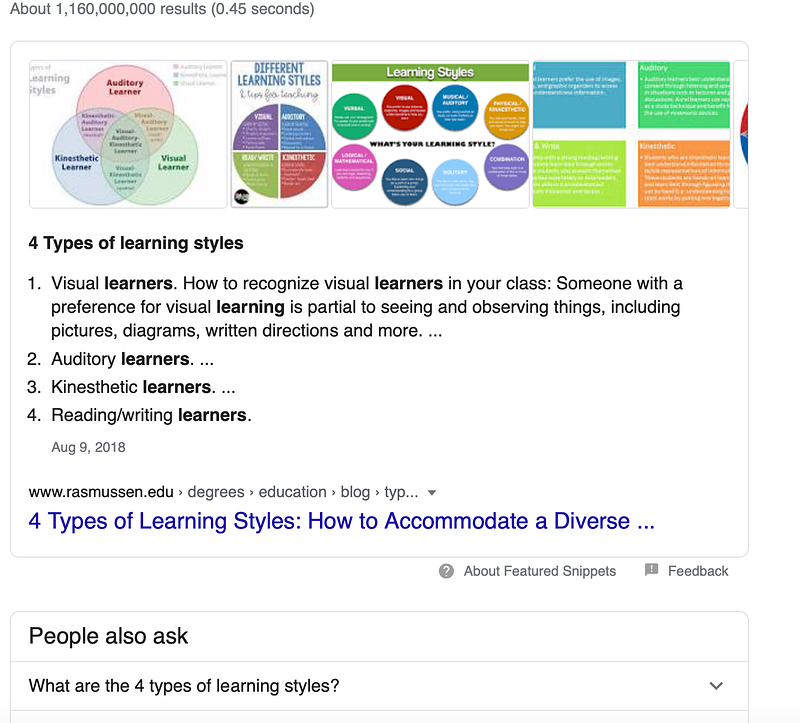
If you keep scrolling, you’ll find quizzes you can take to discover what your learning style is. But if you pay close attention, buried between the quizzes and explanations, there’s an article from The Atlantic called, The Myth of Learning Styles. Take a gander. It cites research as far back as 2015 confirming that learning styles just, “have not panned out”.
Despite all the evidence that learning styles don’t exist, it’s a widely held belief. More than 90% of teachers believe in learning styles. Yikes. The Atlantic article has a theory about why it’s so commonly believed:
“The concept is intuitively appealing, promising to reveal secret brain processes with just a few questions.” — The Atlantic, 2018
Yup. That’s definitely part of it. Wouldn’t it be great if we could just categorize every student, easily differentiate our teaching based on their individual learning style, and get amazing results? It’s a very alluring concept.
I have an additional theory — Learning styles became so popular for the same reason the four houses in Harry Potter are so popular. The same reason the MBTI is so popular (also a myth btw — check out this article if you’re curious).
We love to put ourselves in categories. Maybe it’s a byproduct of our hyper-individualistic culture. Maybe we have an innate biological tendency to want to put everything in neat categories as a mental shortcut. Maybe we just like feeling special.
Oh, and here’s another reason — money!
“Industry has capitalized on this desire to use learning style philosophies in the classroom, resulting in widely available and commonly used assessments such as the Dunn, Dunn, and Price Learning Styles Inventory.” — American Psychological Association, 2019
Learning styles are a cash cow for the people who write and sell assessments.
Companies have invested enormous amounts of time and money into developing these assessments and effectively marketing them. With the percentage of people who buy into the myth already, I would imagine their marketing people had a pretty easy time selling it!
My parents took me to a tutoring company when I was in middle school because I needed a little extra help with math. I vividly recall the first session because we didn’t do any math. All day, I had been dreading doing more math after school let out. I remember the sense of relief upon realizing we weren’t going to do any math.
Instead, I sat through two hours of assessments as she tried to figure out my learning style with an array of assessments. She read sentences out loud, asking me to repeat them.
I scored in the 98th percentile for that section — Turns out, I was an auditory learner! She gave me a set of tapes about math to listen to as my first homework assignment.
Spoiler alert — my math test scores didn’t suddenly improve.

Whatever the reason learning styles are so widely believed in, it’s time to lay this piece of psychology folklore to rest in the same place we buried Freud’s Oedipus Complex.
If you don’t want to abandon the concept entirely, then at least start calling them learning preferences instead of learning styles. Sure, kids can have preferences for how they learn in different subjects (like preferring hands-on activities for science classes). But there isn’t a single kid in the world who learns best in one “style” in every subject. Our brains aren’t that simple.
It’s time to lay this piece of psychology folklore to rest in the same place we buried Freud’s Oedipus Complex.
And if you’re ever tutoring a middle schooler struggling in math, don’t tell her she’s an auditory learner and give her tapes about math (she won’t listen to half of them…)
What to Do Instead
If I’ve convinced you that learning styles don’t exist, you may be wondering what we should be doing instead. Fortunately, educational psychology and teaching are huge fields and there are a ton of evidence-based ways to get better at learning. Here are a few:
Use Metacognitive Strategies
Metacognition is “thinking about thinking”. Adult learners can become masters at this. It’s a higher-order set of thinking skills that enables us to assess our learning, makes changes as necessary, and optimize our outcomes.
Think about your weaknesses and strengths in how you learn, and test out different ways to improve. If you’re trying to learn a new language, for example, try using a habit tracking app to monitor your progress. Set specific and attainable goals and track your progress.
Learn From Mistakes
Errors are good for learning. Use them as opportunities to learn something new. Never be afraid to fail or think it’s “too late” for you to learn about a new field, a new language, a new skill, etc. Embrace errors when they happen and learn from them.
Try Spaced Learning Techniques
We retain information better with spaced out repetition and review. Here’s a great guide that dives deep into a specific method for spaced learning.
Find Educational Content That Uses Humor!
Humor helps students retain information, builds trust between the student and teacher, and reduces students’ anxiety. It’s a useful tool for learners of all ages. For example, there are humorous history podcasts you can find and listen to.
Lastly — Question Everything
I’ll leave you with one last piece of advice — always be skeptical. Question everything you think you know. If you enjoyed this article, you should check out this article on why we’re so prone to believing and spreading misinformation by Simon Pitt:
“Extraordinary claims require extraordinary evidence.” ― Carl Sagan


