
You’re Managing Your Time Wrong

“Until we can manage time, we can manage nothing else.” — Peter Drucker
Are you stressed out trying to do everything that must get done each day? Do you have a schedule, a list of priorities, or a to-do list that overwhelms you?
You’re not alone. I have a long history of failed attempts at time management. My most classic was when I enrolled in a time management class at work…for which I was 15 minutes late.
In recent years, I’ve done well with a creativity-based project planner, that allows me to indicate the two or three major projects I plan to work on each day. But I still struggle with overcommitting on the number of things I can handle within a day, and making the tough decisions of foregoing something I want to do in favor of something I’ve committed to do.
So imagine my surprise when reading the book “The Big Leap” by Gay Hendricks, coming across the statement, “You’re where time comes from, you have the power to make as much of it as you want.”
Say what? I can manufacture time? I can get 30 hours in my day instead of the 24 everyone else gets? Sign me up for that superpower!
It’s not quite that easy. But it can feel that way, if you’re managing your time correctly.
In this article, I’ll cover:
- What is time management?
- Systems of time management
- The goal of time management
- How to expand your available time
- How to recover time from time thieves
What is time management?
“Time management is a misnomer — the challenge is not to manage time, but to manage ourselves.” ― Stephen R. Covey
Traditional time management is the ability to use your time effectively or productively. The idea is to consciously plan and control your use of time on specific activities. This allows you to increase your effectiveness, efficiency, and productivity.
There are many different strategies for managing your time productively. For example, you can schedule your time, and allocate just so much time and no more to specific tasks. People who handle all of their emails during scheduled blocks of time fall into this camp. If they reach the end of their time before they reach the end of their emails, any emails they didn’t get to will have to wait until the next block of time.
Alternatively, you can schedule your tasks, and allow no other tasks to distract you until you complete that task. People who start their day by devoting an hour to their most important project with no interruptions fall into this camp.
Time management systems
This list of time management systems will give you a sense of the wide range of options people have created for trying to manage their time.
- ABCD Analysis — group all tasks into things that must be done immediately (A), this week (B), this month ©, and that can be deleted or delegated (D)
- 80/20 Analysis — identify the 20% of your activities that produce 80% of your results, and focus your time and efforts on those
- Eisenhower Matrix — divide tasks by urgency and importance, and focus your attention on those that are both urgent and important
- Getting Things Done — get all tasks onto paper and assign them to the appropriate time and place for completion; break large projects into smaller tasks
- Pomodoro Method — devote an intense 20–25 minutes to a task, followed by a five minute break; rest for 15–30 minutes after four intense periods
- Chunking — group similar tasks together and do them all one after another
The goal of time management
“You can do anything, but not everything.” — David Allen
The holy grail of time management is that you will sail through your days, calm and in control, accomplishing everything that needs to be done with plenty of time left over to do the things you want to do. Those things you want to do are what is normally considered “personal time” or “leisure time”.
The idea is that your employer pays you to do the things they want done during work time, and you do the things you want to do the rest of the time.
In practice, it’s never that cut and dried. If you’re worried about something at home that needs to be done, it will impact your ability to concentrate at work. If you’re on a deadline at work, you may use your personal time to finish the project.
Then there’s the question of self-employed people. Where is the boundary between personal and work time, when all of the time is yours?
Finally, there’s the real issue of burnout. There needs to be a sustainable balance between the energy you expend in work and the energy you recover from regenerative practices such as meditation or solitary walks in nature. Especially for creatives, such as writers and artists, there is a need to “fill the well” as Julia Cameron puts it, and not allow the work to drain the well until nothing is left.
How to expand your available time
“You will never ‘find’ time for anything. If you want time, make it.” — Charles Buxton
This brings us back around to the original idea that stopped me in my tracks — that we are responsible for creating time, and that we can create as much of it as we need.
The first thing you must do, if you want to create more time in your life, is to stop complaining about time. Paradoxically, every time you complain that you don’t have time to do something, you ensure that you don’t. You actually remove time from your life when you do this.
You do not physically remove time. You don’t suddenly teleport from 8:07 in the morning to 8:09. But you do the next best thing. You ensure that your brain is wrapped up in the consideration of the things you’re not doing. It’s so wrapped up, in fact, that you can’t actually spare any attention for the things you’re supposed to be doing.
Instead, whenever you find yourself thinking, “I don’t have time for this,” stop. Take a moment. You have all the time you want. So what is it that you don’t want to give time to? Put another way, what is calling to you to give it time, instead of this thing?
For example, last night my husband asked me to watch an episode of a new television series we are enjoying. Instead of saying, “I don’t have time,” I listed the two other things that I felt were more pressing. I needed to return a revised short story to my editor, and I needed to cook us both dinner. I offered to skip dinner in favor of watching TV, but he felt dinner was more important. So I cooked us an early dinner, then while he was cleaning up, I focused intensely on typing up my revisions. Half an hour later, we settled in to watch two episodes of the show.
By being focused in the moment, I used all of the time available for the activities I wanted to accomplish. I wasn’t losing time, thinking about the thing I wasn’t doing. And it turned out that I had plenty of time to do everything I wanted!
Recovering time from time thieves
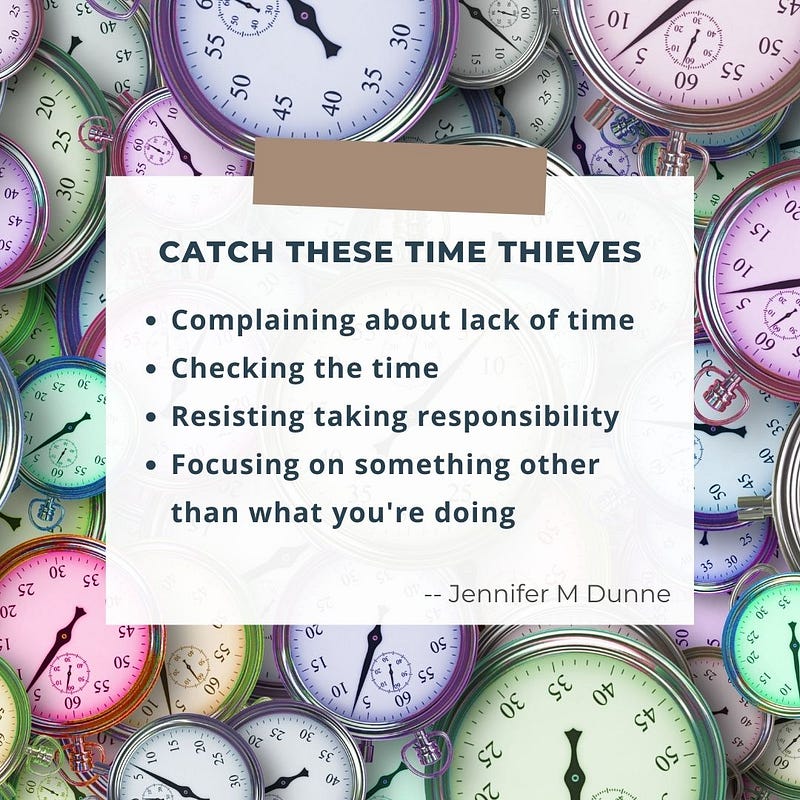
Complaining about not having enough time is a time thief. But there are other things that steal your time as well.
One of the more insidious time thieves is the sense of time pressure. If you’re constantly checking your watch, you’re actually losing time to the fear that you don’t have enough of it. The average person checks their smart phone 58 times in a day, both to check the clock and to see if they have received any messages. That combination of time pressure and a desire to be doing something (like reading social media) other than what you’re actually doing is a huge time thief.
In general, any part of your life where you are resisting taking responsibility is a time thief. For example, say you had an argument with your partner, for which you do not take full responsibility. Your mind keeps returning to the argument, searching your memory for evidence that you were right. It keeps whipping up a sense of outrage and anger that you were victimized in this way.
All of those thoughts are time thieves — and they steal energy and happiness, too. Instead, accept that you are 100% responsible for the argument — after all, had you reacted differently to the initial problem, there may still have been a problem, but there might not have been an argument.
Keep in mind that this doesn’t turn you into a doormat. (If you’re in an unhealthy relationship, taking responsibility means you leave that relationship, not accept the blame for your partner’s actions.) However, once you take responsibility for what you’re resisting, you will free up the time previously spent in justifying your resistance.
Key takeaways
“One always has time enough, if one will apply it well.” — Goethe
Time management is an attempt to create a system that allows people to be more effective and efficient in their use of time. However, the reason time management systems fail for most people is unacknowledged time thieves.
To recover from time thieves and “make” all the time you need in a day:
- Stop complaining about time
- Stop checking the time
- Focus completely on what you’re doing in the moment
- Take full responsibility for anything in your life that you are resisting
You will find that you are able to get more done in less time, have more energy, and feel better. It will be time well spent!
Ready to have a better tomorrow?
I’ve created a cheat sheet to help you gain control of your life, increase your confidence, and become optimistic about the future. If you follow this daily, you will change your life very quickly!


