
Your Tribe of Mentors Wants You to Know, it’s Not Supposed to be Easy
Come down this rabbit hole with me.

I came across someone writing about something Tim Ferriss wrote that sent me down a rabbit hole that landed on this quote:
What would this look like if it were easy? is such a lovely and deceptively leveraged question. It’s easy to convince yourself that things need to be hard, that if you’re not redlining, you’re not trying hard enough. This leads us to look for paths of most resistance, creating unnecessary hardship in the process.
It’s an excerpt from Ferriss’s book Tribe of Mentors. On the surface, I like it. I do think that humans as a whole have this mental hiccup that tells us if it’s not hard, we’re doing it wrong. But then I read the rest of the sample chapter.
I want to fully disclose that I haven’t read it. Just this sample chapter, which is the book’s introduction, and two of the mentor profiles that make up the rest of the book.
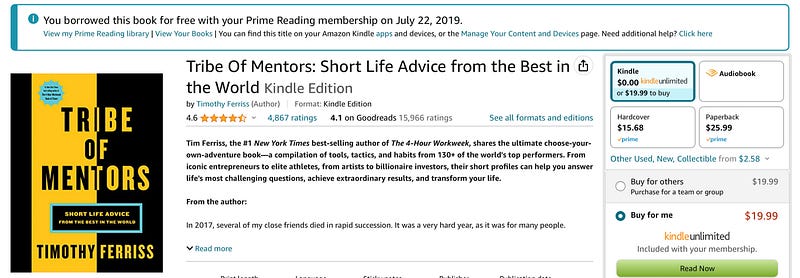
The book is free on Kindle Unlimited. When I went to look at it, I saw that I’ve had it in my queue since July 22, 2019. Four years.
The sample chapter got me thinking about Tim Ferris and guru men and, oh, all sorts of things.
Ferris is Gen X, like me. His audience, as far as I can tell, is mainly men who want to be like him. Not only, I’m sure. But when I hear people talking about him, it’s usually men. He’s talked before about finding his demographic in men like himself.
That’s the case for lots of business/money/productivity-type gurus. They are mostly (but not only) men. And they sell themselves and their stories to younger men who want to be just like them.
If you think about it, that’s the essence of mentorship. Who wants to be mentored by someone completely unlike them and who isn’t doing something that they want to do?
This sample chapter struck me as a really good example of that.
Tim Ferriss is Famous
He talks about the process of writing his book in the sample chapter.
He decided he wanted to embrace things being easy and that having a big tribe of mentors would achieve that. So he brainstormed a huge list of possible members of his tribe.
Then he secured a book contract with an advance he promised to return if his plan didn’t pan out. (I’m sure that was in his contract.) He came up with a list of eleven questions he’d honed while interviewing hundreds of people for his podcast.
He sent the questions out to those people on his list. More than a hundred of them. This line cracked me up:
For 12 to 24 hours, nothing.
He emailed people like the Dalai Lama and Neil Gaiman — and then twiddled his thumbs for one day.
Tell me you’re used to folks jumping at the chance to speak to you without telling me you’re used to folks jumping at the chance to speak to you.
Okay, Guru.
Tim Ferriss is a famous, bestselling author.
So going out and securing a book deal with an advance that he could confidently say that he’d pay back if he had to is a different experience for him than it would be for us mere mortals.
I’m fairly sure that the point of his book isn’t to teach you how to get your own roster of high-end, well-known mentors, though. It’s to give you access to the tribe of mentors he was able to gather up, via his book.
I think this whole thing was a brilliant idea. A book guaranteed to sell. An interesting premise. It has more than 4800 reviews on Amazon. A fraction of the 25,000+ The 4-Hour Work Week has, but still. Not small bananas.
The idea that we could all email a hundred or so possible famous-person mentors with a list of questions and get responses at all (never mind in twelve to twenty-four hours) is a little out there.
For one thing, there are way, way, way more of us than them. How many emails are they going to actually answer before they just start ignoring them? (Answer: probably only Tim Ferriss’s.)
But he didn’t suggest that.
The best thing, in my opinion, that he did with Tribe of Mentors was show how easy it is to get mentoring from a book you can borrow from your local library, download for free if you have Kindle Unlimited, or buy for less than $20.
The second profile I read sent me down another rabbit hole. And that led me to writing this blog post. So, I’d say the book worked for me exactly how it was supposed to.
Having a tribe of mentors is a really good idea.
I’m in love with it, to be honest.
I actually bought a book at Ollie’s yesterday written by someone I’d pick for my personal tribe. No, scratch that. She’s all already there. Not because I know her personally. I don’t.
She’s part of my tribe of mentors because she wrote down all her advice and I read it. Then I used it.
Her book The Creative Habit changed my life. It is, truly, one of the most amazing books about living a creative life that I’ve ever read.
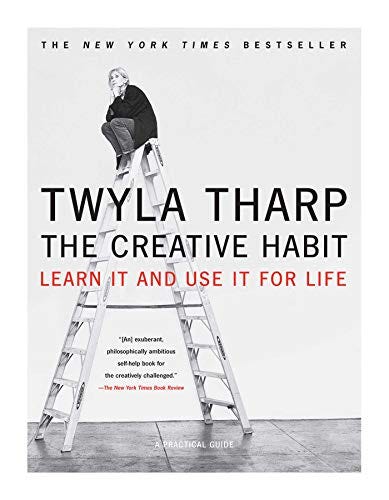
So, when I found Keep it Moving for $4.99 at Ollie’s, a close-out discount store, I snapped it right up.
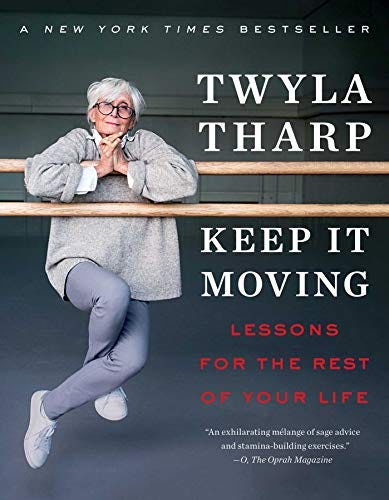
How exciting!
I’ve actually built a whole tribe of mentors without ever having to ask them to answer my questions. Because they already have. Would it be awesome to meet Twyla Tharp. Uh. Yeah.
But do I have to, in order to be mentored by her? No. I don’t.
This morning I brainstormed my own Tribe of Mentors.
I started with a list of the areas in my life where I feel the need for mentorship. Then I thought about who has already helped me by writing books, writing essays, or creating videos that have taught me something or supported me in some way.
This isn’t a wish list. These are people who have already mentored me via their work.
As long as I have access to the Internet and/or a library card — these amazing human beings can mentor me for free. Without any intrusion at all on their lives.
Again, if you ask me whether I’d like to have them actually mentor me in person, the answer would one-million percent be yes.
One time I made my daughters stand in line with me for three hours just to have Judy Blume sign my copy of Tiger Eyes, for Pete’s sake.
Here’s photographic proof.
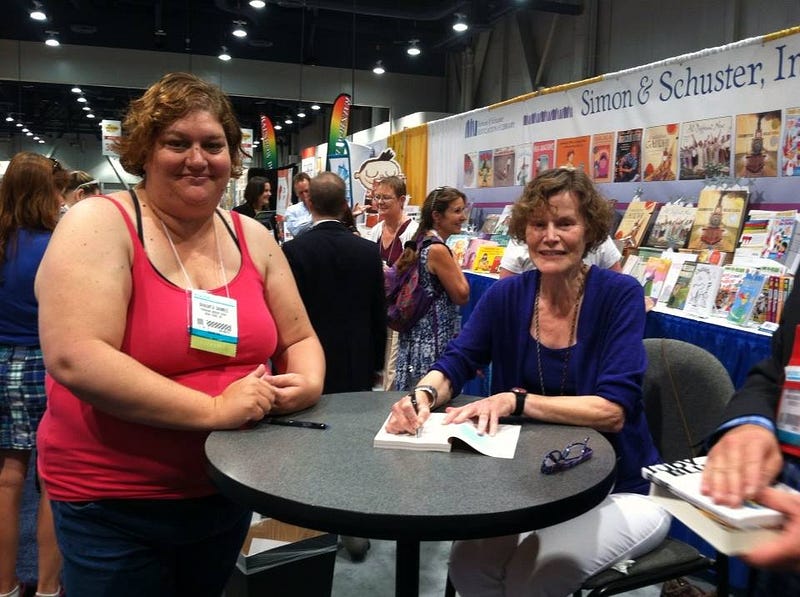
I was inspired just breathing the same air as she did. It was August in Las Vegas — at least 115 degrees. I was sweating. I felt gross. I looked gross. But I literally didn’t care.
A few months later, I got to listen to her speak at a conference.
A little bit after that, she created a class about developing characters and hooking your readers. I joined Masterclass just to take it. And it was brilliant.
My point is that anything you want mentoring for, someone who you’d love to mentor you has already put everything they know into a form that’s both fairly inexpensive (or even free) and easily accessible with no gatekeepers.
In fact, you’ve already built your dream team. You just don’t know it.
Judy Blue was promoting a book and so was I, which is why we were in the same space twice within several weeks. Otherwise, she was my favorite writer when I was eight and an important part of my childhood. Mine and a million other 50-somethings. (Millennials will feel this way someday when they take their children to get Susanne Collins to sign their well-loved copy of The Hunger Games.)
She mentored me when I was a child. Think about that. She made me want to be a writer. She was one of the first people to teach me how good stories are put together. It was awesome to hand over my copy of Tiger Eyes and watch her sign it.
But it was awesome because she was already my mentor.
All of the people below embody my personal tribe. And they have already gone to the trouble of giving me their wisdom. I didn’t need to ask. I just needed to take it.
Creativity
- Twyla Tharp — The Creative Habit.
- Ed Catmull — Creativity, Inc.
- Austin Kleon — Steal Like an Artist (and all of his other books.)
- Raybrad Bury — Zen in the Art of Writing.
Writing
- Stephen King — On Writing.
- Christopher Vogler — The Writer’s Journey.
- Ursula K. Le Guin — Steering the Craft.
- Chuck Palahniuk— Nuts and Bolts: “Thought” Verbs. (This is an article that I truly believe that every single writer on the planet needs to read.
- Renni Browne and Dave King — Self-Editing for Fiction Writers.
- Raybrad Bradbury — An Evening with Ray Bradbury. (This is a video — I’ve watched it at least once a year for the decade or so.)
Productivity
- James Clear — Atomic Habits.
- Ryan Holiday — How and Why to Keep a “Commonplace Book.” (This is an article on Ryan’s blog. It’s incredible.)
- John Doerr — Why the Secret to Success is Setting the Right Goals. (This is a Ted Talk.)
- John Doerr — Measure What Matters (This is a book on the same subject as the Ted Talk above.)
Goals
- Barbara Sher — Wishcraft.
- Glenna Salisbury — The Art of the Fresh Start.
Mental Health
- KC Davis — How to Keep House While Drowning.
- Don Richard Riso — The Wisdom of the Enneagram.
- Bessel Van Der Klok — The Body Keeps the Score.
Life in General
- Amanda Palmer — The Art of Asking.
- Elizabeth Gilbert — Big Magic.
- Brene Brown — The Power of Vulnerability. (This is a Ted Talk.)
- A collection of novels that I turn to when there’s something I need to process or feel.
Home/Family
- Pam Young and Peggy Jones — Sidetracked Home Executives.
- Temple Grandin — Thinking in Pictures.
- Grace Llewellyn — The Teenage Liberation Handbook.
Take the time to put together your own list. Chances are, you don’t need to do much more than that to assemble your tribe of Mentors. You already have them.
If there’s something you’re struggling with — seek out a mentor at the library or bookstore. Or with a Google search. They are out there. I promise you.
Tim Ferriss asks the question — what if this was easy?
I’d like to suggest you look at your life another way. What if, you asked yourself this instead: What if this was hard?
I can hear you now. But, Shaunta, it’s already hard. Trust me.
I know. And I get it. But what if it’s supposed to be?
Let’s do a little thought experiment.
What if you decided that the hard work was the point?
Ferriss has sold roughly a gazillion books telling us to strive for a four-hour work week — which of course leads to massive stress and anxiety when we can’t make it happen. Like we’re not doing it right. Or we’re not lucky enough. Or whatever.
That’s not elegant. It’s not even easy.
Maybe life isn’t about avoiding work. Maybe, life is about figuring out the work that we don’t want to relegate to four hours a week.
I’m not talking about struggle. Hard doesn’t have to mean miserable. It can just mean a challenge. And I’m not talking about doing work you hate for meager wages.
Ferriss isn’t talking about standard 9–5 shift work in his book, and I’m not either.
That’s the work you have to do, so you can eat and sleep and otherwise take care of yourself. If that work sucks for you, then make it a priority to find other day-to-day work that takes less from you.
No. This is about the work of your heart. Building something. Creating something. Doing something that matters to you. This is about starting a business, becoming an artist (of whatever kind), your career.
Even if your huge goal in life is to retire early and spend your time with your family — is that really easy? You could phone it in, I guess. But do you want to?
Think about this: What if the work you want to do isn’t supposed to be easy?
Look — everyone wants the easy way. Countless gurus could fill their pools like Scrooge McDuck with dollar bills they earned selling us all the dream of easy.
Four hour work weeks. The art of not giving a fuck. So many whys. The list goes on.
I’ve had more than one of those gurus try to convince me to tell my students that I can make writing easier for them. That I have some kind of secret sauce, magic bean that will make writing easy.
But I don’t. There isn’t such a thing. And I won’t lie about it.
I want you to ask yourself whether or not you think that these gurus are actually living easy lives. Does it make sense that anyone runs a freaking empire easily?
No. They work. Hard, I’m willing to bet. They manage teams. They create content. They write books. They have fancy meetings with other hard-working gurus. They give talks. They innovate.
Maybe their Instagram feed tells a different story, but I that’s not real life.
So what if instead of constantly chasing easy, we embraced hard? You know — just like the gurus do. Just like every mentor you could ever dream of having has done.
Start by figuring out what you want.
I mean really, down in your bones, what do you want?
If it helps, start with the superficial: success, money, freedom, a big house, your dream job. But then dig deeper. Keep asking the question why? until you get to something that feels real.
Let’s see what I come up with.
- I want to be a writer.
- Why? Because it’s all I’ve ever wanted.
- Why? Because I love stories.
- Why? I think they can change the world.
- Why? Because they saved my life when I was a kid.
Oh. Okay, then.
I want to be a writer because stories saved my life when I was a kid. That’s interesting, and not where I thought this inquiry would go.
And this is interesting, too — I don’t feel compelled to figure out how to make writing stories that change the world and kids’ lives easy. In fact, I try to make everything else easier, so that I can do this hard work.
Most of my education, on every level, has been learning things that make writing harder.
Let’s do that again.
- I want to have a successful business.
- Why? Because I don’t want to be poor.
- Why? Because being poor scares me.
- Why? Because I was extremely poor as a kid and it was terrifying.
- Why? Because I didn’t know how I would feed my brothers and I don’t ever want to be in that position again.
Ah. I actually thought I was going to say — because I want to help people. Which I do. It’s my whole thing.
But that wasn’t what came out first. On a very personal level, I want a successful business because I don’t ever want to be in the position again of not knowing how I’m going to feed people who depend on me.
This is true for Ninja Writers. Where both of my older children work.
Also? This summer I started a whole other business so that one of those brothers would have a softer place to land when he moved close to me.
This is at the heart of why I want to be successful in business. Eyeopening.
If your whole focus is trying to figure out how to make it easier, maybe it’s not what you want in the first place.
That doesn’t mean that efficiency and productivity don’t matter. I don’t want to spend my time spinning my wheels doing things the long, hard way.
I’m the queen of coming up with systems to keep me out of the weeds, so that I can actually finish things.
And remember, I agree with Ferriss about the human capacity for equating difficult with better. If there’s an easier way, I ferret it out. But the process — the work itself — is it really supposed to be easy?
I’m a novelist and — fun fact — I hate writing the first draft of a novel.
But I love having written a book. And I really love editing. In order to edit, I have to write that first draft.
I write in tiny bites. Ten minutes a day, every single day. I’ve done that for eighteen years. That’s less than four hours a week. It’s actually one hour and ten minutes. And it’s my entire goal.
I usually write more, but I get full credit as long as I spend ten minutes a day on that first draft.
I do what I can to make that work easier. I use a plot board. I have studied story structure and theory so that writing doesn’t feel like such a black hole of holy crap, what am I doing? I set up my work space so that I like being there. I reward myself.
It’s still hard work, but it’s less hard if I’m comfortable and without the anxiety of not being sure what I’m going to write.
What I don’t do is hire someone to write that first draft for me. Or use AI to do it. I don’t let myself get away with telling a story that’s not as good as it could be, because it’s too hard to figure it out.
I have tools in place to make writing those first drafts smoother and less stressful. But if my only goal is to rip books out of my head easily, then maybe that’s not what I really want to do with my life.
Once you figure out what you actually want, you can start working toward that thing. When that happens, even the work you don’t love becomes easier to take. And the work you do that is out of alignment with yourself — you can start to put effort into exchanging that for work that suits you better.
Not because it’s easier. Just because it’s better.
Shaunta Grimes is a writer and teacher. She is an out-of-place Nevadan living in Northwestern PA with her husband, three superstar kids, Louie Baloo the dog, and Ollie Wilbur the cat. She’s on Instagram @ninjawritershop and is the author of Viral Nation, Rebel Nation, The Astonishing Maybe, and Center of Gravity. She is the original Ninja Writer.
Sign up for her Substack newsletter, Then See What Happens. Or follow her on TikTok.