
Your Toothbrush is a Swamp of Bacteria
Your toilet and toothbrush have a disturbing amount in common
Just like everyone else in the world, I’ve been spending a lot more time at home lately. This has caused me to look around and become a lot more grossed out by things that used to seem normal to me.
This has come to include my bathroom, which is the kind of bathroom that has the shower and toilet in the same room.
A bathroom built this way is more convenient for a small apartment, but at the expense of microbial health.
Studies show that flushing the toilet releases a “toilet plume” into the air. This is an arch of microscopic particles that become airborne after flushing and coat every surface. These particles are made up of everything that was deposited into the toilet right before flushing.
To combat this, it’s recommended that we always flush the toilet with the lid down. But despite always doing this I still had the itching feeling that my toothbrush (sitting in its holder mere feet from the toilet) was not safe.
The Swampy Brush
According to the University of Manchester, there are over 10 million bacteria living on our toothbrushes at any given moment, including E. coli and staph.
What makes this thought especially disgusting is knowing that while brushing, it’s possible to push these bacteria underneath your gums. Doing this could be a contributing factor to infection or even gum disease.
Prosthodontist Ann Wei told The Huffington Post,
“Your toothbrush is a bacteria magnet, attracting the little buggers from several sources. If you store your toothbrush on or next to the bathroom sink, it gets contaminated from splashing from washing hands.”
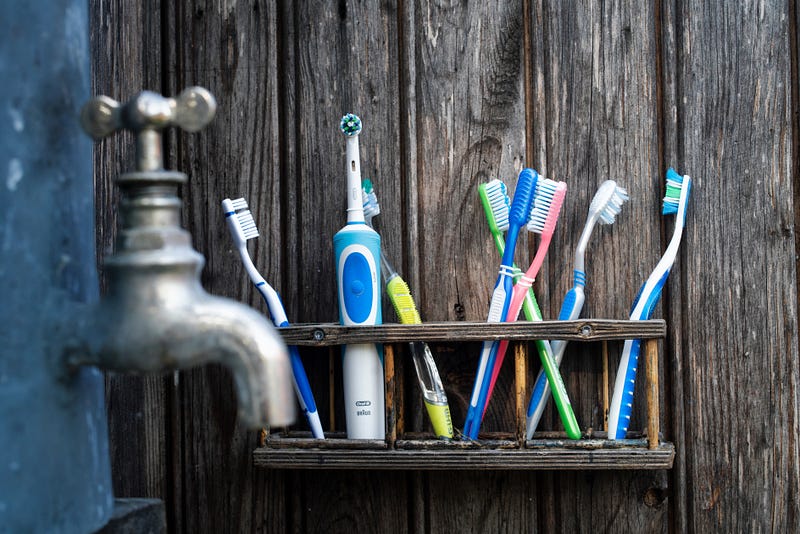
Our toothbrushes aren’t designed to be disgusting; they just become this way because of how we use and store them. Like everything else, they become germ magnets when they’re left wet and are stored in closed dark spaces.
Combatting the Filth
My original plan for protecting my toothbrush was buying those little plastic covers that snap over the bristles.
I tried it with my previous toothbrush, but after a few weeks I noticed that a thin layer of mold was growing on the inside.
I Googled what was going on, and it turns out that keeping a toothbrush in tight containers is a really bad idea because they don’t let the toothbrush dry.
A wet toothbrush is one that’s growing bacteria and mold, so the goal is to dry them as fast as possible and keep them that way.
I couldn’t believe that toothbrush manufacturers were selling those little snap-on covers, even including them with toothbrushes when they go so far against toothbrush hygiene.
I’m betting that morons like me wanted to feel safer about storing our toothbrushes, and toothbrush companies wanted to sell us a solution that felt right, even when it wasn’t.
With that knowledge in mind, here is my plan to avoid smearing disgusting bacteria all over my teeth and underneath my gums in future.
The Plan
Firstly, my toothbrush now lives in the kitchen. There’s a lot of natural light and space, so the air can keep it dry and clean.
I don’t cook, so there’s no chance of contaminating the bristles with raw ingredients.
Keeping the toothbrush somewhere with lots of space and light is key to keeping bristles dry and minimising bacteria growth.
One way that some germ-focused people try to keep their toothbrushes dry is by buying a second toothbrush. They then use their two brushes intermittently and allow one brush more time to dry while using the other.
While I don’t plan on doing that, I do plan on replacing the toothbrush more often. I recently switched to an electric toothbrush because I’d heard that they’re more efficient at cleaning, and the heads are pretty cheap.
With the heads of toothbrushes being inexpensive, I really have no reason not to swap them on time. Dentists recommend swapping toothbrushes out every three months, but that’s only as long as nothing has happened to jeopardise the integrity of the brush.
If you’ve been sick, dropped it on the floor, or have been keeping it too close to brushes being used by other people; it’s time to replace the head right away.
I once saw a friend of mine pick his toothbrush off the bathroom floor and rinse it off under tap water. He was under the impression that the millions of bacteria that had passed from the grossest and wettest floor in the entire house were going to be decimated by water.
Bacteria that can survive tile flooring and wet feet is not going to be killed off by running tap water.
Needless to say, I’ve never spoken to that friend again.
Microbial Health
It’s during moments like these that we all need to stop and take a minute to figure out the practices in our lives that are too gross to continue.
For me, I’m no longer allowing myself to clean my teeth with a germ-infested brush. To make this happen, I plan on storing the brush in an open space with natural light.
I’m also going to soak the brush head in Listerine to kill the bacteria that live in the bristles and replace it very often.
Now that this issue is out of the way, it’s time to look for whatever else needs to be changed in the name of health. Whatever it is, it’s probably something else in the bathroom.
That room is a Disneyland for bacteria.