
Your Tears Are Made of Emotion
and other chemicals
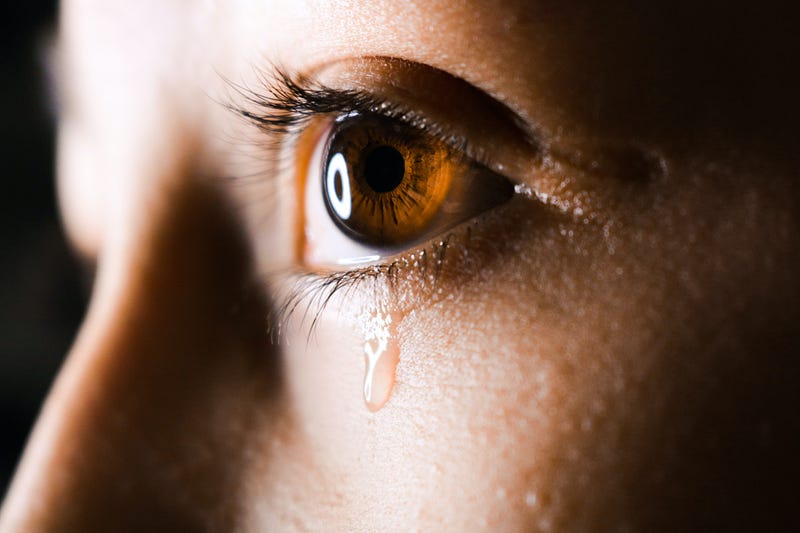
Did you know that you have psychic tears? You can’t use them to tell the future but you can use them to release an excess of emotion.
I cry somewhat easily nowadays. Just the mention of a dying animal in an Instagram comic can bring tears to my eyes. I try to scroll past them as soon as I realize the context but my eyes get wet by the time I’ve settled on a happier post. I also struggle with mental health issues that can bring me to some pretty heavy crying fests. The other night when I was feeling sorry for myself and crying in my closet, I remembered a Tumblr post about tears.
The claim made by one the site’s users insisted that tears caused by different emotions were structurally different. I decided to do some research on the subject.
The pictures used on that Tumblr post belong to the photographer Rose-Lynn Fisher. Fisher used her own dried tears for a project she called “Topography of Tears” which showed just how uniquely structured tears caused by different sources can be. I recommend clicking on the link to see those pictures, they’re super fascinating! The Smithsonian article that discussed this project then went over the science behind tear types.
The different tears that we as humans can create are basal, reflex, and psychic. Basal tears are the basic tears that lubricate your eye at all times, and reflex tears wash away irritants like dirt or onion fumes. (Like onions, all the tears we produce have layers! Tears are composed of mucus, water, and oily layers and also contain enzymes, electrolytes, and more.) Finally, we have psychic tears, the third tear type, which has additional components.
These emotional tears are produced during moments of strong emotion, either positive or negative, and during moments of intense pain. Psychic tears also contain hormones, such as prolactin, adrenocorticotropic hormone, and leucine enkephalin. Prolactin is responsible for stimulating breast milk production, and the adrenocorticotropic hormone contributes to the stress response system. You may have heard of those two, but leucine enkephalin may be a new vocabulary term for you. This hormone is thought to be a natural painkiller that assists in homeostasis. Maybe this is why we feel better after a good cry? This hormone is only found in psychic, or emotional tears.
Psychic tears are even produced during moments of empathy because the same areas of the brain light up when we see others cry as when we do. Scientists haven’t found this empathic psychic crying in other animals, just humans. They believe this has to do with the frontal lobe’s involvement, a part of our anatomy that is unique to and what makes us human.
What was the point of my sharing this newfound knowledge with you? I wanted to remind you all that it’s okay to cry. Even once we get passed the difficult times that this globe and this nation (I write from the U.S.) are going through, you will still have moments of emotional intensity. This could include great moments like the birth of a child or tragic moments like the death of a pet, but they will inevitably happen.
During those moments, you may feel your throat tighten, and feel a lump come up. Your eyes tear up (beyond the basal type that we discussed earlier), and you might want to hold back. Don’t. It is better to express these emotions in the natural way your body provides than to shove them down and ignore them. Crying is good for you.