
The Denial of Black Innocence
Being a child while black has its consequences.
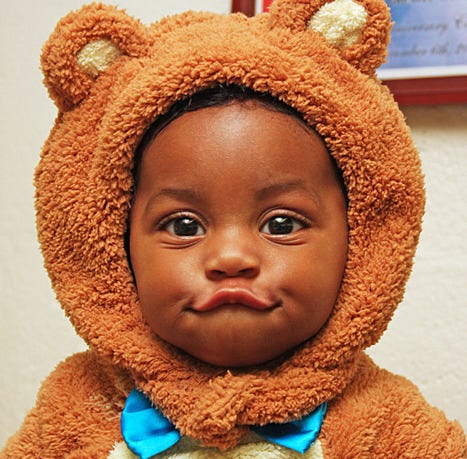
When you think of children, you may think of their innocent questions, their harmlessly foolish adventures in the backyard, or their funny reactions to tasting lemons for the first time. Unfortunately, when it comes to black children, their cuteness can not save them from their limited innocence in America. For black children, their innocence expires much faster than their white counterparts.
In a study conducted by the American Psychology Association in 2014, which involved 264 mostly white, female students from different universities, students overestimated the age of blacks by an average of 4.5 years and found them more culpable than whites or Latinos, particularly when the boys were matched with serious crimes. Researchers used questionnaires to assess the participants’ prejudice and dehumanization of black people. When asked to associate black people with big cats or apes, they found that participants who implicitly associated blacks with apes thought the black children were older and less innocent.
Thankfully, researchers did not stop there. 176 Police officers were tested as well.
The 176, mostly white officers, completed a psychological questionnaire with statements such as “It is likely that blacks will bring violence to neighborhoods when they move in.” To ascertain officers’ dehumanization of blacks, the researchers gave them a psychological task in which they paired black and white people with large cats, such as lions, or with apes.
Researchers reviewed police officers’ personnel records to measure use of force while on duty and found that those who dehumanized blacks were more likely to have used force against a black child in custody than officers who did not dehumanize blacks.
In the tragic case of sweet 16-year-old Cornelius Fredericks, I wonder if his innocence would have expired as quickly as it did if he were white. Sadly, I know the answer. May he rest in peace.
Young black boys are viewed wrongfully as men. Part of being black is knowing that once you slip up, once you get in trouble, your innocence is null and void. But it doesn’t stop there. Let’s discuss how young black girls are viewed wrongfully as women.
I am going to say this for the people who fail to grasp this: young black girls are girls NOT women. Young black girls are not trying to be “fast,” so please stop using that term. Little girls can not be fast. No matter what they are wearing, how they are dancing, or what they are saying. Young black girls are girls NOT women. It does not matter how “curvy” or “developed” their bodies are. Do not justify the sexualization and adultification of black children. It’s actually disgusting.
In 2017, “Girlhood Interrupted: The Erasure of Black Girls’ Childhood,” a report from the Georgetown Law Center on Poverty and Inequality, proved that black girls were more likely to be perceived as knowing more about adult topics, such as sex, and were more likely to be perceived as needing less protection and nurturing from as young as age five in comparison to white girls, according to the survey results.
When black girls are viewed as stronger, more independent, and less innocent, it creates a space for inequality, subconscious and conscious racism, and prejudice regardless of the setting.
Let’s take school for example.
“Though they make up less than 16 percent of the female school population, black girls account for 28 percent of referrals to law enforcement and 37 percent of arrests. Black girls are also almost three times more likely than white girls to be referred to the juvenile justice system and 20 percent more likely to be charged with a crime.”
Black children should not have to suffer from unfair consequences because of a teacher’s harmful racial bias. We did not choose to be black, but it is a choice to hold onto racist biases, stereotypes, and ideas.
Wherever this racist bias lies, there will be inequality, racism, and prejudice, and as kind and sweet as black children may be, they will not be exempt. For black people, racial bias like this is deadly. It leads to health disparities, police brutality, and sexualization and adultification of black children.


