
Your PoC Customers Think You’re Virtue-Signaling and Bandwagoning
But keep doing it anyway.
My Inbox is filled with earnest, graphic-free letters from brands:
- “We Stand with the Black Community” (17 emails with this title)
- “Black Lives Matter” (10 emails)
- “Taking a Stand for Black Lives” (5 emails)
- “We Must Do Better to Combat Racism” (4 emails)
I’m sure your Inbox is, too.
As a Person of Color, hey, that’s cool. I did raise an eyebrow, but, I don’t mind.
I don’t mind that many brands have been posting, even if mostly because they see other brands posting. I get they can’t be seen as not with it. They can’t be seen being silent. It looks complicit.
But more importantly, they oh-my-goodness need to get in front of customers, or a competitor will. Participate in the Attention Economy. Sow some goodwill…but get some eyeballs for it.
I’m cool with this.
Because it’s better than the alternative. It’s better than before.
And “better than before” is what we all want.
Until recently, brands steered clear of Black Lives Matter. Influencers who openly voiced support for causes were shunned or fired; many felt pressure to stay vanilla to maximize appeal to brands.
The last time people protested brutal killings—in 2016—one lonely brand crooned into my Inbox: “Can’t we all just get along???”
No, they had no idea how classic that line is in silencing and tone-policing the objections of the marginalized. “People don’t have to destroy things.” Awww, sweetie. Very simply, protests are messy. There is no such thing as a peaceful revolution.
For his very-peaceful anthem-time kneeling, Colin Kaepernick was considered radioactive, unemployable, by N.F.L. teams. What happens when you don’t have a team logo to be put on merchandise? He was nearby dropped by Nike.
At the urging of their longtime ad agency, Nike decided to redouble their efforts with Kaepernick with a groundbreaking ad campaign: Believe in something, even if it means sacrificing everything. The bet paid off—chief executive Mark Parker announced on the company’s quarterly earnings call “record engagement with the brand”.
And Nike’s stock rose to an all-time high.
No, you might not have another Colin Kaepernick. Or another phoenix-rising-from-ashes story. But listening to your customers and paying attention to who inspires them will always come back to you in the long run.
By all means, let your PoC customers know you don’t operate like the brands of yesteryear.
You’ll get stuff wrong, but it’s cool.
Your PoC customers have a pretty decent tolerance for people getting things wrong. We’ve had to build up layers of epidermis, over a lifetime, just for the paper cuts of everyday racism.
And that’s not even the metaphorical slings and arrows, or the very-real truncheons, bullets, and knees to the neck.
Racism kills. Not just the monstrous executions in the case of Ahmaud Arbery and George Floyd, but the stresses of racism harm the physiological and psychological health of racial minorities.
It’s lonely fighting the good fight.
For every BLM support tweet, persistent souls reply “All lives matter.”
For every question asking how people can still be racist in [insert current year], there is How does looting solve anything.
It seems if People of Color don’t respond, explain, educate, we give free rein to racist voices. And giving free rein to racists is what sitting US president Trump has been doing since his “rapist, murderers” speech.
Your customers want to know you stand with them.
More than ever, brands are counted on by their customers to embody the right principles as much as they deliver the right products.
Nearly two-thirds of consumers worldwide are belief-driven: they will choose or boycott a brand based on where it stands on issues they care about.
Belief-driven buyers are now the majority in every market surveyed, across all age groups and all income levels.
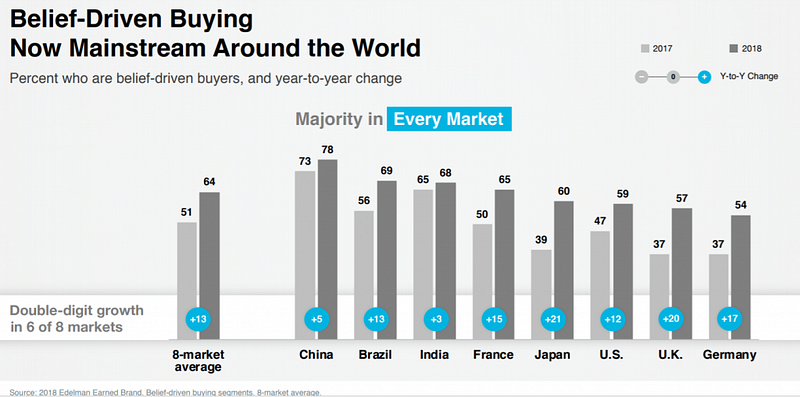
Surveys show that the public believes brands should not stay silent. More people than not consider a lack of a statement of support shows a brand in a negative light. Ignore this at your company’s peril.
Speaking up and joining the movement will lead to real change —including in your own company.
Attention is being paid to how you take real-life action.
A mirror is being held up to companies by their employees and customers alike.
Is it painful when negative press happens? No doubt. Can it ultimately work out better for you, should you choose to learn the lesson? Absolutely.
Yes, your brand image will take a hit in the interim. Starbucks has always presented itself as inclusive and progressive. After a Philadelphia store went viral for calling the police on two young black men, Starbucks’s consumer perception dropped to its lowest since November 2015.
Industry experts praised their subsequent remedial action for its quick response, full-throated apology, actions (not just words) to back it up, and working with experts and employees to truly learn from the incident.
Retailers from Walmart to Sephora are taking a long-overdue look at their harmful practices. They address them openly, owning up to and ending racist policies such as placing products targeted at black consumers under lock and key, rolling out anti-bias training, and setting targets for diversifying suppliers.
Employees, customers, and watchdogs will call out your hypocrisies. And you’ll grow from the experience.
So we’re all clear, the invitation to take a stand on social issues is not “throw us PoC a bone, anything.”
Nor should you view this as the end justifies the means. Inauthenticity will be noticed in this world of constant scrutiny and a social media army ready to preserve your infamy for posterity.
There is a lot of long-term value in speaking up.
Speaking up is how we can change the tide.
Every social change works like this.
Take the shift in public attitudes over gay marriage in the United States. According to a recent survey by the Pew Research Center, 14% of all Americans have changed their minds in favor of gay marriage.
Millennial support grew from 51% in 2003 to 70% today. Why has there been such a dramatic change? 32% say that it is because they know someone. 18% say they changed their mind because the world has changed.
Shifts in public opinion beget more shifts in public opinion.
You see people like you getting cool with something.
And, suddenly, most people are OK with gay people, when most people weren’t just a few years before. There isn’t much sudden about it, of course. Monkey see monkey do. That’s us, primates.
So what if your outrage isn’t original, or revolutionary? It’s still all right with me.
Even if all too soon, you’re switching over to the next Cause of the Month.
Publish your we’re heart-broken emails. Go beyond we’re going to do better and list out racial imbalances and insensitivities in your workforce, your product development, and your outreach.
Make everyone know that you’re in this with The Community.
Because things repeated over and over have the power to seep into minds.
How else do you think racism gets passed down to kids and is so hard to get rid of?
So, brands, businesses large and small — make your anti-racism normal, not just fashionable, or seasonal.
In words, and deeds.
Because it’s about time.