
Mental health | Trauma | cognition
Your Perception of Time is Inaccurate
How our mental states alter the flow of time
Have you ever been in a situation where you felt that time has slowed down? Or, perhaps, that time is moving too fast? Have you ever been in a threatening situation and felt like things around you move in slow motion?
Scientists have already proven that time is not linear. I am not a physicist, but this article contains all the information about how time actually works and how we perceive it, in an easy-to-understand language.
Recent studies conducted with the help of fMRI (functional magnetic resonance imaging) technology that measures brain activity, have shown that our physiological state influences how our brain perceives time. This means that our bodies can alter the flow of time, and consequently our memories.
The role of the amygdala In our brain, there is a complex structure called amygdala. The name is derived from the Greek word for “almonds” (αμύγδαλα), because the structure looks a lot like a couple of almonds.
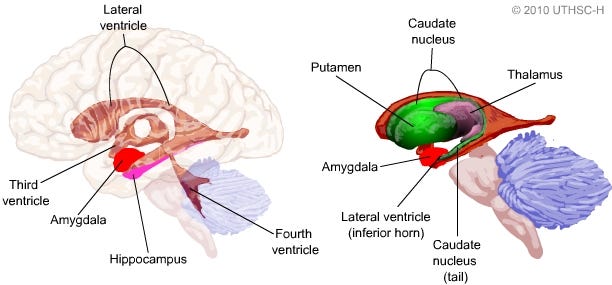
This structure is responsible for our emotions, and it’s part of our limbic system, which is the part of the brain that is broadly responsible for our behaviors and emotions. It’s how we make sense of the world, and it’s part of our primal or “reptilian” brain.
This term is used to signify the parts of the brain that are the oldest from an evolutionary perspective. In general, these parts include anything that has to do with our reflexes for survival: hunger, thirst, sex, fight/flight/freeze responses and so on.
When we find ourselves in a situation that is too exciting, too stressful, too threatening, etc., our amygdala react.
If the situation is perceived by the body and the brain to be too intense, the amygdala signals the brain to slow down the way it processes things. This gives us the advantage of having a few more seconds to think.
On another level though, our physiological responses get ramped up. The other parts of the brain over-function, thus making it seem that the exterior world is moving slower.
When these two responses co-occur, the effect of time slowing down becomes very pronounced.
Time and Trauma During a situation that is traumatic, people have reported that time slowed down for them. Scientists were able to verify that through fMRIs.
From a mental health perspective, this is a significant breakthrough, since it changes the way we work with traumatic memories. Also, reassuring the person that they are not “going crazy” and that time indeed slowed down, can be very beneficial.
The accounts of people who have been in accidents or have been assaulted are a great example of this. It really feels like everything moves in slow motion, even sound.
What about fun and boredom? Our perception of time also changes when we’re having fun (we might feel that time is moving faster) or when we’re bored (time might appear to be slowed down).
In the case of having fun, we feel that time moves faster because we are more relaxed and the survival part of our brain isn’t on alert. This allows the other areas of the brain to be more engaged (e.g. in order to have a meaningful discussion), thus “forgetting” to perceive time accurately. And, before we know it, hours have passed but it felt like minutes!
When we feel bored, the physiological responses of our body send a signal to the brain that something might be wrong. So, the brain gets slowly on alert, trying to figure out what’s happening. To do that, the amygdala get in a “high arousal” mode. This results in the brain perceiving that more time has passed than actually has.
Conclusion The way we perceive time depends on our physiological state. Time is not linear and throughout the day we might experience variations of time slowing down or speeding up. All these responses are normal, and they’re the way our brain is trying to make sense of the world.
So, what about you? Have you ever felt that time slowed down or sped up? Have you ever felt the “slow motion” effect?