
Your Music on Spotify Will Never Get Heard or Monetized
The harsh reality for new musicians in the streaming era
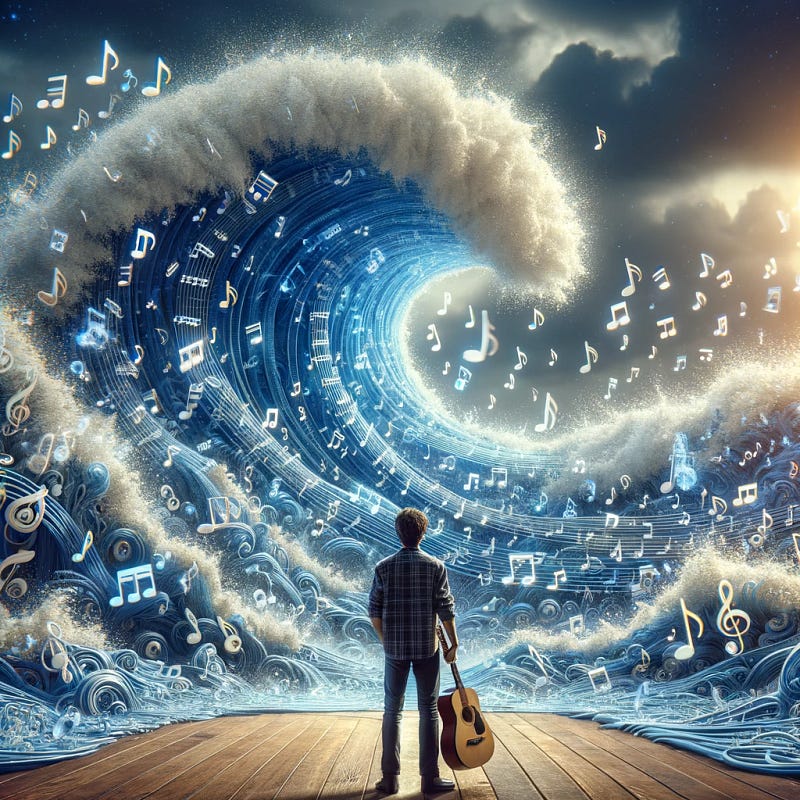
A flood of songs hit the streaming platforms every day.
120,000 new tracks to be precise.
It’s an oversupply of content, a lot of which is generated by AI according to Universal Music Group’s CEO, Lucian Grainge. In this sea of audio, there’s a low chance of getting heard. To make things worse, you’re not only competing with other artists but with AI-generated “musicians” too.
Sadly, most of these tracks are just digital noise.
So where does a new or unknown artist fit into this picture?
Do people even listen to my music?
In a 2023 year-end report, Luminate revealed that a staggering 158 million tracks got 1,000 plays or less during last year.
Let’s say Spotify pays roughly $0.04 per 10 streams. A thousand streams would generate only $4. But this only applies if you meet several criteria like the track being listened to entirely (and not just for let’s say 10 seconds) or if the fans listening to the song are paid subscribers to Spotify.
Let’s make this even worse.
That same report revealed that 45 million didn’t even get a single play last year! This means nearly a quarter of the music catalog on streaming services didn’t get any attention at all.
So you have more than 80% of songs with less than 1,000 plays and nearly 25% of those with no plays at all.
I tell you this, it is easier for a camel to go through the eye of a needle than for a young musician to enter the kingdom of mainstream music.
Many (young) artists are eager to show their music to the world. Their dreams are still intact. They know they’re no one, but that will change once people listen to their music. That’s what they think but oh boy how wrong they are.
This is how it will look most probably.
Playing awesome music that no one has time for or simply doesn’t care.
These kids don’t realize that they might just be shouting into a void. They don’t see that their music journey will be an endless struggle to survive in an ocean of content.
If your music isn’t getting heard, you’re invisible.
In the digital age, that’s career suicide.
Making matters worse
Spotify and Deezer are shifting to ‘artist-centric’ payment models.
This is a misleading term. It’s not artist-centric at all, quite the opposite.
Tracks under 1,000 streams per month will not receive any royalties at all.
Not only that but the songs have to get a minimum number of unique listeners. You can’t just listen to your song 1,000 times. And what’s the amount? Spotify is not disclosing it to avoid “gaming the system”.
However, your song needs to keep up its pace. If in any month the total streams for the past year dip below 1,000, there are no more royalties until it crosses that 1,000-stream line again.
With giants like Universal Music Group and Warner Music Group already on board, this model could soon become the norm.
What this means for musicians
For new artists, the challenge just got tougher.
If you’re not getting streams, you’re both missing out on exposure and out on money. If it wasn’t discouraging enough, now it’s double.
This could also incentivize artists to cut corners or play it safe.
Since these platforms will be tightening their wallets, there will be more pressure to make music that gets those plays. Forget artistry, creativity, and originality. Why experiment with new or unique styles when you have a safer bet with catchy hooks or relatable lyrics? Let’s just repeat a formula that works.
Artists will spend more time on marketing and social media strategies to boost play counts instead of composing. Promotion becomes more important than the creative process.
Artists will be “stream friendly”. They’ll compromise for a few bucks and a unique artistic vision will be a thing of the past.
Sad times await for music.
How do we balance this oversupply with fair compensation?
We could have niche streaming services that are solely focused on specific genres or artist communities. This could help musicians find and grow their audience. This is more difficult to implement on larger and more generalized platforms, but then again those are the ones that drive most of listeners.
These big platforms could refine their algorithms to promote a wider variety of artists. If they could include emerging and independent musicians, or give at least one boost to those 46 million tracks nobody listens to, that would be great.
We need fairer exposure. Let the audience decide who they want to stick with after giving every artist at least one chance.
Another approach? Differentiate the value of streams based on content quality or artist popularity. This means that not all streams are equal. A stream of ambient white noise shouldn’t count as an actual artist.
That looks fairer until you realize that higher royalties would be paid for streams of artists who have a larger following, like Taylor Swift. Yes, you decrease the power of generic, lower-quality tracks like white noise for sleep, but you also encourage songs from those already at the top.
There’s no simple fix.
It’s a multi-layered mess that might require a multi-layered fix.
Final thoughts
Artists have to realize what they’re dealing with.
Many will create music that few will hear and even fewer will pay for.
Once they realize this, they face a choice: remain true to their art and risk obscurity, or compromise for commercial success.
In the investing world, people say, “Do you want to be right or rich?”
In music, they’d say, “Do you want to remain true to your art and risk not making it, or bow to the big bucks?”
As a musician, your creativity will be up against the ruthless efficiency of streaming algorithms. You’ll have to choose to pursue your path or conform to the mainstream. Now, blending in doesn’t guarantee success, but it might make it more likely (by “more likely” think of a 1% chance of making it versus 0.1%).
Or you might even start with your artistry intact but compromise once you get famous. Ironic, because you’d think you’re finally free to do whatever you want. If you’ve come that far, sadly you’re not free.
But ultimately the path for each artist is unique.
Some may find success and fulfillment in sticking to their artistic roots, while others may thrive by sticking to the industry’s demands.
Let the journey begin.
Want to learn more about the sound verse?
Join my newsletter to explore everything related to music and sound, from the effects on our psyche to the technologies that use sound to improve our lives.


