
Your Mind Had Already Begun to Peel Away From Your Body
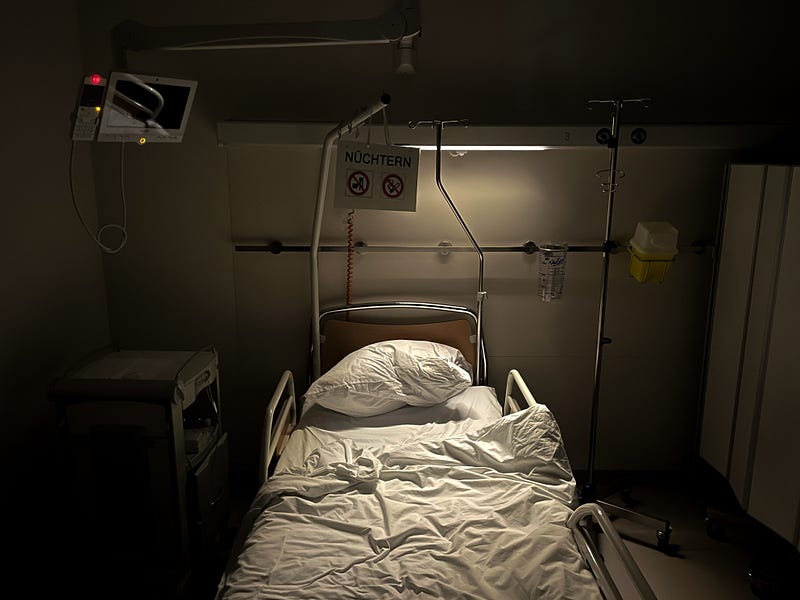
That much was clear from the start, as you first appeared at the end of the hospital corridor.
My father, my brother, my sister and I continued on in artificial sunlight. Memories leapt from the soles of our feet, as we walked your timeline to its gently resting terminus at the end of the hall.
Death is supposed to be so many things.
We who are lucky enough to know it is coming have rehearsed it all in our heads. We have superimposed ourselves into movie scenes, sunk into the melodies of our favourite songs. We have test-driven these emotions, have simulated the circumstances like an actor preparing his part. We know the talking points of the coming conversation, and the tears we will try to hold back until they depart.
I knew I had no real knowledge of what lay ahead. Things had gone downhill so quickly (as they are apt to do) from talk of a fall and a lengthy recovery, to a realization that cast me deep in a dreamlike stupor. Suddenly, as if the words had tumbled from the lips of an indifferent judge, here it was, this was it: time collapsed and expanded at once, a breath of silence before the fall — this was it, this was the end of it all.
It became clear that you were happy to die; or, rather, happy you no longer had to fight. Happy at the thought of no longer being alone. And so I rehearsed. I saw all the ways I had come up short until that time and I rehearsed — faces, expressions, words and memories primed to trip forward from the tongue. Memories of lazy Sunday afternoons, or mornings perfumed by bergamot; memories ready to fall into our laps with a hollow thump, as if they were apples bruising themselves on a bed of grass, and we just sat there, on one of those infinite summer afternoons, and enjoyed their cool splendour.
And yet, there I was, by your side in that windowless room — frozen. As though a facsimile, a statue of perfect proportions had been wheeled into place in my absence, and I stood facing the scene unfolding from a distance, deeply unsettled and powerless, like my replacement, to affect a difference at what I saw.
As I stood on that little island looking at the mainland of my life, I knew I could not be what I needed to be for you. I saw the confusion in your brow, the wandering thoughts in your hair, and I knew, like a child lost in a blue sea of linens, you needed a way home. I knew you needed something firm, a hug, a kind word, a kiss placed just so; something tangible, like a shiny stone, something to press between palm and breast, as if you could force the knowledge of my love straight into your heart.
We all understood, without saying a word, that it was for the best we came. Even though, we all knew, the best was far from what we brought. The smiles were mechanical, the words were under-wrought — not because we didn’t care, but because we didn’t know how to start. We’d prepared, but we couldn’t; we had tried to mimic in microcosm, but we’d been foolish — there is no bridge from thought to action — only time, and in time, only now is action real; its genesis, not the grasping of the mind, but the beat of the heart.
But that day all of our hearts faltered. All I could do was stand and stare. Everything failed and I knew nothing. A rising tide hit the island, the waters grabbed my feet. Everything was sinking. Everything was ending and all I could do was focus selfishly.
I was caught in a mental whirlpool. And I could see you drowning, too, but I had no breath to spare, no way to call your name. Perhaps if I had tried harder — I know how to swim, I’ve voiced that name a thousand times.
But still, nothing.
We humans are not meant to understand absence, to understand lack. We conceive of absolutes.
From a young age, we play to the part of the little Piagetian empiricist. We notice patterns, we form and reform theories. We form expectations and these expectations, in turn, form our world. But these axioms — these rules of experience — as they are at the base of our understanding, they do not readily admit to argumentation. We might read about death, we might know that centuries of lives before ours have been lost, we might cry at the cinema — but it takes more than this to understand loss.
We need something radical. Something experienced. Something so fresh and unexpected that, in an instant, it proves the most esoteric of theories right upon our pulse. It is only then that we might wake up from our dreamworld and be aware of a life being lived. It is only then, like Escher’s salamander, we can gain a dimension, set off from home, and find the finish was always the start.
We learn that most of life is designed to obscure what is valuable; good people, good conversation, an expansive attention. Life becomes so clear that we think we will be awake forever. But the game is reawakening; life begins each time you pierce the veil of thought.
You made many mistakes and drew many erroneous conclusions in the experiment of your life. I know you would have done much differently, given time. But you were born into one important discovery, a revelation that continued to inspire you. You grew up in England during and in the aftermath of the Second World War. You learned the virtue of Charity, the responsibility of the strong to give to the weak. Throughout your life you embodied the importance of this idea, this all important idea, that one must carry their share of the collective burden. For the Good of the People is not found idling in the mouths of its leaders; it is earned everyday in the actions its garbage-men, its teachers and country wives. The Good is a process, a never ending process, that takes all of us as its constituents.
With one final act of Charity, you have begun to teach me how to live my life. You have helped illuminate my misplaced values. And, though I am bound to fail, you have given me the tools to examine my own life. You have shown me the players of my life come out after curtain call, the king hand-in-hand with his subjects, the prisoner shoulder-to-shoulder with his captor. You have revealed to me the utter and precious equality of mind. The fact that, in the final analysis, sadness is not so different from joy. For that which experiences the both of them cannot, itself, be them. They are all but players on the stage; and, though the story is improvised, it is precious and short and indivisible, and, in this way, divine.
Thank you for reading. If you enjoyed this, please consider subscribing by email to never miss a post.