
Your Idea’s Prototype Is More Important Than Your Idea
Achieving your dreams successfully
One of the choicest blessings I have received are friends who are dreamers. I thrive in their imagination. I take great pride in knowing their wishes in detail, visualizing their success, and supporting them as they change the world. The way their eyes light up and the sound of their voices sharing something deep and heartfelt gives me incredible joy. Alas, there is a flip side to this. Even though most of my friends are dreamers, very few are achievers of those dreams. Today, I will dissect the dreamer and share with you my observations between dreamers and doers. I used to be only a dreamer myself. Here’s how I converted into a doer.
Man is the only creature capable of imagination. Daydreaming is a survival tool given to us, which comes to our rescue when life is not as rosy as we’d like. We all carry a light within us, unique to our mission on Earth and something only our soul is meant to create. Nobody else has this unique signature even though people band together for similar dreams. What you alone can do, nobody else can. It is therefore critical for your journey here on this planet that you make these dreams come true, apart from your responsibilities and duties. You need to co-create this world. Why else would Life create you, if it didn’t think your perspective was necessary? Life doesn’t create waste. Which in turn means if you are here already, you have a good purpose, because Life felt you are worth it. You may or may not feel so, but Life does. It’s about time we agreed with it.
This purpose we all have is received in the form of heartache. Drawn to do something grander, we all have this calling. Your heartstrings might be pulling you towards animal welfare or climate change. Why you, have you ever enquired? Why doesn’t your spouse feel the same about racism? Maybe your parents and you have such diametrically opposite views that make you wonder how you come from the same family. There is no rule on why you feel so strongly about something and your loved ones don’t. It's because apart from the relationships we have, we are here to make a change far broader than our family and friends circle. We are going to use this heartache to change the world and expand and envelope everyone. Are you ready?
Step number 1: The Great Hunger
I learned from Dr. Tererai Trent’s remarkable book The Awakened Woman, about the Great Hunger. Asking yourself what makes your heartache will give you an idea about your purpose. For some of my friends, its gender bias, for another is animal welfare. For the third, it’s about creating a magazine. For another, it's becoming a travel agent. These sound more like tasks, but are they really? The heartache is a very specific pull. It’s what makes you sleepless thinking of suffering animals. It’s how you feel about elderly people who can’t book trips and aren’t tech-savvy. Those places where schools are in ruins crush your heart. Each one has this. Keep asking yourself until you get an answer.
Step number 2: The prototype
This is the most important step for YOU to be convinced ‘It is Achievable’ — one of Tererai’s most powerful statements. So you want to set up a school for kids? How long until you have enough funds, or your own retirement, or investment, or something else that delays your wish. Most dreamers are not aware of this step, how to apply it, or simply skip it. They directly imagine the end goal but can’t put one foot ahead of the other to get there. The gap is too much for them to believe it’s doable. It’s either too big, or too difficult or too something else. Today allow me to shift that for you. Today, let us make your dream come true. Yes, grab a paper and pen. It’s that important!
What we need is a prototype of your dream. What is that exactly?
A prototype is a working model, proof of concept, example, mould, blueprint, design, guide, illustration, representation or a sample of your idea.
Prototyping is a simple exercise to shape up your dream sufficiently without investing too much time, effort, or money and yet be convinced it works. It helps test out the hypothesis of your idea. A hypothesis is more than guesswork and helps establish firm theories of what’s feasible. In prototyping, we take the approach of being open to experiments, short increments of change, and noting down observations. It is so powerful in that it will shape your idea, or completely destruct it and create something even better. For once you will be able to answer this question yourself — Is this idea really good?
What are some prototypes of dreams?
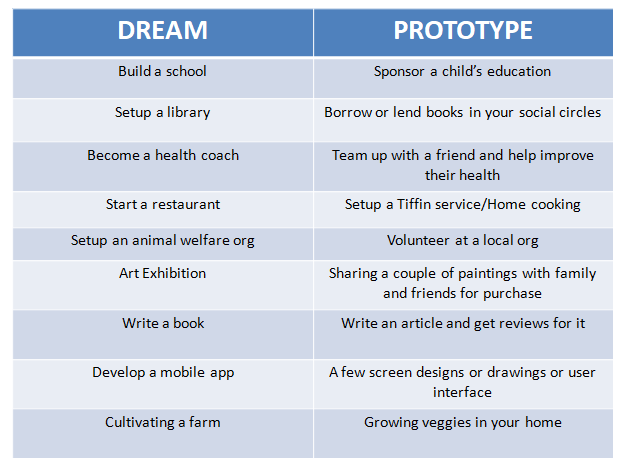
A Prototype: Dream relation is that of an Offspring: Adult, in that it has all qualities and attributes of the parent. It is NOT a step or one of the phases of the dream, it's a micro-version of the dream. If someone wishes to set up a school, sponsoring a child’s education is one prototype. It helps one understand what it takes to educate one child — money, books, uniforms, desk, activities, etc. Then it can be scaled further to more children and expanded upon. Securing a loan for building the school, or buying desks and chairs are steps towards the dream, not the prototype. A complete hypothesis test of the prototype must make the dreamer aware of what it takes to make the dream come true, in its entirety not partially. A full lifecycle of the dream or most of it must be experienced.
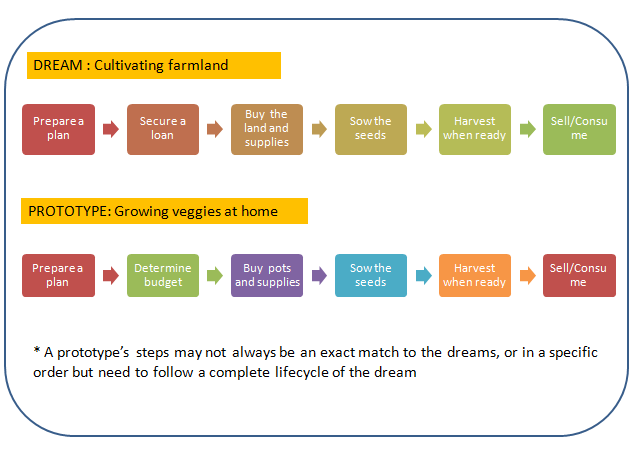
Step 3: The dream come true
Once you have experimented and tried out your dream on a smaller scale you will be empowered with ideas, perspectives, feasibility, and depth of your purpose. Prototypes can even alter the course of your dreams, change them altogether, or make you pursue them harder. With a working model, whose steps you are already aware of, you can now move towards making your wishes come true. You will have confidence, done your due diligence, begun truly following your dream than waiting for special circumstances, and changed the world.
Dreams give wings to our souls. We want to fly and yet hold ourselves back because sometimes we can’t see the path to our dreams. Let that not happen anymore. We owe it to Life. Explore, discover, and dive deep into your imagination. Seek to find possibilities that make you believe in them. I hope you feel inspired to pursue your dreams even more now. Our dreams need not make us feel scared. We just need to rehearse for them. Will you think about your prototype and get going?


