
Your Diversity May Not Be My Diversity
The persistence of “OnlyOneness” in America
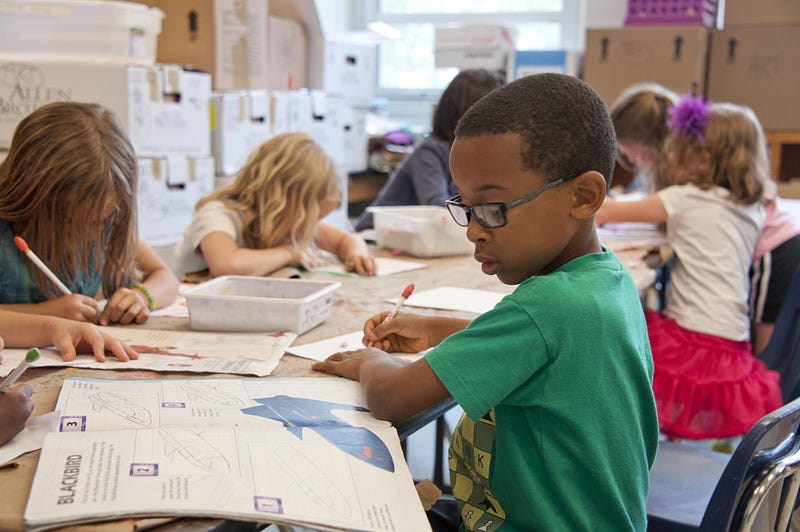
I noticed it again. I wasn’t intending to; it’s almost an automatic action at this point. My son was standing in line in front of one set of doors to his elementary school. It was the first day of the first full week of in-person school for all grade levels. I couldn’t see but certainly sensed the glowing cheeks under the masks of the parents that dotted the lawn, some clustered in small groups, others keeping a safe six feet apart. The mood was festive. Each time a teacher or staff member emerged from the building, they were met with enthusiastic claps and even some cheers. And after the starting bell (that rings more like an alarm), the sounds of the hallelujah chorus (no joke) could be heard from the outdoor speakers of a nearby house. But in the midst of these joyous expressions of relief at the resumption of some degree of “normalcy”, I felt uneasy.
In the minutes before my little peanut (small for his age) trudged into school, weighed down by his overstuffed bookbag, I felt a heaviness of my own. He is the only black boy in his class. I checked, I double-checked. Here we go again. I do not know if he knows. I try to reassure myself. There are other students in his class who are not white. And his female teacher’s skin tone is similar to that of his older sister — the warm shade of a chestnut oak acorn. But he is the only black male in the class. And this bothered me. It upset me. It still does.
When our offer on a modest house in a town with a reputation for high taxes but lots of diversity was accepted, my husband and I were incredulous. Well, I was somewhat delirious because I was about to give birth to my second child (the little peanut). Quite honestly, I didn’t even remember the details of the house — we had seen so many during that marathon of Open Houses. But ultimately, we were ecstatic. We were in. And we had escaped our twice-flooded (from Hurricane Irene and then from Hurricane Sandy) previous home. We were on dry land. And to make matters even better, the elementary school was within walking distance. Stop it!
The good news continued. Within a few days of moving in, a block party took place, literally on our block. It had been planned well in advance but our first-born daughter, six at the time, thought that the neighbors were throwing us a welcoming party! In her defense, it kinda felt that way. My husband and I were greeted by couples, families, the local council person, a fire truck came on the scene and kids got to climb into it and wear firefighter helmets. There was good music, really good food, and great company. I recall sitting on the front steps of the house, my infant son asleep in his stroller, the setting sun caressing my face, and I felt at home. I still do. But I would soon find out that the diversity of the block we live on did not represent the town as a whole.
Having grown up on Roosevelt Island, I knew that my childhood had been unique and I had hoped to give my own children a similar exposure to the strength and beauty of difference. I knew I would not be able to replicate it but I remember thinking that evening, ‘this is a good place to be.’ But diversity did not translate to the classroom. And to be honest, even if there was one other black boy in my son’s first grade class, I still wouldn’t be happy. If the town is so diverse, why do I always see relatively few parents and children of color on the school lawn every morning?
My daughter was not spared the experience of onlyoneness. In fact, she was the only brown face in her kindergarten school picture and then again at horse camp, and at one of her summer gymnastics camps. And as a child who endures eczema, that last one was a particularly rough experience. But so was the horse camp. I remember feeling horribly guilty as I started to drive away after dropping her off the first day. I winced as I caught sight of the group of white girls clustered and smiling and laughing and my daughter, off to the side, looking at the nearby horses — the animals she absolutely adored. I had winced and then winced at my own wincing. Why assume such a protective (and somewhat defensive) stance? Why not have some faith that all would be well?
When I picked her up, she did not look happy. Part of the reason was because there had been a bonfire for roasting marshmallows and my daughter — at the time — had sensory sensitivity. She was afraid of fire. So that did not help matters. I sensed how out of place she felt and I immediately suffered those emotions. The camp counselor spoke to me briefly, while my daughter sat in the car looking both relieved and sad. And I shared in those feelings as we drove home. But what I bore alone was a mixture of guilt and anger: How could I have not known? Why did I put her through that?
As a girl, I was no stranger to onlyoneness, even in the multi-cultural, multi-racial, multi-class, multi-national PUD of Roosevelt Island, that was sometimes compared to “Sesame Street.” Among my friends, as we approached the end of our tween years, I was the only one who wasn’t “dating.” I recall a moment when I confided to one of my white friends that I felt left out and ugly. She recommended that I pursue the one black boy in our crew, reassuring me that he was cute and would like me. Apparently, he was my only option.
I could also tell you about the “Sun-In" experience at a sleepover at the country house of one of my friends. The goal had been blond sun-kissed highlights. We had all followed the instructions on the box to the letter and let the chemicals work their magic overnight. Apparently the sun kissed me differently cause I was the only one who woke up to red highlights.
And then there was German school…
And now there are the volunteer organizations I am part of…
Ironically, I know my family and I are not alone in our experiences of onlyoneness. And that it is not singular to black folk or limited to race. What upsets me most about all of this is not what I, or my partner, or my kids or other “not white” (I know, I know — words fail) people have to go through, although it clearly sucks. What hurts my heart is what those experiences expose about our country.
People who feel that they are a part of genuinely diverse communities often fail (or decide not) to see past the smoke and mirrors, fail (or choose not) to recognize the ugliness of segregation and the ways in which lack of access/options are sustained by physical divisions. We are not an integrated society. Even if there may be some (or more than some) variegation in the demographics on our block, there are still whole separated communities outside of our purview. And more than often, we don’t really see them, don’t interact with them, will just drive through the neighborhoods on the way to the highway. This is a reality that hurts us all.
I am part of the “we” that I just mentioned. I admit that I find a lot of this overwhelming. I admit that I am often unsure of what to do. I get angry with myself. I admonish myself: why can’t you just interact with people and stop complaining? Why can’t you reach a place of acceptance and be satisfied with how things are? I get tired and go to bed, thinking: what is the point in engaging in all of this? But I wake up in the morning with a “groundhog day" like perception: doing nothing feels wrong, very wrong. And so I write this in an effort to outrun the apathy that I always feel right at my back. And I write this as a way to fight off the urge to turn and flee in the direction of perceived safety that is really a space of estrangement.
James Baldwin once stated quite earnestly: “…apathy and ignorance…is the price we pay for segregation. That’s what segregation means. You don’t know what’s happening on the other side of the wall, because you don’t want to know.” (I Am Not Your Negro) True diversity requires widespread integration alongside re-education. The few of us need the many of us to help them advocate for shifts in education, in laws, in policies. But too many of us are still unwilling or afraid. Or both. Or worse: we have convinced ourselves that it doesn’t matter.


