
Your Children Are Listening: Addressing Racism with Your Privileged White Kids
The kids that I nanny know that the protests are happening. They know the name George Floyd. But, other than that, their days haven’t really been all that different.
Last week, for the first time in nearly two years of playing Talisman — a fantasy board game with a myriad of leading players to choose from — the eldest looked at the main cards and said, “Hey, none of these characters are black.” We then spent the next few minutes trying to find one character in this massive deck that didn’t have porcelain skin but also wasn’t an ogre, and we found one person of color: a secondary character who is a healer — which, frankly, felt particularly ironic giving the current social climate.
The kids that I watch are privileged and they, thankfully, go to a school that celebrates diversity, inclusion, and awareness. Still, this was the first time that I had ever seen him take notice of lack of representation and I know that that observation was a direct result of him listening to what the world is saying around him.
It’s not that these kids aren’t well versed in “history” (a relative term, as I’m finding out). Books like Separate Is Never Equal and biographies of Rosa Parks and Martin Luther King Jr. are just a few that grace their shelves. I’ve read them aloud countless times, but I think the pain at the center of these historic stories is somewhat lost on them. Maybe because it feels far away from the reality that they live in now in progressive Southern California; the very idea of segregation is a preposterous scenario to a couple of kids who have always viewed their classmates equally, without question. And to time-challenged children who think that a minute feels like an eternity, it’s hard to convey that six decades of integration really isn’t that long. Still, we kept surrounding them with this knowledge, hoping that it might manifest itself should the fight for equality come to the streets of their neighborhood.
And this weekend, it did.
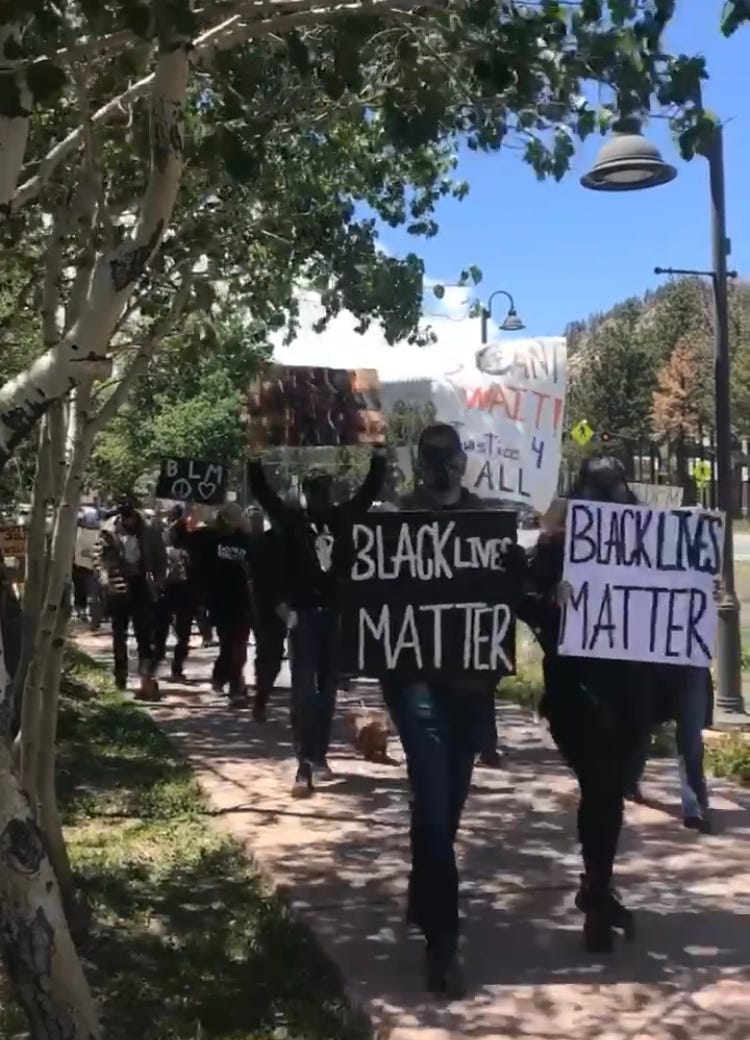
When the opportunity to join a Black Lives Matter protest in our community arose, my bosses and I decided it wasn’t really a question: we were going. We busted out the box cutter and the marker collection and, within minutes, had five placards in the making.
As a caretaker and, by default, an influencer of young minds, I’ve always given room for the kids to form their own opinion; which is why I try not to impose my personal distaste for, say, current leaders of this country on them. If asked, I will always give them my honest opinion, but only with the caveat that it is just that: my opinion, and not rhetoric that they should parrot without doing their research first. So, we opened the floor for any questions that the children might have.
I’ve worked with kids from the ages of fresh-from-the-womb to preteen, and, if I’ve learned anything, it’s that kids are capable of understanding far deeper issues than we give them credit for. It’s because of this that I’ve had more meaningful conversations about God, war, and mental illness with a ten-year-old than I have with most adults. Dumbing things down for the sake of protecting them doesn’t really do them any favors. Their brains will rise to the occasion if you only give them the right spark to light their curiosity. So when it came time to address systemic racism, it would have been all too easy to pare it down to their kindergarten mantras of “treat others as you’d like to be treated” and “if you see something wrong, say something.” Instead, we chose to get specific, and we found that this precision only strengthened their desire to understand.
The morning was filled with conversations about how this movement made them feel. How they would feel if their friends of color were mistreated. How “complicity” is defined. How not all police officers are corrupt, but that enough black and brown people have suffered at the hands — or the knees — of bad ones to justify this call for action. We gave them the option to decorate their own signs, and their imaginations took off. The eldest saw a grand vision of a monster eating the word ‘Racism,’ while the littlest wanted to incorporate an ice cream cone into hers. We politely told her that might be better for a different sign. Though, in retrospect, if it had been a Ben and Jerry’s pint, it would have been on brand.
We carried our signs to the village square, fully expecting to see only a handful of other like-minded people. We were met with a parking lot of nearly six hundred masked supporters.
I watched the kids take in their surroundings: dogs sporting placards, car horns blaring in solidarity, a chant of “No Justice, No Peace” rippling down the line as the steady beat of a drum urged us forward. The kids read the other messages on display and heard the names Breonna Taylor and Ahmaud Arbery echo through the brisk mountain air. They were quiet, taking it all in, but I could see something shift in them; an understanding that they were part of something bigger.
Everyone is entitled to their opinion, yes. That is true. But I will never understand why anyone would choose to instill in their child a belief — or rather a fear — that promotes exclusion. Some parents desire to shield their children from the ugliness of politics but, the way I see it, there’s nothing ugly about the universal fight for humanity. I will never feel like I am on the wrong side of history by choosing love over hate.
I also think it’s important to show your children just how passionate you are about the things that truly matter. When children feel things, they feel it with their whole selves; it’s a double edged sword, because it’s this same level of commitment that leads them to rage-cry and noodle their bodies against getting strapped into a car seat. As adults, we sometimes try to mute our emotions to present a façade of calm security to our kids, but I think that if you let your kids see a bit of the fire that lives inside of you, it might speak to their hearts better than words ever could.
So, the next time an opportunity to educate comes along, seize it. Teach them the language of compassion. Show them how to use their voice. Help them to heal the world from our mistakes. Trust me when I say: your kids are paying attention. Include them in the conversation, for they carry the change we hope to see.


