
Your Cat’s Secret Body Language
An illustrated breakdown of kitty communication
Cats are often moody and hard to read. Sometimes your cat seems happy you are home, and sometimes she acts like you are an alien invading her domain. The following cat body language will decode all that mysterious feline behavior.
I trust you
Many cat owners are all too familiar with their cat having a lengthy starring contest with them. According to cat behaviorist Jackson Galaxy, your cat gazes into your eyes to show her comfort level. A slow blink indicates she loves and trusts you. Animal experts recommend that you flutter your eyelashes back at kitty to build rapport.
A cat will never close its eyes around a predator or an untrusting person. This is also why cats may have an unblinking stare toward strangers.
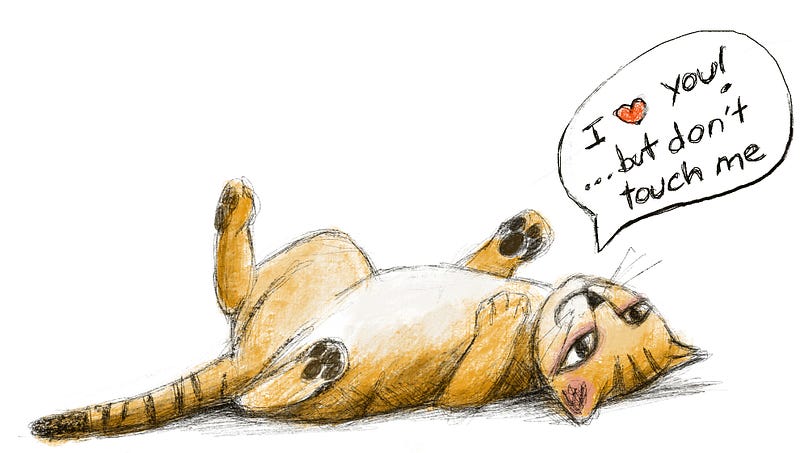
Trusting cats will also roll over on their backs, exposing their stomachs. But this is NOT always an invitation to rub their belly. According to animal behaviorist Lena Provoost, hair follicles in this area are extra sensitive, so rubbing a cat’s belly can feel like someone tickling you in the armpits.
Back off!
Cats show their displeasure in many ways. A rapidly swishing tail, dilated pupils, open mouth, and flattened ears are some clues. A threatened cat will also narrow its eyes if it plans to attack. Cats narrow their eyes to protect this fragile organ from injury. (If a cat is sleepy, it will also narrow its eyes so owners must consider the context.)
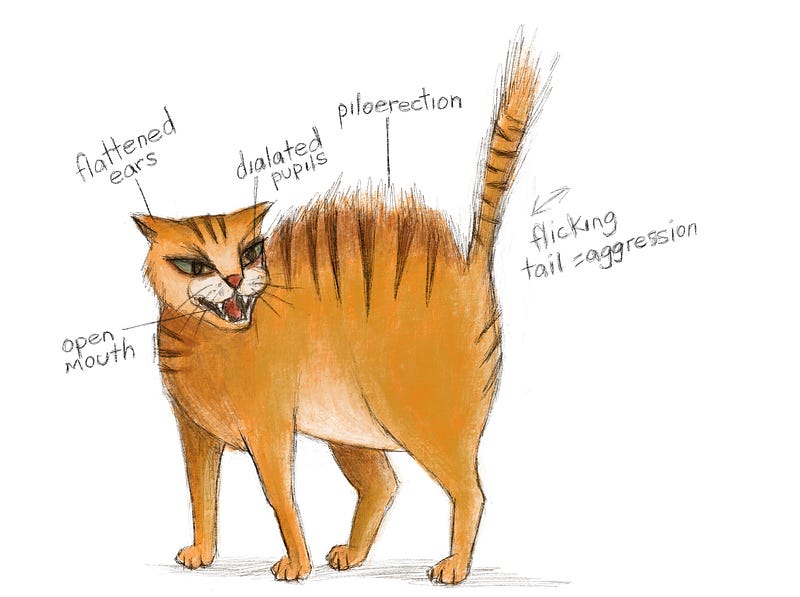
Cats often swat their tails as a sign of aggravation. This is different from a worried tail flicking. (See below.)
An aggressive cat also will stick their tail straight in the air and puff it out. Like dogs and other animals, a fearful cat makes themselves as large as possible to intimidate predators. Some aggressive cats will arch their back, and their hair will stand up. This is called piloerection, and it is a sure sign that a cat feels imperiled.
Many of these signs are warnings a cat is about to attack. If those warnings are not heeded, a threatened cat will often lower its back legs and position itself to pounce. (But cats get into the pounce position during play too.)
I am nervous
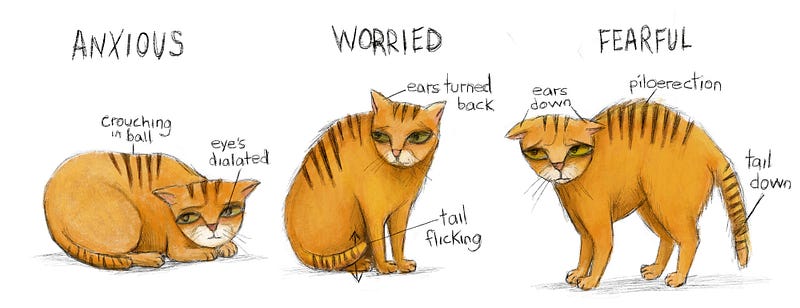
An anxious or fearful cat will do the opposite of an aggressive cat — they will roll up in a ball to make themselves appear smaller.
Other cats will tuck their tails between their legs when nervous. Tail flicking can also be a sign of anxiety or a watchful cat.
I really love you
Your lover brings you flowers. Your cat brings you dead things. It can be upsetting to find a dead mouse in your bed, but it is the ultimate feline love token.
Cats will also bunt their head against their owner to show their love. This is a way for them to get all their kitty scents on their owner. It’s kind of the equivalent of your cat, saying, “I love you, but I would love you more if you smelled like me.”
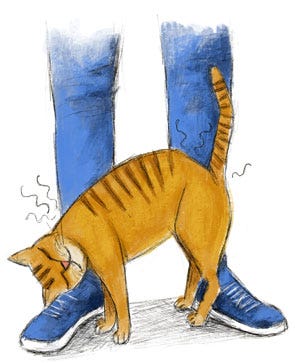
Cats also show their love by rubbing up against their owners. This rubbing transfers their pheromones onto their owners. A cat that gives you her scent is paying you the highest compliment.
Many cats knead their owners as a sign of love too. Animal behaviorists are still divided on why cats knead. Many believe it is a learned behavior — babies knead their moms when they want milk.
I am excited
When your cat is excited, their ears will perk forward, their eyes will widen, and their tail may flick. Tail flicking can be a sign of overstimulation, but can also mean your cat is excited and ready to play.
And many cat owners are familiar with their cat zooming up and down a room and up the walls. This is your cat’s way of releasing all that pent up energy. It can get annoying, but at least it is a sign of a healthy cat.
I am curious
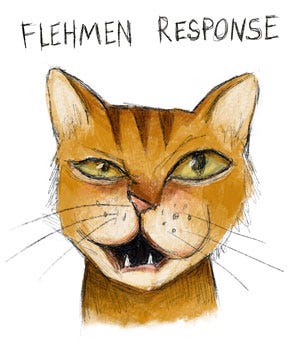
One of the kitty face expressions that is often mistaken for mistrust is the flehmen response. The flehmen response is when your cat curls its lips backward in what appears to be a sneer. Your cat is not disgusted with you. She is trying to smell the pheromones in the air. When the cat curls its lips back, it exposes the Jacobson’s organ — a smell-sensing organ in the roof of her mouth.
I am bored
Many cat owners become all too familiar with the sound of another glass shattering on the floor. Ah, yes, cats…adorable little Isaac Newtons obsessed with gravity. To curb this destructive habit, experts recommend you have plenty of toys to engage their curiosity.
And yes, your cat sits on your laptop or whatever book you are reading to get your attention. Cats are not stupid. They know what works…
Cats, just like humans, are unique in their body language, so not all nonverbal cues will mean the same in every cat. And just like reading human body language, one must consider context and add up all the different microexpressions to interpret the big picture.
Either way, if you pay attention, your cat is speaking to you. And by getting to know your cat’s unique mannerism, you can better communicate with your pet.


