
Your Advocacy Work Might Take Over Your Life
But if you feel it’s your purpose, then it’s worth it.
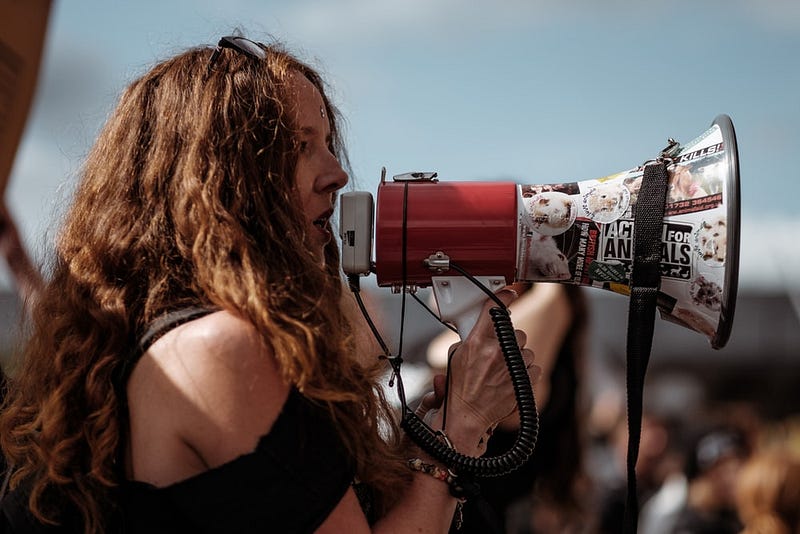
So here’s the thing. I have a lot of opinions. Don’t we all? Since I’m personally on the more introverted side, you won’t usually find me at a physical rally or screaming at a protest (power to those who do though!). However, I am admittedly much more vocal behind the armor of my Medium and Twitter profiles. These are the godsend of anyone who finds themselves both introverted and angrily brimming with opinions under their composed exterior.
As such, although I aim not to offend and to be sensitive, articulate, and understanding in my approach to the issues I write about — from gender shaming and inequalities to animal rights — when push comes to shove, I will defend my values. My life and actions are centred around them. And so, I believe, they should be.
Is being an activist a waste of time?
So what’s the problem? I have opinions, I like to write about them, as do many others — who cares?
Well, I was recently told by a well-meaning relative that I spend “too much time and energy” worrying about the problems of the world and should learn to “blank it out.”
Learn to focus on my own life and my own problems.
“You’ll burn yourself out…You’ll waste your life.”
And, as do many things, this apparent warning really made me think.
After a little reflection, I remain pretty sure one cannot “waste their life” by caring about the issues beyond the relative privilege of their own day-to-day. And besides — if you do have the likes of politics, climate change or social inequalities high on your agenda, then these are very real and inescapable threats to both your own life and your loved ones.
We can’t ignore these issues. They are already threatening, and will only continue to threaten, life and the planet as we know it.
When abstract problems become your reality
I campaigned against Brexit while I worked in EU affairs in Brussels, and now find myself having to change my long-term career plans. To see if I can continue to work in my field - or in the other Member States at all - as the scenario I tried to fight against is fast becoming a reality.
I campaigned against animal agriculture and for universal healthcare — and now find myself trapped indoors during a pandemic which came about due to irresponsible animal agriculture and is now an unwelcome tornado for our already-strained healthcare systems threatening both human lives, and the modern world as we know it.
Even if we can keep our heads buried in the sand for the time being — and, to be honest, the ship is even sailing on that one at this point — we will all need to eventually face the facts that our whole world is under threat from the current environmental, pathogenic and ideological threats we are facing.
You can care about both the world and yourself
I have written about the dangers of compassion fatigue, so am well aware that while it’s all well and good to fight your corner and engage in global affairs, you still need to give yourself a break and be sure to take care of your own emotional needs first and foremost— if not only for your own good but also for the cause that you can better fight for when you are mentally and physically strong.
But there are some problems with this suggestion that we should somehow blinker ourselves to the issues which — although they may keep us up at night from time to time — are also the fuel to our passions and keep us yearning for progress. The issues which spur us on to take action and become engaged in something outside of ourselves.
You can care about both the world and yourself. In fact — without the former, then concern for the latter becomes obsolete.
Be kind, sure — but have values
At risk of surrendering to an all-to-familiar rant about gender stereotypes, (hey, don’t blame me for their omnipresence in most sociopolitical issues) I do wonder if I would be so quickly labelled “whiny” or “pushy” if I were a man?
Why is it that when a woman is open about her opinions — whether that be out at a protest, or in the Twittersphere (thankfully, not so much here on Medium) it’s still so often deemed negative? But a man can be much louder and “pushier” than I ever am — and receive nothing but praise and admiration?
Okay, this wasn’t even supposed to be a lesson in feminism — you can find more of that here or here if that’s what you’re after (I appreciate that it most likely isn’t) but this actually helps to prove my point that when it comes to the causes you fight for, they tend to infiltrate many of your conversations. And if you are truly passionate about them, they are at the forefront of your mind. And you make it your mission to call out those particular injustices whenever duty calls.
Why turn off that spark? It’s a part of you. And quite possibly, it’s what makes you tick.
As long as your chosen cause remains something which drives you, and doesn't start to become a drain on your energy and motivation, then speak up! If not you, then who will?
Use whatever skills you have to communicate whatever changes you deem important
Let’s not lose sight of the bigger picture here. If we don't put our skills towards the causes which matter to us most — then what else is there? I don’t care whether it’s writing, singing, or playing the piccolo that you are personally gifted with — if you can channel this skill somehow into the message you feel compelled to shout out to the world, then I say go for it.
Surely this is the holy grail of the “flow state” everyone is talking about now?
Not everyone is lucky enough to feel a passion or calling in life — so if you feel the urge to speak out about something you find important, then relish it.
As discussed in my article on storytelling for advocacy, when it comes to inspiring change, we must evoke empathy. And when it comes to evoking empathy, we must tell stories. This could indeed be in the traditional sense, via writing. But for you, it may be via video production, public speaking, dancing, or whatever else.
In a world of “fake news” combined with our desensitization thanks to our over-exposure to the media, it is increasingly challenging to grab the attention of a potential supporter of your advocacy mission. As such, becoming more creative in the way in which we communicate on an issue can have a huge impact on your… well… impact.
Advocacy: Striking a Balance
We cannot simply brush off the world’s problems— and even if we do, that won’t stop them from affecting us and the people we care about. This is not only a selfish way of looking at it, but it’s hopelessly naive, too. Because many of the world’s problems will indeed have a knock-on effect on your own bubble. And even if issues don't affect us personally, we should still care! It’s called empathy.
In the comfort of most western nations, we can more easily switch off our concern for the Syrian war, the Israeli-Palestinian conflict or unrest in the Congo, for example— but this doesn’t mean that we should.
Overall, we must find a balance between caring for the world’s problems and maintaining our own mental health. There is a limit to how much we can do as individuals when it comes to the world’s greatest problems, after all. But by doing whatever we can to help — even if it’s an act as simple as writing a tweet, signing a petition, adapting your consumption habits, or right now — simply staying at home — these little acts really do add up when enough of us step up.
So don’t drive yourself mad. Don’t sink into a depression at the state of the world. And take care of your own needs.
But don’t become hardened or cynical either. Don’t quit caring altogether. Do what you can to help the causes which call out to you personally, but respect your own personal capacities and limits too.
Roxanna is a British-Iranian content writer specialised in human rights, health, and welfare. With a languages degree from King’s College London, a Masters in European Studies from LSE, and an EU communications background, she strives to increase the visibility and encourage debate around ethical and sociocultural issues around the world. http://roxannaazimy.com Twitter/ Instagram: @roxannayasmin


