
Young Attila
Even the Scourge of God was once a little boy
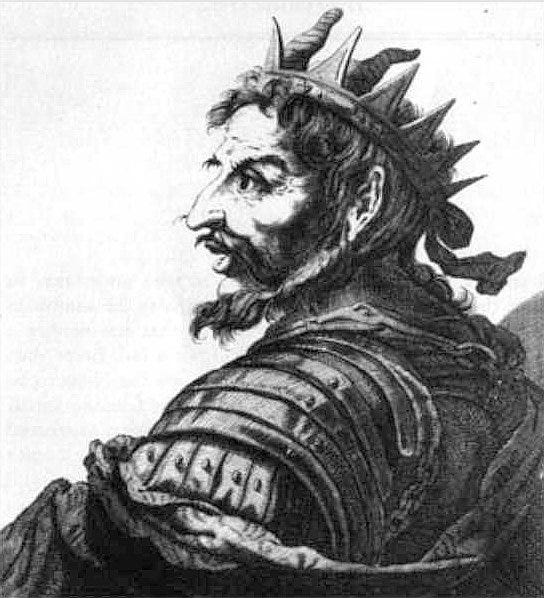
Everything was a towering menace. Attila toddled past fires that roared over his head. He scampered around the heavy, stomping boots of warriors. They were huge, dark, unpredictable giants, and Attila was but a foal. His mother corralled him in her arm to feed him with a wooden spoon bigger than his crown.
He dodged thundering carts laden with heaping bags of silver and huge trunks full of silks, precious gems and weapons. He tip-toed around the giant craters left in the dirt by stout, squat horses whose hooves were the size of his belly. He ate dinner around embers the size of his fists, recoiling as they leapt from the flames.
The men bellowed in song and in celebration. He staggered on spindly legs in the shadows of their blackened brows, afraid he could be mistaken for food. He held to his mother each time the leather quivers flapped in unison on the backs of the warriors as the army stormed away. Hundreds of carts, craftsmen, smiths, cooks and their families followed behind. The earth shuddered to silence as twenty thousand horses and ten thousand support regimens disappeared in a cloud.
“Why does Father go?” Attila asked his mother one day. She introduced a big spoon the size of his cheek.
“Our home is the center,” she parroted the Hunnic theme. “All else is the hinter. The fathers, and some of the mothers, go there to make sure our enemies don’t come here.”
“Why would they come here?” he asked, reaching for the wooden ladle with both hands.
“Attila,” she pulled his chin to her face, “they will steal our food and take our homeland. One day, you will be a great warrior, a protector just like your father.”
Attila was satisfied. His mother’s response was supported by the food in his belly and the huge trunks of silks and weapons. The fields were full of horses, and Attila slept in a warm bed.
Eventually, the cooking fires didn’t seem so tall. Attila looked like a heron as he chewed on a root, his thin legs folded, the bony knee caps resting near his ears, his black hair swooped beyond the nape of his neck.
Freezing winters gave way to warmth. Each season of plunder was unforeseeable in its length. In the interim, boys molded themselves to war ponies and grew out of their toddling ways. The Carpathians loomed purple to the east, and the women commanded the wide plains.
One day, the earth trembled, and the tiny stones around the cooking pot began to vibrate and jump all around. Attila’s mother stood and shaded her eyes. A cloud of yellow smoke curled on the horizon. All the people left their cooking tents and smiths and tanneries and gathered outside the unfinished walls of the town.
Attila’s body unfolded, unraveled and snapped into place as he rose to stand next to his mother. His eyes gazed just over the top of her head. In a glint of sunlight, he could see the silver streaks mixed in with her wiry, black hair. Attila squinted through the dust, his bony chest dressed in skins, his young face patched in wisps of hair.
“It’s Father,” he meant to announce with authority, but his voice cracked, and his mother giggled.
Gone for three years, a massive wall of horses and wagons, bearing more than forty thousand people — a city of warriors, women, herders and suppliers — came storming out of a glowing vortex of kicked-up earth. A roar rose up among the people in front of the town, their soft boots stamping in the ground.
The black squall of hooves and clattering wheels grew ever louder, whipping the people into a voracious chorus of whoops and hollers. Young boys bore out rhythmic thuds on drums and cast a spell over the revelers, a tough and taut people loosed all at once into ravenous abandon. Children weaved through the forest of tall legs all around. The elders raised their arms.
Attila could trace the forms of men whose eyes were battle-worn and whose thighs were crushing boulders on their mounts and whose arms were clad in muscle and iron. He was caught in the frenzy and cupped his mother’s smallish body in the crook of his arm as they jumped up and down, their teeth gleaming in the sun, their hair down to their waists.
The soldiers approached the gates, and the people flooded into the town alongside them, chanting and singing and undulating their bodies to the beat of the drums. Attila jaunted in behind his mother, but then slowed, his attention caught by something that furrowed his brow. Dangling from a warrior’s saddle was a fleshy curiosity, something that bounced not like the birch of an arrow or the cow horn of a bow. It was capped with hair, hair much like his own.
It had hollow eyes, eyes like a man’s.
Attila widened his focus. Every saddle of every warrior was flapping with a human head, each grey and sallow, hanging in deep folds like worn leather.
Attila recoiled. Nausea thudded in his belly, in his ears. The town gates continued to swallow gulps of cheering revelers and horses and wagons, an endless, gushing river of booty and victorious growling. Hot saliva burned Attila’s lips. He doubled over and wretched into the hoof print of a war pony.
The reverie quieted as the sun dropped down from the sky. Its pale light still glowed through a fog of yellow dust hanging in the air. Attila found himself alone. The ghosts of the townspeople still hopped up and down all around him, thronging against the trotting beasts bearing men and flaccid heads along a parade route, a triumph.
Attila took up the rear of the waning procession. He followed other boys into the forest to cut timber for fires. With every stroke of an axe, his thoughts were stained with his foolishness. When his father left, Attila had been a boy among boys who cheered the men from the town and bristled with pride, each father a hero on a mighty war pony, each brother a savior with pure intent.
As the sky grew indigo, the boys emerged from the woods and cut behind the smiths and tanneries to enter the town. Attila happened up on his father and uncle, having strapped themselves in with ale and mutton to give the kids some entertainment. He began to smile at his memories of boyhood and battle tales, then forced it down. He dropped the wood and drew in closer, concealing himself behind a stack of feed.
“Eh? Roman, senator or farmer, all they do is lie,” began Béla, his eyes wet with firelight. The youngsters stopped chewing to hear the tale. “They offer you bread and make a deal,” he spat through his teeth, “and then stab you in the back as soon as you turn ‘round!”
“LI-ars and CHEATS we steal their MEAT,” Mundzuk and Ruas pumped their fists and grinned through the hefty chorus of justified pillage.
“They give a daughter in marriage,” Béla shook his mug, “then tell the Legion you kidnapped her!”
“That RO-man cross is an OAK-en CAGE!” Mundzuk and Ruas clapped arms and raised their gravelly throats as King Ruglia approached with his lieutenants.
“The Romans promise you land, youngsters, take note,” Béla rose from his seat and hissed, “and then poison the soil with their very own hands!”
“Cut the MEN make the WOM-en PAY! A HUN takes whatever he WANTS THIS DAY!” a chorus of shouting laughter rose up past the flames. The king, donned in common garb, swayed a skull full of ale to and fro while Mundzuk and Ruas came to his side. These men, with hair like brilliant, flapping standards, clasped together in muscle and iron, recalling the thrill of the plunder. The kids clapped wildly and ran around the fire, feigning battle moves, stabbing each other with fowl bones.
Béla wiped grease from his mouth and eyed Mundzuk, “Surely the boy, Attila, wouldn’t miss the reverie? Where’s he gone?”
“I wouldn’t miss it,” said Attila, appearing from behind the feed.
Mundzuk raised his eyes and kept having to raise them still further to capture the tall beauty of the young man taking long strides toward the fire. He upended a jug of wine into the dirt as he rose and closed the distance between him and his son.
Attila buried his head into his father’s barrel chest. He could hear a pounding drum ringing out beneath the flesh. He held his father tighter, the two of them a still, silent embrace among the children who’d gone back to eating while the men broke into another song.
His father’s hand clasped the long hair behind Attila’s head. His eyes beamed over Attila, the boy who had become nearly a man in his absence. Attila pictured the other hand slicing forth with a blade to cut off his head.
Under chilly stars, the people continued to erupt in cries of victory. Warriors sat about huge fires, regaling the children with tales of vicious redemption. The women circled in a never-ending conveyer of blackened meat and beer. Attila lay outside his family abode vainly averting his ears from his father’s grunts and his mother’s coos within the walls. The embers before him were the size of a baby’s fist.
His mind floated away to his father’s large hand embracing the body of a small boy, and how his father’s battle beaten face would smile tenderly, squinting in the sun, and how his father had ridden into town with a decomposing head strapped to his saddle, holding his bow aloft, his voice charged with blood and plunder.
Attila slept and grew ever more through the night.
“Why do we kill them?” Attila asked his mother at dawn. He sharpened his arrows in preparation for the hunt. Her eyes shot up from their task. She rose and stood over him gripping a trowel.
“Because they have no honor,” she hissed, her eyes hard. “Don’t you weep for those animals. If they come for us, they will murder our people and sell me to lie under a line of Roman soldiers.”
Attila swallowed. He realized his knuckles were white around the whetstone and he lightened his grip. A quick wind carried the bray of a trumpet in the distance. He cast his eyes to the arrow at hand, its fletching quivered.
Attila grew. His nausea left him. His chest broadened, and his thighs became crushing boulders, and his arms became muscle and iron. As Mundzuk tied back his frayed, silver hair and prepared his pony for the hunt, Attila eyed his scarred body, still of rugged rock but now with brittle ligaments and patches of veins poking through thin, stretched skin. Mundzuk’s fearsome presence nonetheless was a boon to his son, Attila, the new chieftain.
For a long time, Attila’s love for his father had remained tempered by the image of that savage charging through the gates. In the night, Attila often dreamt of a wide plain budding with pipacs. A white, searing sun shone on the ponies. In this ever-present scape, his belly stirs at the approach of a woman. He covets her warm flesh though he knows she is a noblewoman, a Roman.
She opens her tunic down to her waist — white skin, red hair. And always, with the spectral lesson never learned, his inability to control his desire is confused with victory. That she will have him is enough to set the fields alight, and he takes her to the ground. He kisses her mouth, and the earth warps, dropping his stomach in a spinning whorl. He cannot reconcile his ecstasy with the feeling that she has infused him with some malevolent force. Under his weight, she clasps his back. He cries out in a familiar, forlorn prescience as she sheaths a blade into his spleen.
He lifts up over her. The blade is in his flesh to the hilt. He can’t breathe. He is going to die. He casts his eyes down to her, mourning her treachery, and screams in horror as her mouth turns black and begins to ooze off of her face. Her eyes are still filled with frozen want as she is snatched from beneath him, and Attila is left staring at the grass. Attila floats above the ground, watching as his father drops the half-naked corpse into the field and gallops away with the maiden’s head flopping right alongside a mace, in cadence with a quiver hopping on his back.
Attila wakes, wide-eyed and sweating, and reaches for his wife Kreka, quietly snoring beside him.
Now, Attila himself is on a war pony. His father and brother are dead, and he is king. His bow and arrows repose on his back like a baby swaddled to its mother. Behind him are twenty thousand horsemen, mirror images of himself, on a quiet, breezy day overlooking a naïve, bustling town.
“And your meeting with the consul?” inquired Edeko, Attila’s deputy.
“The usual,” sighed Attila, his teeth grinding a root. “He spat before me, saying he hopes to command the legion which will destroy the Huns and enslave our daughters for the whores that they are.”
The wind picked up on the hillside and whistled through all the shields. The horses all flapped their tails.
“The townspeople won’t detect us until we’re over the walls,” offered Edeko. “They’re stupid enough to think their gates protect them.”
“We are the Flagellum Dei, I suppose,” Attila chuckled, holding his arms in a pose of inevitability, “the Scourge of God, really now?”
He found it amusing that the Romans practically asked him to be a savage. He darkened his brow.
“Your orders, King?” his general asked, squinting over the town, a wry smile creeping to his ears.
“Rip into the women. Soak your hands in the blood of the men. Take their heads. Pack the booty. Retreat to the Danube.”