
You’ll Never Watch The Matrix The Same Way Again
TRANScendent Connections Between The Matrix and Everything Everywhere All At Once
Welcome to TRANSlating Everything, a newsletter covering pop culture, news, politics, and the science of storytelling through the lens of a cool trans mom. You can support my work by leaving a tip or choosing a paid subscription to Translating Everything on Medium or Substack.
Note: this is an excerpt from the full article on Substack
TRANSlating the connections between Everything Everywhere All At Once and The Matrix
Everything Everywhere All At Once is almost guaranteed to win Best Picture at the Oscars — or, depending on when you read this, has already won. I doubt even five paper cuts would get you to a universe where the directors don’t walk away with a trophy.

On a recent episode of the Filmcast, film critic and entrepreneur Dave Chen explained why EEAAO resonates with so many different kinds of people.
People are reading EEAAO as a metaphor for whatever is true for them. It’s a metaphor for menopause. It’s a metaphor for parenting. It’s a metaphor for the immigrant experience. And there is something really special about how this movie has managed to capture the imagination of any people going through any challenges of any kind.
Indeed, Filmcast guest Walter Chaw — a film critic increasingly acclaimed as much for his activism as his cinematic trash talk — expanded on his thoughts from his article for Film Freak Central, saying:
When you force [a person] to think about everything that could have been that’s not what their current life is, it does induce depression. It does make [everything] become meaningless. Which ultimately is what the villain of the film suffers from. Once she comprehended all possibilities — everything — it all became meaningless. That’s ultimately the darkness that threatens to destroy the universe.
Filmcast co-host Jeff Canatta, one generation removed from an immigrant family, shared wisdom born from his recent years as a new father finding compassion for his parents, his children, and himself.
Every time you feel like a failure, it’s just a lack of perception. [The movie is a] symbol of the decisions we make in our lives and how life continues regardless of how those pan out.
In the same conversation, Walter Chaw touched on the moment we find that compassion and accept each other as individuals rather than extensions of ourselves.
It’s an extraordinary act of generosity to see people outside of the box that we put them in. Maybe that’s what the movie is about.
It’s that same ambitious pursuit of authentic existence that ties EEAAO to the reality-hopping spectacle made by the Wachowskis in 1999.
Trans allies and statistical anomalies

From Walter Chaw’s Film Freak Central article:
[Joy seeks out every multiverse iteration of her mother] in an effort to get a single version of her mother to talk her out of annihilation, but each iteration proves incapable because of the solipsism that seems to unite the Evelyns across the timeline. (It’s not Joy’s burden to understand how that solipsism is born more from regret than from narcissism.)
Now, finally, our Evelyn, this failed Evelyn, the statistical anomaly, who is so without obvious wins, is the one most likely to figure out how the only expectation she really needs to honour — indeed, really can honour — is to be in love with the people who love her. It’s not a message to lie down and die, it’s a prayer for appreciation of grace when it appears.
You saw those two words, didn’t you?
Statistical anomaly.
Walter says Evelyn being one is the distinction that makes Everything Everywhere All At Once not a retelling of The Matrix.
In his article for FFC, Walter continues:
Evelyn is warned that something transdimensional is making its way towards her — a source of great destabilizing power that is looking, for whatever reason, for every version of Evelyn in search of The One. I was afraid this was a messianic plot in the vein of The Matrix, but it’s not that. The Evelyn of the audit is, in fact, “the One,” though not because she’s the best Evelyn — because she’s the worst: the most despairing, the most useless, the one who made every possible “bad” decision in her life to lead her to this moment, having accomplished nothing and about to lose everything.
But I think he missed, like, what The Matrix was about?
Each iteration of the Matrix can be seen as a multiverse — sort of what some people suspect our own universe to be like. One universe dies so that the next can be born.
The Matrix continues its cycle of rebirth by guiding every iteration of The One to meet the Architect. Each time, The One has no emotional connection to humanity beyond their purpose to ensure its survival, and so they accept their role in perpetuating the cycle. His function is, for lack of a better word, perfect.
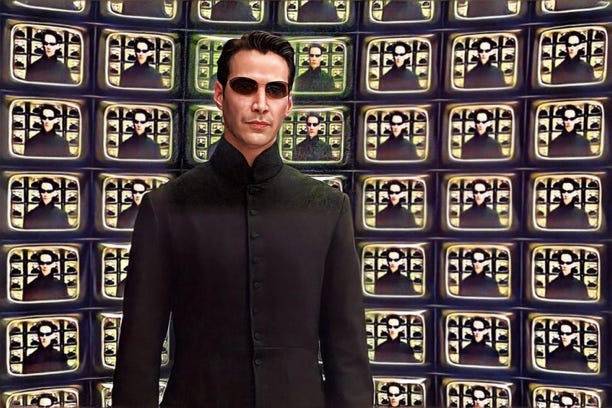
Neo, aka Mr. Anderson, changed that. Whereas each other One succeeded, he failed. Where the other One pushed past every human obstacle, this Neo was grounded by his love for Trinity.

The Architect told him choice was the problem. If only Neo would continue not to choose.
Instead, he chose love.
That’s a beautiful thing, right? Even if breaking the cycle of generational trauma almost got everyone killed.
Is Walter Chaw one of the Ones?

Thank the Oracle that people like Walter Chaw are here to help through it all. Is he secretly one of The Ones? Because it takes super powers to so casually turn JK Rowling’s transphobia into fuel for hope.
Walter: “After [Everything Everywhere All At Once], I started donating a few bucks every time JK Rowling said something horrible. I can clap back and she’ll never read it, but my followers will read it, and they love me. Instead of that, I’m just going to give $5 to a trans charity every time she says something [awful].”
About Stephenie Magister

If you like my work and want to support it, buy me a cup of coffee! For more of my content, subscribe to my Substack newsletter: Translating Everything


