
You’ll Never Get Rid of Conflict, So Learn to Engage It Better
Part One: The new “How to Tend and Befriend Conflict” series. If you think you know how to deal with conflict, think again.

Today kicks off what I’m calling the “Tend and Befriend Conflict” column : A four-part series that will change the way you understand, navigate, and engage the conflict in your life. The good news is that it works for all types of conflict: personal, professional, and in the broader community. Would love to hear what you think.
When I was young, I had three approaches to conflict. One was to yell, “Stop it!” (pronounced stauuuupit) in my best Whiners Family voice at whoever was irking me. A second was to try to talk out a problem with another person, but I’d often get so worked up in the moment that the words I wanted wouldn’t come. And the third was to run to my Harry-Potter-like cubby beneath the stairs in my house where a Strawberry Shortcake sleeping bag, flashlight, and Nancy Drew mystery could convince me that all would be okay when eventually I did emerge. None of these approaches were especially helpful.
In my work as a mediator, therapist, and clinical ethicist, I’ve come to see that I was not alone in my failed strategies to deal with life’s challenges or tension. What’s more, that these strategies and others like them easily carry over into adolescence and adulthood, often because we’ve never really learned what conflict is, what’s happening to us at an embodied level when it strikes, how this influences our feelings, thoughts, and behaviors — and ultimately, how all this directs how we approach conflict.
So, what is conflict?
In its simplest form, conflict is a natural disruption in human relationships. The word conflict comes from the Latin confligere, meaning “to strike together.” In other words, conflict is what happens when elements that are in opposition to one another are “striking” together or clashing.
Conflict is a natural disruption in human relationships.
There is actually “conflict” among scholars and interested others about how to define conflict in a broader sense. Some suggest it is a situation or else a type of behavior; others say it is both. Some suggest that human consciousness must be present for there to be conflict; others say the subconscious is always involved. What is generally agreed upon is that whenever there is a difference of or divergence in needs, wants, desires, attitudes, understanding, beliefs, values, interests, and requirements, conflict often erupts.
How conflict forms inside us — The internal process
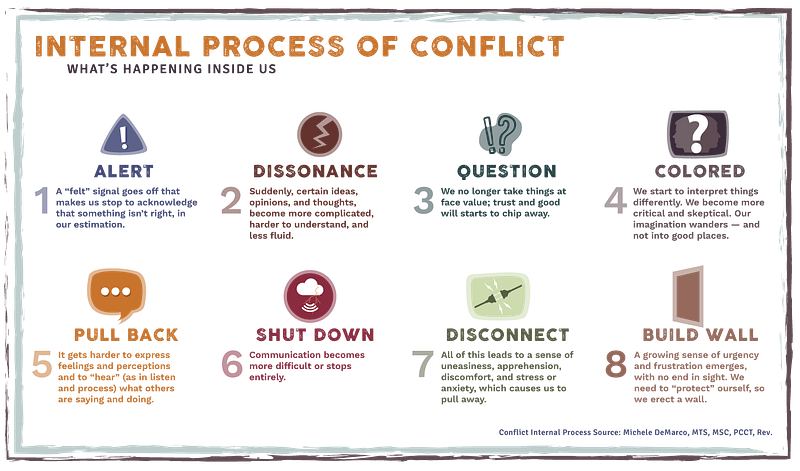
In the heat of battle, rarely will we stop to consider what’s happening beneath the surface of our skin, but whether we’re aware of it or not, a lot is happening. Here’s a chart to illustrate it.
Of course, none of this internal process feels particularly good — which is one reason why so many of us view conflict as a problem to avoid like the plague. But really, conflict is life-affirming:
- Conflict simply tells us that something isn’t working as well as it should. This presents an opportunity to make things better.
- Conflict allows us to pause for a time, take notice of what’s happening both inside and outside of us, and to assess the situation and its variables. This presents an opportunity to discern and learn.
- Conflict keeps things moving (nothing in life is fully at rest other than that which is dead.) This presents an opportunity to grow.
- Conflict is a motor for change. This presents an opportunity to expand and create new.
How conflict affects us, both individually and collectively
Conflict affects us at four levels:
1. Personal: This results when our own feelings, emotions, understanding, perceptions, and beliefs rumble like thunder against underlying others, creating an inner storm with seemingly little cover.
2. Relational: This happens when changes in face-to-face or person-to-person patterns of interaction, communication, respect, allegiance, or faith shift our emotional or psychological “proximity” — in other words, how close or how polarized we and another person/group are.
3. Structural: This occurs when underlying causes embedded in the social, political, and economic structures of organizations, institutions, and society are stressed and become disproportionate, pitting one against another.
4. Cultural: This happens when changes that affect accumulated norms and narratives and patters of group life are no longer perceived as resonant, right, or sustainable to some, but not to others.
Conflict simply tells us that something isn’t working as well as it should. This presents an opportunity to make things better.
The number of things that create conflict is infinite, but typically, they fall into four groups.
1. Data and information. The lack of it. The distortion of it (think misinformation and disinformation). The interpretation of it (like who’s doing the interpreting and how their assessment is performed). And differing views on what information and data is relevant. The digital revolution and social media age are sending this category into orbit — with daily “Big Bangs.”
2. Relationships. For instance, strong and unfettered emotions, stereotypes, miscommunications, and repetitive negative behavior.
3. Values and beliefs. Such as, ideological differences or differing standards of ideas or what is acceptable behavior. An interesting note: research shows that actual values don’t necessarily lead to conflict. It’s when our values are minimized or else when others’ values are imposed on us, and so prevent us from living in accordance with our own, that creates conflict. This is one reason why all the major socio-political issues are so controversial.
4. Social Structure. For instance, unequal/unfair power distributions and resources, time constraints, destructive patterns of interaction, and unconducive geographical or environmental factors.
One of my mentors said that conflict is like progressive (eyeglass) lenses: first, no one lens is capable of bringing everything into focus, and because other lenses are often blurred, we can’t rely on only one, therefore each lens has a function that makes certain realities clear; and second, there are multiple lenses in a single frame, each of which is essential, but ultimately, all must be integrated in order to see the whole picture.
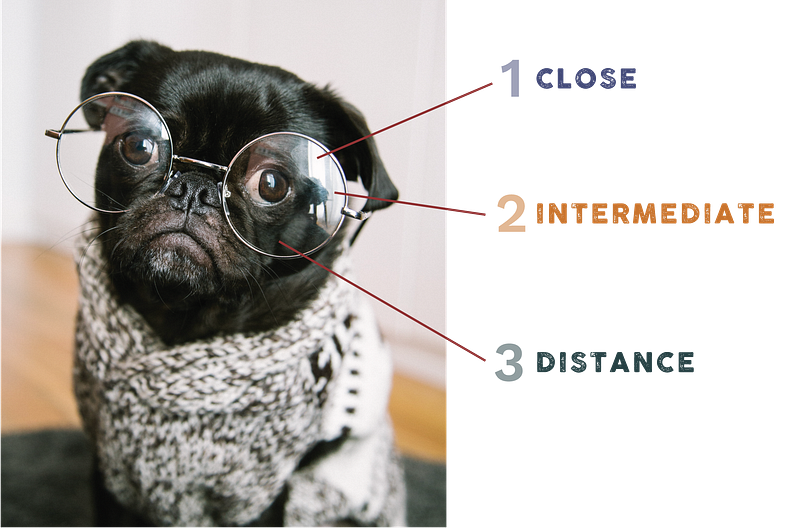
The biggest danger with conflict isn’t that it exists; rather, that it prevents us from seeing clearly — from seeing the “whole picture.” This skewed perspective can easily tip the balance of any relationship and can cause it to be thrown off, so much so that it has damaging results.
As we will see in the next column: Part Two, the goal when dealing with conflict, especially conflict that erupts in our most important and meaningful relationships, isn’t simply to “resolve” it or “just get passed” it, nor is it to “manage” it “for now.” Rather, it is to transform it by creating something new because of it, thereby shifting the asymmetry of the relationship back into balance. If that’s a mouthful, stay tuned. Part Two has SO much more to say!
Next up! Part Two: “Stop Trying to “Manage” or “Resolve” Conflict — Here’s A Better Approach.


