
Food and Drink
You’ll Never Need to Buy Barbecue Sauce at the Store Again.
Promise me.
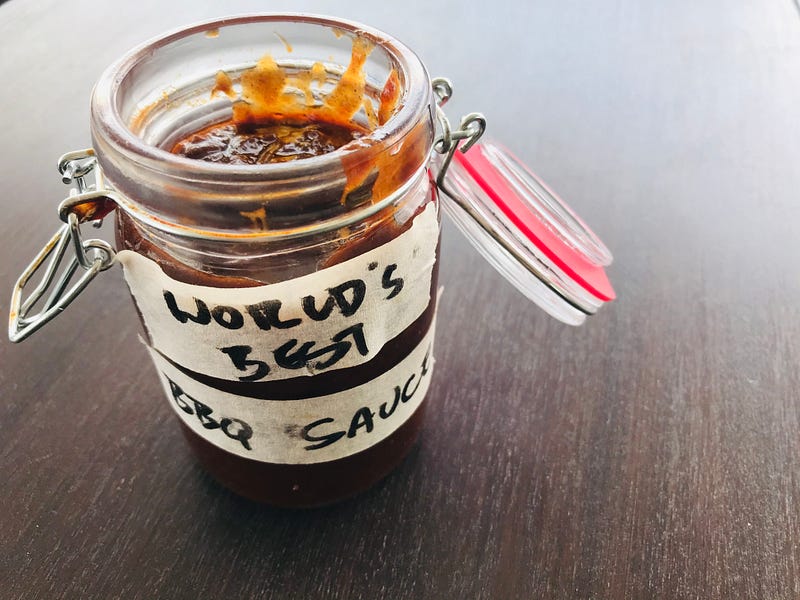
There are those of us who labour for years, sweating it out over a hot stove, perfecting a recipe and never sharing its deepest secrets with anyone, guarding it like the Holy Grail that by now should be.
On the other side of the coin, there are those of us who go to the store and find the bottle with the most authentic looking label, get it home, slather it all over a piece of meat, cook it on a gas grill and call it a day.
But this coin has three sides. And so, there are those of us who, during Covid lived on the other side of the world and still wanted to cook meat over an open flame on the rooftop deck but were unable to find anything suitable in terms of sauce at the grocery store that wasn’t made in a factory thousands of miles away and shipped to our location. Those are the people who decided to go it alone and see if they could make something better, with only the things that were available in that location.
Which, by the way, for me was Dar es Salaam, Tanzania. They do love their grilled meats there — nyama choma, in the KiSwahili language. It’s delicious alongside a few baridi sana (very cold) Kilimanjaros but they don’t concern themselves too much with sauces and marinades.
What I learned is that it can be done and not just in terms of your barbecue sauce, either.
Come along then, and let’s figure out a way to make your own stuff, better, without relying on a supply chain, greenhouse gas emissions, preservatives and chemicals and with the knowledge that you have the capability and skill to do this and lastly, wonder why you haven’t been, all along.
You are going to need: 1 large white onion / 6–8 cloves of garlic / olive oil / ground cumin / chili powder or cayenne / paprika / salt / brown sugar / tomato ketchup / tomato paste / brown sugar / espresso coffee / apple cider vinegar / bourbon.
And a large, high sided pan and some sort of whisk and / or spatula. And about an hour to do this right.
Alright, here we go. Cut that onion and garlic into pieces as fine as you can and get both simultaneously into a pan with a few good glugs of olive oil that you’ve been warming. Let them mingle and get soft and translucent. You can’t hurry this part, it should take about 20 minutes while stirring frequently so that they don’t carmelize or burn.
Once you are satisfied with the softness, add one tablespoon of cumin, ½ teaspoon of chili powder, another of paprika and 1–2 teaspoons of table salt. When you mix this together you should find it to be quite stiff and grainy. Add some water if this is the case and stir together. Keep the heat on medium. You will notice that as the water evaporates the mixture will stiffen again somewhat. Add water and repeat, probably 2 or 3 times in all. This should take about 10 minutes.
While this is happening, make a double shot of espresso. In the absence of the ability to do this, a really strong coffee will do. Once that is ready, mix together an equal part of bourbon and double the amount of apple cider vinegar. Once mixed, add this to the pan and mix everything together. Let that simmer away for about 10 minutes. Things will be starting to smell good, as the bourbon burns off. Don’t let it boil and keep a close eye on this, stirring frequently. If it starts to really get sticky, add some water.
Now, add the ketchup and the tomato paste, keeping in mind that the more you add, the more acidity you are including in the sauce. It’s probably best to add 150–200ml of the ketchup first and about 50ml of the paste. As well, two good tablespoons of brown sugar go in, to balance out the acid that I just mentioned.
Whisk this all together and let it bubble away for about 15–20 minutes, again keeping a close eye and stirring and tasting. If you think it’s a bit sweet, add some more ketchup or paste. If it’s a bit sour, add some more sugar.
After about 20 minutes, it should be the consistency of what you’d typically think of as barbecue sauce. Pat yourself on the back because you didn’t use any stabilizers, emulsifiers, colouring, sodium benzoate or guar gum and any of that other bullshit you see on the labels on the bottle you bought at the store.
You could zip in the blender or the bullet at this point, if you want it perfectly smooth. However, I like it when the bits of onion and garlic are still visible. They will also crisp nicely on the grill.
Let it sit now for a while. If you were to add it at this temperature to meat from the fridge at this point, you would a) cook the meat and b) toughen it. Nobody wants that. Your sauce should be room temperature when you cover the meat with it, and then it should stay in the fridge for a good three hours, marinading.
About 30–40 minutes before you are ready to grill it, take it out of the fridge and get to work on getting your grill ready. For the love of Pete, I hope you will be cooking on coals. These will take about 30 minutes to light up, burn, get a glow on them and be ready to go under the grill on which you will place the meat. Crack a beer and enjoy the process. If you have no choice but to use a gas grill, well, it can be ready to go in under five minutes. You can crack a beer too.
Now all that’s left to do is grill. And to give yourself a high five for being so self sufficient while you crack another beer.
Here’s another one:


