You’ll Catch More Zeroes with Bees Than Toddlers
How in the world do bees understand the concept and value of 0?
We’ve long believed only humans had the intelligence to get the concept, but recent research has shown monkeys and birds have the brains for it as well.
What we haven’t known — until now — is whether insects can also understand zero.
The first recorded use of zero dates back over 5000 years to Mesopotamia. Since then, the concept spread like wildfire throughout the Ancient world. This concept contributed to many scientific, philosophical and economic endeavours. We learn and understand the concept of zero, as well as its implications, thanks to our highly developed cerebral cortex. This wrinkly organ encased in our skulls is a byproduct of evolutionary adaptation.
The understanding of this tricky concept is unique to a few animals within the natural world. How can bees, with their small brains, understand the value and concept of zero?
Behind Every Bee is a Brain
It may come to you as no surprise that the bee brain is substantially smaller than the human brain. We have a staggering 10 billion neurons in our brains while bees have less than 1 million! Yet while we’re prone to getting lost wandering around our neighbourhood, bees navigate through an ever-changing urban landscape with 10 000 times fewer neurons.
The insect brain is a truly alien computer. When looking at it in any anatomical detail, it looks and functions differently than ours. The prefrontal cortex in humans is involved in decision making and complex behaviour. It is a driver of our intelligence, but such a region is absent in bees.
Deep within the bee brain are two round specialized regions, called mushroom bodies. Scientists believe that these bodies allow bees to process complex information such as locations. While the mushroom bodies integrate information, the central complex is responsible for integrating motor output. These two systems take input from the environment to determine where they should fly for optimal feeding.
Though the common fly, Drosophila melanogaster, it has ten times fewer neurons than the mighty bee. The bee has more neurons in its mushroom bodies than the fly has in its entire brain, providing more processing power. Thus, bees are capable of associative learning.
Are you interested in the bee brain? Here’s a link to an online atlas!

Associative Learning
The classic example, named for behavioural scientist Ivan Pavlov, involves ringing a bell before giving a dog food. Once the dog receives its food, it begins to salivate. After a while, the dog would salivate to the sound of the bell. This is due to the successful association of a cue, with the stimulus, the dog food.
By giving bees different tasks, researchers can reinforce certain behaviours. Then by subtly changing the experimental conditions, they can test how well the bees can understand more complicated concepts. Bees are smart insects that use a complex hierarchy and dance to communicate. Why is it surprising that they can grasp the concept of zero?
It may come to you as no surprise that the bee brain is substantially smaller than the human brain. We have a staggering 10 billion neurons in our brains while bees have less than 1 million! Yet while we’re prone to getting lost wandering around our neighbourhood, bees navigate through an ever-changing urban landscape with 10 000 times less neurons.
The Great Experiment
It takes us humans a few years to talk, learn basic math and understand zero. Bees don’t have time for all of that. With their relatively short lifespans, they benefit from a brain optimized for food foraging. Often bees must make fast decisions, determining which fields provide more pollen and nectar. They determine this on the fly, while their brain makes sure their wings keep flapping and their eyes scan the horizon for more information.
Researchers exploited this evolutionary adaptation to learn more about the limits of bee cognition. Cards with one to six shapes trained the bees in the first phase of the experiment. In each trial, two cards were shown to bees, rewarding them with sucrose water for flying to the card with fewer shapes on it. If bees flew to the other card, they received a bitter-tasting water solution. This trained and incentivized bees to identify the card with the least amount of shapes. Once individual bees reached an 80% success rate, researchers presented them with the ultimate test!
The researchers showed that bees could count from zero all the way up to six.
Researchers showed the bees two cards again. While one card had two or three shapes drawn onto it, the other card was blank. The bees determined that the blank card displayed fewer shapes! In this way, the bees showed an understanding of zero. The researchers showed that bees could count from zero all the way up to six. If you’re interested in this beguiling study, you can read more here!
Of Bees and Drones
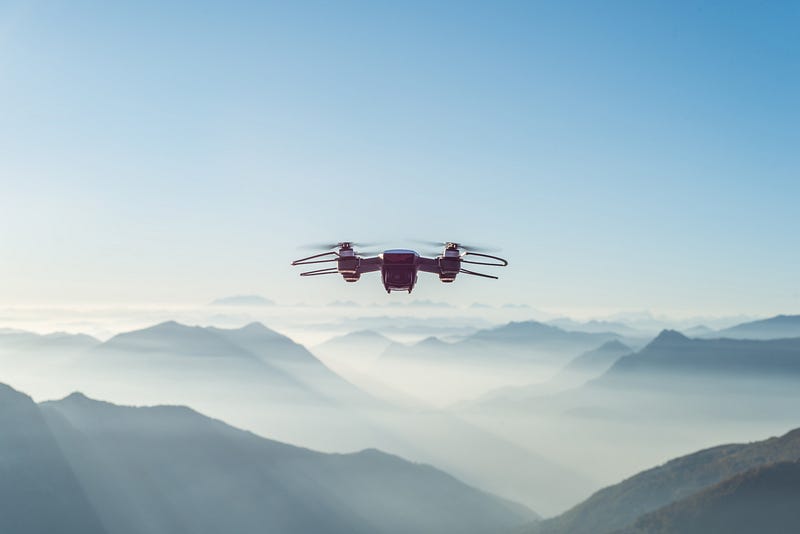
There are many practical applications from understanding bee intelligence. When scientists look to nature for new technology, it’s called biologically-inspired engineering. Understanding how bees determine and plan their flight paths provides a step forward to developing smarter delivery drones.
Seeing is really bee-lieving, who knows what else we can learn from these friendly fuzzy insects!