
You Went On Your Knee During A Protest as A Lieutenant — Now You’re Having Regrets?
Why having regrets?
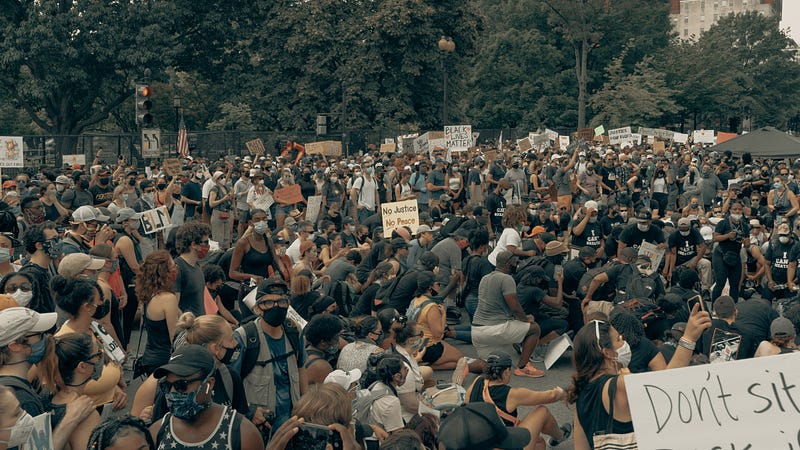
In this time of a movement, Black Lives Matter Movement, you have to be aware of what is going on why it is going on. What didn’t I do and what can I do now?
This is also about the cops.
Cops in the USA are having a hard time right now, I think (I’m not sure with my Dutch background living in The Netherlands). They have to be loyal to their companions, but some of them also are willing to make a change, but I think they don’t know how to do it.
Some are not so willing to do so. It is stuck in their system and that has to change. It is stuck in their system for generations that they turn their back towards black people.
There are also cops that regret what they are doing when working during a protest. They did look better in public but never meant what they did. As watching this protests from The Netherlands, this is just my perspective. And I hope that I will see the change someday in my life.
One of them — who faked his behavior — is Lt. Robert Cattani.
Robert Cattani kneeled while the protesters asked him and his colleagues to do so. He did what has been asked. It was during a protest on the 31st of May in Lower Manhattan.
After what happened during the protest — his kneeling, he didn't feel good that he knelt. He wrote a letter to his colleagues that he is sorry for kneeling during the protest.
The New York Post obtained to have a copy of this email.
In this email, Cattani said a lot of things that he has regrets about what he did during that protest in Lower Manhatten.
“The cop in me wants to kick my own ass.” What does he mean by this? Does he want to correct himself? And for what? And he had to stick with not kneeling and not willing to fight for justice? Or did he wants to be loyal towards his cop mates?
He also said this “goes against every principle and value that I stand for.” What are his principles? Are his principles that his boss wants him to present and looks like while being on duty as a cop? Or does he also have his own principles in life? Can he adjust to that in life as a cop? What are his values as a person and as a cop? Does he has his own values as a cop, or does he needs to present the unit values above his own values? Which one is a priority during such a protest? What are you really standing for, sir? Are you standing for change or not?
In his email, Cattani wrote that he “made a horrible decision to give into a crowd of protesters demands and kneeled alongside several other officers.” What is horrible on kneeling in front of protestors who asked for it? Isn’t this an act of a cop that could lead to a change in this movement? Those protestors want to see the cops change and their way of looking at black people.
“The conditions prior to the decision to take a knee were very difficult as we were put center stage with the entire crowd chanting,” What conditions does he mean? The conditions to not get the protest out of hand? Or the conditions of the department he works for to not get involved in the racism and injustice movement? I don't understand that. I mean, when you’re a police officer, you should give the right example towards your citizens. Am I right? That means — as a police officer — you should include justice. But that is not what (always) happens. That is a shame.
“I couldn’t imagine the idea of going back to work and putting on the uniform that I so wrongly embarrassed,” I don’t know what he meant by this. Is it going back to work in that uniform and laughed by his colleagues for kneeling? And he will be embarrassed? Or will he be embarrassed to wear his uniform again after kneeling? By whom? Only his colleagues? Or also his family and friends?
“However, I decided that was the easy way out for me and I will continue to go to work every day for my staff.” What is the easiest way out? Kneeling while you don’t mean it? When you’re saying something or doing something you don’t mean, it is not only lying to others but also lying to yourself. Who are you really? You have to think about that in the first place. Figure that out first.
“The conditions prior to the decision to take a knee were very difficult as we were put center stage with the entire crowd chanting,” These last weeks, years are very difficult for the cops. They are always the center in those difficult situations. What were you thinking when you stood there in front of the protesters, sir? Yeah, being in duty and that is what you should have done, but faking to kneel, is not what you should do.
“I know I made the wrong decision. We didn’t know how the protesters would have reacted if we didn’t and were attempting to reduce any extra violence.” What is wrong kneeling? In this case, I think he was ashamed that he knelt together with some of his mates. And that he will be made fun of him by whoever that might be? Or that he will be fired by his boss? Isn’t this just the change that so much is needed?
“I thought maybe that one protester/rioter who saw it would later think twice about fighting or hurting a cop,” Why would a protester be hurting a cop when you’re doing your job? What could you do to do your duty? I would go and have a conversation with the protestors. But I am not them and I wasn’t there, but why on earth kneeling why you regret it? I don’t understand. I should get something positive out of it. Well, that is what I should do and stand for it, even if that was not me before. Cattani thought that there will be more violence if he didn’t kneel.
“I was wrong. At least that [sic] what I told myself when we made that bad decision. I know that it was wrong and something I will be ashamed and humiliated about for the rest of my life.” Wow, this statement. Being wrong to kneel, being humiliated, and being ashamed for that? For the rest of his life? Why not being ashamed of getting involved with equality? Why being humiliated for equality?
“I spent the first part of my career thriving to build a reputation of a good cop,” he wrote. “I threw that all in the garbage on Sunday [May 31].” Did he throw all his good cop reputation in the garbage by kneeling because protestors wanted to? And is his reputation, as a good cop, not involved with equality, against racism and justice? I think
“We all know that asshole in Minneapolis was wrong,” Cattani wrote. And what about this? Does he mean George Floyd? Why? Was this asshole in Minneapolis a bad person? Because he was black and therefore wrong? Or because this lovely black man had something done but learned from it? If it wasn’t George Floyd, about who was it then?
“Yet we don’t concede for other officers’ mistakes. I do not place blame on anyone other than myself for not standing my ground.” Why not concede for other officers while some of them were wrong? Why not concede for other officers as the whole system needs to change? Why not concede for other officers when you can say something about their behavior? Yes, indeed, you should blame yourself, but also the ones that were not correct in their behavior? And why not for standing yourself to the ground while you can make the change?
I read that people shouldn’t knee and that there should be actions taken to get that change. If this cop really wanted change, was this kneeling a sign he wanted to change? Then, I think, was this kneeling a start of a change? If it only was not fake, of course.
But this cop did have regrets. In this way, it doesn’t count.
Still, I want to think about kneeling first, and then when you have done than, your system could take this for a new start.
We also have to think about people who are willing to change and start, for example, with kneeling.
You see, I have a lot of questions. I think there will be no answers for, but which I think we should try to find and also think about for ourselves.
My frustration with this cop is that he was not taking kneeling very seriously, but only thinking about himself and the cop system, and how he wants to get away safe. Also, his image towards other people and how will look in public. I believe that is insane.
These days, it is all about image instead of
That the protesters were going to use violence if he didn’t kneel? What if he did start a conversation with the protestors? Could it have changed everything?
It is hard to understand both sides but talking, writing, and having a conversation about racism and injustice is still an issue, which is worth is.
I’m in.


