
Introverts Are Successful Businesses Leaders
Debunked myths in entrepreneurship

A young, rebellious, overconfident white male, full of fiery passion for his business idea — this is the image many of us have when we think of successful business founders. But is the profile of a young Bill Gates the norm or the exception?
A 2018 study performed at MIT and NBER found that “successful entrepreneurs are middle-aged, not young.” The average age of founders of high-growth, high-performance firms in the United States is 45.
So the idea of the young business genius is a myth.
Are we influenced by other misconceptions? Which traits actually matter?
And more importantly, can one learn to cultivate them?
Entrepreneurship research
From 1934, entrepreneurship has been studied from a psychological perspective. Although between 1980–2005, mainstream research focused more on the economics and strategic aspects of entrepreneurship, more recently (2007), psychology reclaimed its status as a relevant lens for predicting startup success. After all, “entrepreneurship is fundamentally personal” (Baum, Frese, & Baron, 2007). So let’s explore which personal traits have something to do with starting a business and predicting its success.
It is useful to consider the impacts of psychological constructs in entrepreneurship. Encyclopedia Britannica defines a psychological construct as “a tool to facilitate understanding of human behavior.”
In fact, all sciences use constructs. In physics, the concept of temperature helps us make sense of how hot or cold an object is. Or, the human ability to learn, abstract, adapt, and apply knowledge to change one’s environment can be grasped through the construct of intelligence.

Similarly, psychological constructs have been theorized in entrepreneurship research. Some examples are self-efficacy, achievement motivation, proactive personality, stress tolerance, neuroticism, extraversion, agreeableness, and many others. But do they matter?
Although initially regarded as unimportant, today we understand that constructs become relevant in predicting business success if matched with entrepreneurial tasks. One example is practical intelligence, or “street smarts,” which reflects a person’s ability to immediately apply their knowledge to accomplish a business-related task.
Among psychological constructs, the most relevant to business creation and performance were:
- Self-efficacy (relevant to both business creation and performance) represents confidence in oneself to control their motivation, behavior, and actions. In other words, if you are confident that you will be able to perform certain future business-related tasks, you have a higher chance of actually succeeding at those tasks. Exhibiting this quality seems to suggest a better chance to actually start a business and also have it perform well. However, self-efficacy is task-dependent: for example, you might be confident in handling your business’s marketing but hesitant when standing in the manager’s shoes.
- Achievement motivation (relevant to both business creation and performance) refers to a person’s need for achievement. It’s that drive that makes you chase a goal breathlessly and keeps you up at night thinking about the possibilities and how to reach that next goal on your 2020 resolutions list. It has been shown that people with high achievement motivation are more likely to “engage in energetic and innovative activities that require planning for the future.” Such individuals are also attracted to and perform well in careers that involve a moderate degree of risk, a fair amount of control over outcomes, and personal responsibility (all characteristics of entrepreneurship).

- Proactive personality (relevant to business performance) is closely related to identifying opportunities, taking action to solve a problem, coming up with a new product, or changing business strategy altogether. “You have to be self-starting: you shouldn’t wait ’till others do it or ’till others tell you to do it or even the customers tell you to do it. You have to start yourself” says Michael Frese, Professor at the National University of Singapore and Leuphana University of Lunesburg, Germany.
- Innovativeness (relevant to both business creation and performance) has been linked to profit as early as 1934 by the Austrian economist Joseph Schumpeter, who defined an innovative person as someone who “possesses the ability to inspire others, and who does not accept boundaries of structured situations.” Being able to address customer needs in new ways makes creating a business and having it perform well more likely.
- Autonomy (relevant to business creation) is also known as independence or freedom. In their 2006 study of 167 entrepreneurs driven by autonomy, Gelderen and Jansen from Vrije Universiteit Amsterdam found that the main driving forces for small business owner motivated by freedom are decisional freedoms: to work for themselves, to make their own hours, to decide the business strategy and working methods, and to lead instead of being led. Other, perhaps not so surprising, motives are to get away from a difficult boss or company rules (also called negative freedoms).
Surprisingly, the following traits don’t matter:
- Overconfidence “is helpful for entering entrepreneurship but doesn’t actually predict success,” says E. Mollick, Associate Professor of Management at the Wharton School of Business at the University of Pennsylvania. In fact, too many people are starting businesses and this market saturation is thought to be caused by an overestimation of future entrepreneurial success. So don’t worry about being too humble for a businessperson.
- Extraversion represents how assertive, talkative, energetic, and enthusiastic someone is. Very few studies have found that extraversion is more common among entrepreneurs than non-entrepreneurs, and whether this has any impact on business creation or success seems to be negligible. Introverts, do not lose hope.
However, not all constructs are alike. The above-mentioned correlations were all rather small, which is not hard to believe given the multidimensionality of entrepreneurship. This suggests that these correlations are actually heterogeneous; the constructs (traits) are not exact (read not well-defined for the problem) and the relevant traits need to be further distilled.
Relevant traits can absolutely be taught
The impact of a Personal Initiative training program, which uses psychology to teach business, was studied in several countries in West Africa and the results were published in 2017 in the journal Science. The study found that business owners who benefitted from this program were able to increase profits by approximately 30%, compared to a merely 11% growth for entrepreneurs who took traditional business classes (the internationally accredited Business Edge training program in this case).
What is more, the personal initiative training had an especially significant effect on women business owners.
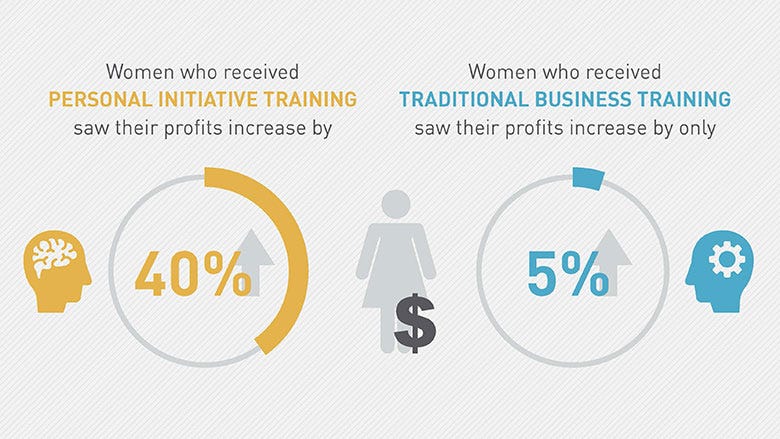
One example is Leila Salifou, a restaurant owner in Togo, who was able to dream big and follow through due to this highly-innovative business training. “I used to have my own little restaurant like the nice ladies at the side of the road. But we wanted our business to evolve and, why not, serve one day heads of State,” says Leila.
Very different than traditional business courses, the Personal Initiative program emphasizes the mindset of being proactive, innovative, and creative in identifying business opportunities, setting achievable goals, analyzing the situation once there is some feedback, and overcoming difficulties.

In the words of the initiator of the program, Professor Michael Frese, “if you have those three things: you’re self-starting, you overcome barriers and you’re also very good in thinking long-term about issues, once you do that, then you are much more successful.”
Today, Leila Salifou is not only an accomplished restaurant owner but also caters to meals for ministerial and organizational events. On top of that, she has built a guided-tour company on the side and is planning on launching a workshop that trains young women in traditional Togolese cuisine.
“If I had not had this training, I would have always been one of those good ladies along the side of the road. Now I’m sure that I am building a lasting business that my children and grandchildren will be able to take over when I’m no longer there,” she says.
Original research: https://www.annualreviews.org/doi/full/10.1146/annurev-orgpsych-031413-091326


