
The Confusion of Being Black but Told ‘You Talk Like a White Boy’
Because without context, this hurts — so think about the impact of your words
When I was 16 years old, I worked at a video store. Instead of cutting lawns or flipping burgers like many kids my age, I wore a snazzy polo and stood behind a big counter. Four days a week, I watched movies and convinced people to buy a family plan membership and the big-ass bag of Twizzlers next to the register. It remains the sweetest gig of my working life.
During one Sunday morning shift, a couple I hadn’t seen before walked in. Getting new members to sign up was my favorite part of the job, so I quickly welcomed them, and encouraged them to look around and let me know if they had any questions. We had a brief exchange about what films had just been released for rental, how long they could keep tapes, and all the usual topics that people ask on the first visit.
As I finished up the husband’s last question, a slow smile grew on his face. It was the kind of smile that makes clear that someone is ready to hit you with an unsolicited opinion that they probably shouldn’t share. The kind of smile that waits for silence. As soon as he got the chance, he struck.
“You talk like a White boy,” he said. “Why do you sound so White?”
It wasn’t the first time I had been asked that question. Black kids — and even some bold White ones — asked me that all the time in school. They twisted their faces in disgust and confusion; their eyes picked me apart like I was some gross racial anomaly. The question would hit me like a sucker punch, landing in my stomach with cold, nauseating pain.
In the ’90s, my teen infatuation with dad jokes and yielding to The Gap’s incessant khaki ads made me a moving, apparently whitewashed target.
No matter how many times I heard it, the question still broke my heart. That’s because it was never a question; it was a verdict.
I was guilty of being a first-degree sellout.
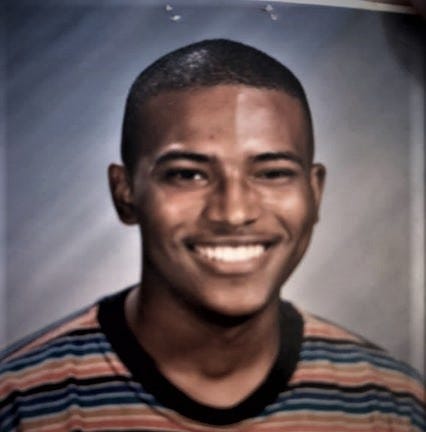
To be a Black American and describe the modern era as “post-racial” is an exercise in folly. There is no birthright, pedigree, education, or level of wealth that will divorce a Black person from their identity. I can’t be just a guy. I am a BLACK guy. And I’ve been a Black student, a Black teen, and a Black video store clerk. My race will always precede me; it’s bonded to me forever.
Thanks to Alfonso Ribeiro’s incredible turn as Carlton Banks on The Fresh Prince of Bel-Air, my generation had this perfect model of a brother dipped in Hollandaise sauce, desperately trying to find acceptance in the world around him. And in the ’90s, my teen infatuation with dad jokes and yielding to The Gap’s incessant khaki ads made me a moving, apparently whitewashed target.
To that judge and juror in the old-dude tracksuit and Kangol hat at the video store, I just responded with some defensive yet charming joke. He chuckled, and at that moment, gave me the break I needed to escape the counter; I had a stack of videos to restock. A co-worker had arrived for the afternoon shift by the time the couple selected their movies, so she walked them through the membership sign-up. When I heard the chime of the door as they exited, the crashing waves I now know as anxiety finally ebbed in my stomach.
Over the years, every time someone asked me that embarrassing question, I tried hard to work through these accusations of “talking White.” In moments of twisted self-reflection, I’d analyze what I could have done to be less odd and more, well, Black, I guess. “What did I say,” I’d ask myself. “Was my voice too high pitched? Was I too cheerful? Too friendly?” I could never figure out the answers, so I felt ashamed, confused, and alone.
Now that I am older, I hear the words differently. I absorb them through the texture of my experiences, and I have a better understanding of the difference between what people say and what they mean. Looking back, I bet that man in my video store thought he was trying to tell me that I could stop “talking White” and just be me in my own skin. Perhaps he meant to say that I should be proud of my heritage and all that comes with it. Maybe he wanted to stop me from going down a path of self-hatred and cultural denial. But like many conversations between a teen and an adult, there was much left unexplained, open to misinterpretation.
I used to think I was the victim any time I retold that story from the video store, but now I see it as a lesson. It taught me to remember that my words can have an impact that I may never fully understand. And it’s why, today, I try so hard to choose them wisely.