
You Should Love Imposter Syndrome
Don’t fake it, embrace it.

Everyone feels like an imposter sometimes, and that’s okay.
I think we’ve all had that feeling. You walk into a room and it feels like all eyes are on you. It’s like you can read their minds. They’re thinking: You don’t belong.
The others are so smart, polished, successful. You are nowhere near as good as these people. They are going to find out you are a fraud in 2-seconds flat. You are an imposter.
We’ve all heard the term “fake it ’til you make it”, but is that really the best advice?
You are not the smartest in the room, and that’s okay
When starting anything new (a job, a business, a sport) those around you are going to be better than you, and that’s okay!
Imposter syndrome is often described as Case 1(below), where others know far less than you think and you know far more than you think.
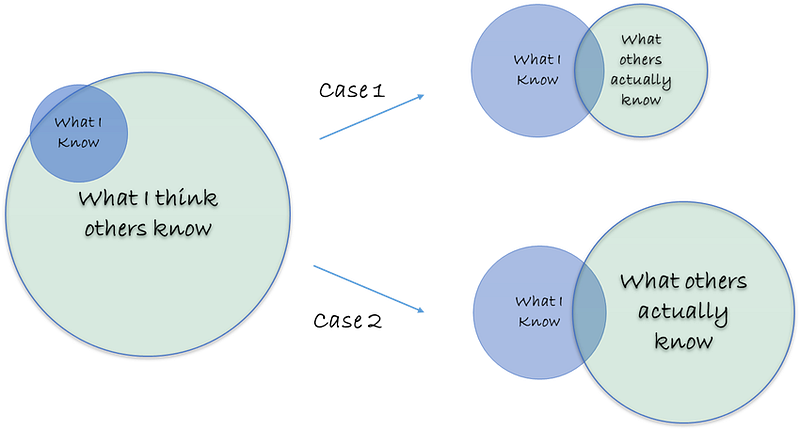
However, often Case 2 (above) is more accurate. Those around you DO have much more knowledge than you do, and you probably shouldn’t fake it to fit in.
Here’s why:
You won’t learn anything
Most of us aren’t mind readers. If you pretend to know everything, no one is going to help you.
When I started grad school, I was overwhelmed with imposter syndrome. I tried my best to fit in with the experienced Ph.D. students, pretending I knew just how to go about my research.
The truth was, I didn’t even know where to start. How was I supposed to solve some scientific mystery of the universe? How do I know what experiments to run first?
I thought I would figure it out on my own eventually and no one would find out I didn’t belong. The longer I pretended, the more disconnected I felt from my peers.
When I finally broke down and admitted I didn’t know where to start, I was flooded with support:
“None of us knew where to start! We were all taught by more experienced students!”
With their help, I was quickly back on track with my research. Plus, I gained some awesome friends.
Remember: People are generally thrilled to pass on their knowledge but, you need to ask for support first.
You could ruin your reputation
Getting caught in a lie can be detrimental to your career.
My colleague once interviewed a candidate that had obviously embellished his resume. He pretended to have several years of leadership experience when in reality he had only worked on group projects in college classes. When confronted about the lie, he said:
“Everybody does it! I wouldn’t have got an interview otherwise!”
Needless to say, he was not hired. It was an entry-level position, the company was not expecting years of experience but, being caught in a lie instantly ruined his job prospects.
Remember: Honesty and authenticity are extremely valued in all businesses. It is fine to be a beginner, don’t lie about your experiences.
Faking it is exhausting
The more you fake it, the less satisfied you will feel at the end of the day.
Pretending biologically consumes more energy, more brainpower. Tie that in with sweaty palms and a racing heartbeat from the nerves, you are well on your way to a meltdown.
“Wearing a mask wears you out. Faking is fatiguing. The most exhausting activity is pretending to be what you know you aren’t” — Rick Warren
Remember: Faking it is a short term solution. It is more important to build true relationships for long-term success.
How can you be confident without faking it?
You can physically change your body chemistry and boost confidence in a couple of ways.

Superhero pose
This was popularized by an episode of Grey’s Anatomy but it is also backed by numerous scientific studies.
Standing in an open pose, with your hands on your hips (like a superhero) or up in a “V”, are known as high power poses. Closed poses, such as having your arms crossed, are known as low power poses.
Studies demonstrated that after 2 minutes of posing, “high-power posers showed an 8% increase in testosterone, whereas low-power posers had a 10% decrease in the hormone.”
Testosterone increases feelings of confidence, therefore, high power poses are natural performance enhancers!
Interestingly, power posing also decreases the stress hormone, cortisol. So, standing in a high power pose for 2 minutes will leave you more confident and less stressed!
Next time you feel imposter syndrome coming on, try a superhero pose (just maybe not in front of everyone).
Meditation
Studies show that meditation practice significantly impacts several hormones. Notably, it can decrease our stress hormone (cortisol) and increase our happy hormone (serotonin).
During meditation you are taught to accept your mind as it is. No matter how you are feeling, this is part of being human! Relish in this shared human condition.
If you are feeling nervous, know that’s okay. If you are feeling intimidated, know that’s okay. If you are feeling like an imposter, know that’s okay.
In accepting the mind as it is, and not judging ourselves, we lift the expectations we have placed on ourselves.
Meditation also teaches us to stay grounded in stressful situations. This is a technique I like to use during interviews.
When I feel stress building in my body, I bring my attention to my feet on the floor or my bum in the chair. Then, take a deep breath.
Often, this quick distraction allows me to refocus my brain on the task at hand instead of getting lost in my anxiety.
So, try meditation! It can be a great tool to deal with the stress that comes with imposter syndrome.
Finally, remember:
Being in uncomfortable situations is beneficial!
When you feel imposter syndrome coming on, it is likely because you are trying to do something you have never done before. It easy to be intimidated by others and feel the urge to fake it. But instead, be true to yourself and enjoy the learning journey.
“Move out of your comfort zone. You can only grow if you are willing to feel awkward and uncomfortable when you try something new” — Brian Tracy


