avatarAmritha Ram

Summary

The text reflects on the divergence of perspectives within a relationship, where one party perceives in absolutes while the other sees nuances, leading to an inevitable parting of ways.

Abstract

The poem "You See Grey" delves into the contrasting worldviews of two individuals in a relationship that has reached a crossroads. The speaker acknowledges the starkness of their own black-and-white vision against their partner's appreciation for the subtle shades of grey. Over time, the couple's once harmonious alignment has faded, with the speaker having suppressed their true feelings for years. The partner's magnetic personality and the speaker's own attempts to cultivate a sense of self have been overshadowed by the realization that their fundamental perceptions are irreconcilable. Despite the emotional turmoil and the silent acceptance of growing apart, the speaker does not view the end of the relationship as a tragic event but rather as a natural progression. The poem captures the essence of personal growth and the bittersweet acknowledgment that sometimes, even the most profound connections must come to an end to preserve the integrity of both individuals' hearts and identities.

Opinions

  • The speaker has a binary view of the world ("I see black and white"), which starkly contrasts with the partner's ability to perceive gradations ("you see twilights, and shades of grey").
  • There is a sense of regret and nostalgia for the loss of a once-shared vision and the synchronized rhythm of their lives.
  • The speaker admits to concealing their inability to see beyond the dichotomy of "in and outside," suggesting a past reluctance or inability to communicate their true perspective.
  • The poem implies that the speaker has grown and evolved, hinting at a suppressed identity that was overshadowed by the partner's strong personality.
  • The imagery of nature ("The tulips will burgeon, the Ferris will continue to turn") symbolizes the continuous cycle of life and growth, independent of the relationship's outcome.
  • The speaker acknowledges the presence of superficiality and falsehoods in their interactions, which have contributed to the relationship's demise.
  • The poem suggests that the relationship has become prosaic and numbing, lacking the depth and authenticity it once had.
  • The speaker values honesty and emotional preservation over maintaining a relationship that no longer serves either party ("to protect two good hearts").
  • The use of phrases like "misplaced voice" and "unsought" indicates a history of the speaker's voice being unheard or dismissed within the relationship.
  • The final lines reiterate the fundamental difference in perception, emphasizing the unbridgeable gap that has led to the relationship's end.

You See Grey

A long overdue parting of ways
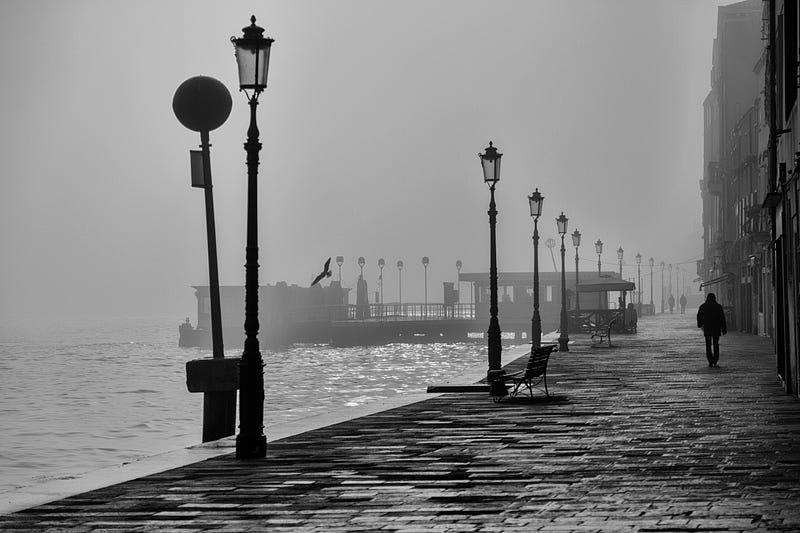
Photo by Philippe Mignot on Unsplash

I see black and white, night and day, But you see twilights, and shades of grey.

Nothing is won, and no one is sacred. Our tendencies to align are regrettably dated. You saw the window, and I tried to hide, That I saw nothing but in and outside.

Seven blind years, I proudly parroted you, I couldn’t whisper even to a reflector, that it was simply all I knew. You draw people in, a raw magnetism difficult to grow, But slowly it bloomed, those seeds of identity I’d repeatedly tried to sow.

The tulips will burgeon, the Ferris will continue to turn, But to protect two good hearts, should we this charade adjourn? I’m in seas of blue and green, paddling some swirls of pink The current of empty and wasted words now elicit only a blink.

Eyes mindlessly studying the concrete, scrutinizing the earnest spider, The chasm between the differences and desires breaking apart dangerously and wider But yet, not once was there a hint of resistance, when frustration and tolerance crept up toward the ceilings, I suppose it’s quite simply, the desperate yearning to spare another’s feelings.

Despite this, I would not describe it as a mirthless and suffocating black pit, That seems a bit extreme, I think it’s prosaic and jading, even numbing, just a bit. The walls still slapped with polaroids of scarves flying before bridges on a windy day, Seems like one just outgrew the adolescent memories, the other won’t cease to replay.

And so we arrive at this juncture, friend, where I must look you in both dark eyes, We started off with footsteps in faultless rhythm, but now the sounds we hear are superficial — they’re lies. It took this long, because of a misplaced voice, unsought as it always was Hidden by distracting shiny spots, wiped clean down to a new slate now, because,

I see black and white, night and day, But you see twilights, and shades of grey.

Poem
Poetry
Partnerships
Relationships
Difference
Recommended from ReadMedium