
You Said ‘Race’, but Are You Actually Talking About Race?
Ask an Ally: I don’t understand what people mean when they say that “race is not biological, it’s a social construct.”
This is a series of posts designed to help people approach diversity and inclusion. These are questions and scenarios we’ve actually heard or seen in the wild. This is part of our corporate programming for Diversity, Equity and Inclusion. For more information, click here.
Question:
I don’t understand what people mean when they say that “race is not biological, it’s a social construct.” Skin color differences are biological and they are obviously real, not just something that society made up. What am I missing? I want to be anti-racist, but I am struggling to even get out of the gate on this issue.
Answer:
There are so many people in your shoes and I was one of them. Until I became an anthropologist, I thought that “race” was just a patterned variation in human biology that points to a person’s recent geographic ancestry. My poorly melanized skin, grayish eyes, and dirty blond hair make it easy for anyone to guess that lots of my recent ancestry came out of Europe, and to see that I’m white. To me, all that was just race.
No, I wasn’t completely naïve about white supremacy before I got into anthropology (though, in my Florida childhood, I was taught the lie that the Civil War was fought over states’ rights and not slavery). And no, I never believed that there were distinct, natural “kinds” of humans as if we’re living some Tolkien or Star Trek mythology here.
Still, before I became an anthropologist, I didn’t grasp the important distinction between human biological variation and “race.” And that’s probably got a lot to do with my whiteness. And it’s also because of the power of the myth/lie that is “race.”
My wrongly believing that race was skin color variation made it challenging for me to also know that race is an arbitrary made-up label, a social construct like money. For some time, I felt like I was holding two separate truths until I finally got the message about “race” and it all made sense. That is, I had to lose common sense about “race” to start to make actual sense of race.
What really helped was shifting my mental conception of race to always include racism. (1)
Then I could no longer imagine using the term “race” as a stand-in or substitute for whatever I was really talking about, like the evolution of geographic variation in skin color or disease resistance, etc. Race isn’t some sort of neutral, natural trait of a person, inherent in their ancestral or inherited biology. Instead, race is a societal system, a force that is projected onto a person.
Making the mental shift from “race” to race/racism is easy once you learn the history of “race” science — by which so many 18th, 19th, and 20th Century European and American men naturalized existing beliefs about the hierarchical ranking of separate human “races.” “Race” science was never an objective approach to explaining human diversity; it was never an innocent project. It justified a political and economic hierarchy, a colonial settler mentality with “superior” humans reigning over, oppressing, enslaving, and exterminating “inferior” ones. “Race” science was the earliest science of human biological variation and its evolution, parlayed visible differences in traits like skin color and head shape into ipso facto evidence for invisible ones like intelligence. “Race” science was responsible for eugenics and its uptake by Nazis. “Race” science-supported (with no evidence) “anti-miscegenation” laws into the 20th Century. Unfortunately, by the21st Century, that “science” isn’t ancient history.
Due in large part to “race” science, and also due to political and religious traditions that have long converged on the same baloney, many Americans believe the myth/lie that is “race.” They think they know what race is, but they’re thinking of “race.”
Before (or without) doing the readings, I often hear some of my students say things like, “we may be different races but we can eradicate racism” or “so what if we’re different, we can be kind!” And these are wonderful, hopeful sentiments, but they’re broadcasting their ignorance about race.
They believe that if we all just decide that different “races” are equal, then racism will end. But, believing the biological concept of “race” prevents the latter because it is racist. I know that sounds overly harsh to people who don’t yet understand, but it is the truth. No matter how kind or fair you behave towards people, if you believe the myth/lie of “race” then you are doing racism.
About this phenomenon, author Ibram X. Kendi writes,
Biological racism rests on two ideas: that the races are meaningfully different in their biology and that these differences create a hierarchy of value. I grew up disbelieving the second idea of biological racial hierarchy, which conflicted with the biblical creation story I’d learned through religious study, in which all humans descend from Adam and Eve. It also conflicted with the secular creed I’d been taught, the American creation story that ‘all men are created equal.’ My acceptance of biological racial distinction and rejection of biological racial hierarchy was like accepting water and rejecting its wetness [emphasis added]. But that is precisely what I learned to do, what so many of us have learned to do in our dueling racial consciousness. Biological racial differences is one of those widely held racist beliefs that few people realize they hold — nor do they realize that those beliefs are rooted in racist ideas.
(from How to Be an AntiRacist)
A crucial component of anti-racism is countering the myth/lie of natural, biological “races.” Knowing that biologically-based, or natural, “race” is a myth/lie is not to deny the reality of biological variation that patterns roughly according to the geography of our recent ancestors. But race is not biological variation.
Race is a system of oppression and so it causes biological variation due to its negative impact on people’s health and development. Skin color is not a system of oppression, neither are genes, ancestry, or ethnicity. Race is not synonymous with skin color, genes, ancestry or ethnicity because race is a system of unequal power and oppression.
Race functions to justify a “natural” hierarchy of groups of people. American culture uses a similar myth/lie to naturalize gender and class inequities. These myths/lies entice us to be passive instead of making the cultural changes to bring justice and freedom of opportunity to all of us.
In Between the World and Me (which was made into a film), Black author Ta-Nehisi Coates says “They made us into a race. We made ourselves into a people.” I work his quote into my teaching on race because it bridges history with the present. It’s just two short sentences, but Coates helps us understand why race in America is the same thing as white supremacy. He helps us understand why people call our current society a white supremacist one and a racist one despite how kind people are to one another. Most importantly, though, Coates’ words affirm the experiences of people of color in this society: Black pride, Latinx pride, Indigenous pride, Asian pride, etc are not racist.
Race is the myth/lie that populations are biologically distinct, which leads us to believe that social, political, and economic inequities that pattern with race are just the natural consequences of differences in biology, which discourages us from changing the social and economic policies that perpetuate racial inequity. We must change our conception of race away from mere human biological variation towards a system of oppression. If we do, then it will be impossible to look away, and “moving on” from our history will be understood as actively changing the current social, environmental, educational, medical, and economic policies that perpetuate racism.
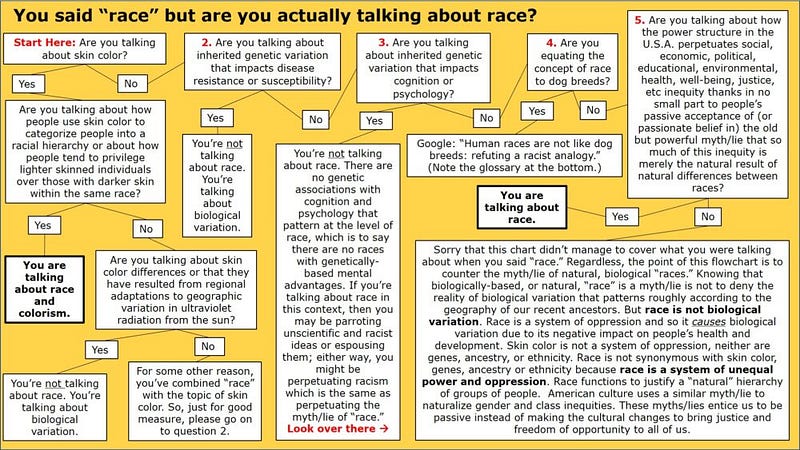
This is a flowchart that says, “You said race, but are you actually talking about race?” and then asks a series of questions as a way to think through what race is (constructed system of unequal power and oppression) and what race is not (biological variation, skin color, genes, ancestry, ethnicity).
(1) Shay-Akil Mclean (@hood_biologist) uses the term race/ism to convey their interconnection. From Rachel Watkins, I learned that McLean is doing so “in the DuBoisian tradition.”
Recommended Resources
This statement from the American Association of Biological Anthropologists (formerly AAPA) says it better than I can: https://physanth.org/about/position-statements/aapa-statement-race-and-racism-2019/
“Skin Color is an Illusion” by Nina Jablonski:
“Colorism and White Latinx Privilege”:
This is an excellent kids’ book that covers basically everything in this post, but more succinctly and with art:
Here is my colleague, Professor Agustín Fuentes, explaining what race is and is not: https://www.pbs.org/video/regional-voices-what-race-and-what-it-not-dr-agustin-fuentes/; and a version on YouTube:
“A Conversation with Native Americans on Race”:
“Letter from a Region in My Mind” by James Baldwin:
“The Problem with Race-based Medicine” by Dorothy Roberts:
“How to Write About Africa” by Binvayanga Wainaina
(Note the dark sarcasm which I’ve learned the hard way that I must point out):
“Ancestry Tests Pose a Threat to Our Social Fabric” by John Edward Terrell:
“Being Black in America Can Be Hazardous to Your Health” by Olga Khazan:
“Minor Feelings” by Cathy Park Hong:
“Ten Facts About Human Variation” by Jonathan Marks:
(This one’s a .pdf, 13 pages)
“Human Races are not like dog breeds: Refuting a racist analogy” by me and my colleagues (note the Glossary at the very bottom):
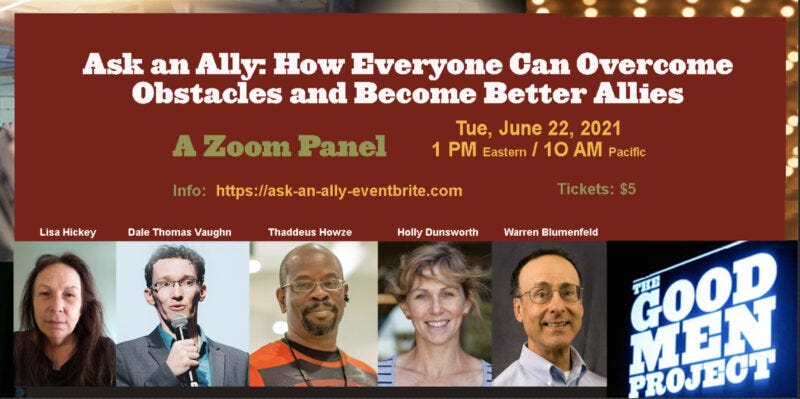
The author of the post, Holly Dunsworth, will be a panelist on our Zoom Panel on Tuesday June 22nd.
Get info and tickets here!
Read more from The Good Men Project on Medium:
The story was previously published on The Good Men Project.
About Holly Dunsworth
Holly Dunsworth, Ph.D. (Penn State) is a biological anthropologist at the University of Rhode Island where she teaches with new and original approaches aimed at overturning evolutionary misconceptions and outdated evolutionary dogma that students bring to college.


