avatarCaleb

Free AI web copilot to create summaries, insights and extended knowledge, download it at here

4507

Abstract

’t just a nice-to-have, it’s a necessity. You need to ensure that your contract executes its intended function while consuming the least amount of gas possible. This means careful planning of your functions, rigorous testing, and constant optimization.</p><p id="0dc4">In the example we walk through today, our <code>sayHello</code> function don’t modify the state of the contract, making it a <code>pure</code> function that costs less gas. But as you explore more complex contracts and operations, the cost will inevitably rise.</p><p id="d067">Remember, optimizing gas consumption isn’t just about saving costs — it’s also about building sustainable, scalable, and eco-friendly DApps.</p><h1 id="fc54">Step 6: Compile the Contract</h1><p id="baec">On the left-side panel, click on the “Solidity compiler” tab. Select the same compiler version you used in your code (0.8.20), then click the “Compile HelloWorld.sol” button. If there are no errors, your contract has been compiled successfully!</p><figure id="6b9c"><img src="https://cdn-images-1.readmedium.com/v2/resize:fit:800/1*rJrHsYy8K6VkxD2pFOKkkw.png"><figcaption></figcaption></figure><h1 id="81e7">Step 7: Deploy the Contract</h1><p id="e9b5">In the left-side panel, click on the “Deploy & run transactions” tab. In the “Environment” dropdown, select “Remix VM (Shanghai)”. This option refers to the Ethereum Virtual Machine (EVM) provided by Remix.</p><p id="5ac5">Please note that these options can change over time as the Remix IDE is updated and improved. Always choose the environment that best suits your current development needs.</p><p id="3532">Under the “Contract” dropdown, select your contract (<code>HelloWorld</code>), and click on the "Deploy" button. Your contract will now be deployed on the Remix VM (Shanghai) test network.</p><figure id="58f3"><img src="https://cdn-images-1.readmedium.com/v2/resize:fit:800/1*QVWN_ysEx5d0NbTfVsu7nw.png"><figcaption></figcaption></figure><h1 id="e211">Step 8: Interact with the Contract</h1><p id="a190">Once the contract has been deployed, you’ll see it listed under the “Deployed Contracts” section in the lower part of the “Deploy & run transactions” tab. Click on the small arrow next to your contract name <code>HelloWorld</code>, and a dropdown menu will appear.</p><p id="1786">Here’s where the fun begins — you get to interact with your smart contract!</p><figure id="54c2"><img src="https://cdn-images-1.readmedium.com/v2/resize:fit:800/1*0662YGzb9H_vot9eniCeWg.png"><figcaption></figcaption></figure><p id="aea0">You’ll see your <code>sayHello</code> function listed. Click on the blue button labelled <code>sayHello</code>. This button triggers the <code>sayHello</code> function that we've previously defined in our contract.</p><p id="cd7f">Upon clicking, the output will be displayed below in the Remix IDE console. If everything is implemented correctly, it should display “Hello, World!” — the string we instructed our function to return.</p><figure id="a607"><img src="https://cdn-images-1.readmedium.com/v2/resize:fit:800/1*bXPJ_P8-QqR84mX6MWuOBQ.png"><figcaption></figcaption></figure><p id="68c5">Congratulations! You’ve just interacted with your very first Ethereum Smart Contract!</p><p id="02bf">That’s all it takes to write and deploy your first Ethereum Smart Contract! Yes, you read it right. It’s that simple, thanks to the power of the Remix IDE.</p><p id="d4c5">Just remember, this is only the beginning. The world of blockchain development and smart contracts is vast and ever-evolving. There’s always something new to learn, be it a new library, a development tool, or even an entirely new concept.</p><p id="581c">But, with this step-by-step guide, you now have skills to start your journey. So, keep experimenting, keep learning, and keep building. The decentralized future is in the hands of developers like you.</p><p id="0058">Are you ready to take the leap? Your blockchain adventure awaits!</p><p id="7d6e"><i>Here are some resources for you to dive deeper into Solidity and smart contract development:</i></p><ol><li><b><i>Solidity Documentation: </i></b><i>This is the official documentation for the Solidity language, it covers everything from basics to advanced topics. A must-read for any aspiring Solidity developer. <a href="https://docs.soliditylang.org/">Solidity Docs</a></i></li><li><b><i>Remix Documentation:</i></b><i> Learn more about the Remix Ethereum IDE and its many features in their official documentation. <a href="https://re

Options

mix-ide.readthedocs.io/">Remix Docs</a></i></li><li><b><i>Ethereum and Solidity, The Complete Developer’s Guide: </i></b><i>This is a complete bootcamp course offered by Udemy. It covers all things Ethereum, Solidity, Data Structures, and Blockchain development. <a href="https://www.udemy.com/course/ethereum-and-solidity-the-complete-developers-guide/">Udemy Course</a></i></li><li><b><i>Ethereum Developer Tools List: </i></b><i>A comprehensive, community-driven list of essential Ethereum development tools, tutorials, and resources. <a href="https://github.com/ConsenSys/ethereum-developer-tools-list">Ethereum Dev Tools</a></i></li><li><b><i>OpenZeppelin:</i></b><i> A library for secure smart contract development. They offer reusable Solidity components to help developers build secure contracts. <a href="https://docs.openzeppelin.com/">OpenZeppelin Docs</a></i></li><li><b><i>Truffle Suite:</i></b><i> Truffle is a popular development framework for Ethereum that provides a suite of tools for smart contracts. <a href="https://www.trufflesuite.com/docs">Truffle Docs</a></i></li><li><b><i>Create and Deploy Your First Next.js Blockchain DApp with Solidity in Minutes:</i></b><i> This step-by-step tutorial on Medium takes you through the process of creating a decentralized application (DApp) using Next.js and Solidity. <a href="https://readmedium.com/create-and-deploy-your-first-next-js-blockchain-dapp-with-solidity-in-minutes-e24fe0a7c933">Medium Article</a></i></li><li><b><i>Master the Art of Ethereum Gas, Boost Your Blockchain Skills, and Save Money on Transactions:</i></b><i> Also on Medium, this comprehensive guide provides an in-depth look into the concept of ‘gas’ in Ethereum, and how understanding it can help you optimize your transactions. <a href="https://readmedium.com/master-the-art-of-ethereum-gas-boost-your-blockchain-skills-and-save-money-on-transactions-be795a16fbf7">Medium Article</a></i></li></ol><div id="c489" class="link-block"> <a href="https://medium.com/@calebpr/subscribe"> <div> <div> <h2>Get an email whenever Caleb publishes.</h2> <div><h3>Get an email whenever Caleb publishes. By signing up, you will create a Medium account if you don’t already have one…</h3></div> <div><p>medium.com</p></div> </div> <div> <div style="background-image: url(https://miro.readmedium.com/v2/resize:fit:320/0*pPSGj3ORvqLvuBYg)"></div> </div> </div> </a> </div><p id="91bd"><i>Enjoyed the read? For more on Web Development, JavaScript, Next.js, Cybersecurity, and Blockchain, check out my other articles here:</i></p><div id="7e3a" class="link-block"> <a href="https://readmedium.com/a-roadmap-to-my-medium-writings-fd04e14cffd7"> <div> <div> <h2>A Roadmap to My Medium Writings</h2> <div><h3>undefined</h3></div> <div><p>undefined</p></div> </div> <div> <div style="background-image: url(https://miro.readmedium.com/v2/resize:fit:320/1*FO4S90VIpPA05s9cP-gFPQ.png)"></div> </div> </div> </a> </div><p id="8496"><i>If you have questions or feedback, don’t hesitate to reach out at [email protected] or in the comments section.</i></p><p id="c73a"><i>[Disclosure: Every article I pen is a fusion of my ideas and the supportive capabilities of artificial intelligence. While AI assists in refining and elaborating, the core thoughts and concepts stem from my perspective and knowledge. <a href="https://readmedium.com/how-does-ai-help-me-write-my-articles-5df265d16527">To know more about my creative process, read this article.</a>]</i></p><div id="a005" class="link-block"> <a href="https://readmedium.com/how-does-ai-help-me-write-my-articles-5df265d16527"> <div> <div> <h2>How Does AI Help Me Write My Articles?</h2> <div><h3>The Medium landscape has seen a transformation, with an increasing number of articles appearing to have the distinct…</h3></div> <div><p>medium.com</p></div> </div> <div> <div style="background-image: url(https://miro.readmedium.com/v2/resize:fit:320/1*sURudlO3SS5ntthELFumcg.jpeg)"></div> </div> </div> </a> </div></article></body>

You Only Need 15 Minutes to Write Your First Ethereum Smart Contract — Here’s How

Do you want to dive into the bustling world of blockchain development? You’re in the right place! Today, we’re going to take a deep dive into writing your very first Ethereum Smart Contract using the Remix IDE. But before we jump right in, let’s clear the air about what exactly these terms mean.

Ethereum is a global, open-source platform for decentralized applications. On Ethereum, you can write code that controls digital value, runs exactly as programmed, and is accessible anywhere in the world.

A Smart Contract is a self-executing contract with the terms of the agreement directly written into code. It is stored on the blockchain and automatically carries out the terms when conditions are met.

The Remix IDE is a powerful open-source tool that helps you write Solidity contracts straight from your browser.

Now, let’s get started!

Step 1: Access the Remix IDE

First, head over to Remix Ethereum using your web browser. The interface you’ll see is the Remix Integrated Development Environment (IDE), a one-stop-shop for writing, testing, and deploying smart contracts.

Step 2: Create a New File

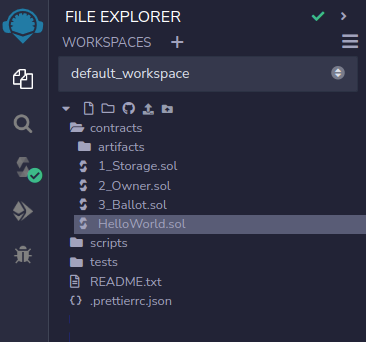
In the left-side panel, you’ll find the “File Explorers” tab. Click on “contracts”, then create a new file. Name your file HelloWorld.sol. The .sol extension is used for Solidity files.
Step 3: Set the Solidity Version

At the top of your new file, specify the Solidity version you’re using. We’re going to use the latest stable release, in May 2023, which is version 0.8.20.

// SPDX-License-Identifier: GPL-3.0
pragma solidity ^0.8.20;

Step 4: Define the Contract

Next, we define the contract. A contract in Solidity is a collection of code (its functions) and data (its state) that resides at a specific address on the Ethereum blockchain.

// SPDX-License-Identifier: GPL-3.0
pragma solidity ^0.8.20;

contract HelloWorld {
    
}

Step 5: Create a Function

Inside the contract, we’re going to create a function called sayHello. This function will return a string "Hello, World!".

// SPDX-License-Identifier: GPL-3.0
pragma solidity ^0.8.20;

contract HelloWorld {
    function sayHello() public pure returns (string memory) {
        return "Hello, World!";
    }
}

Let’s break this down:

  • function declares a function.
  • sayHello is the name of the function.
  • public means that anyone can call this function.
  • pure promises that the function will not alter the contract's state.
  • returns (string memory) indicates that the function will return a string.

In the realm of Ethereum, every operation comes with a price — this price is what we call “gas.” Gas represents the computational effort required to execute operations on the Ethereum network. The more complex your operations, the more gas it will consume, and thus, the more Ether you will need to pay. This is especially true for functions that modify the state of the contract, which tend to be more costly.

For this reason, writing efficient, optimized Solidity code isn’t just a nice-to-have, it’s a necessity. You need to ensure that your contract executes its intended function while consuming the least amount of gas possible. This means careful planning of your functions, rigorous testing, and constant optimization.

In the example we walk through today, our sayHello function don’t modify the state of the contract, making it a pure function that costs less gas. But as you explore more complex contracts and operations, the cost will inevitably rise.

Remember, optimizing gas consumption isn’t just about saving costs — it’s also about building sustainable, scalable, and eco-friendly DApps.

Step 6: Compile the Contract

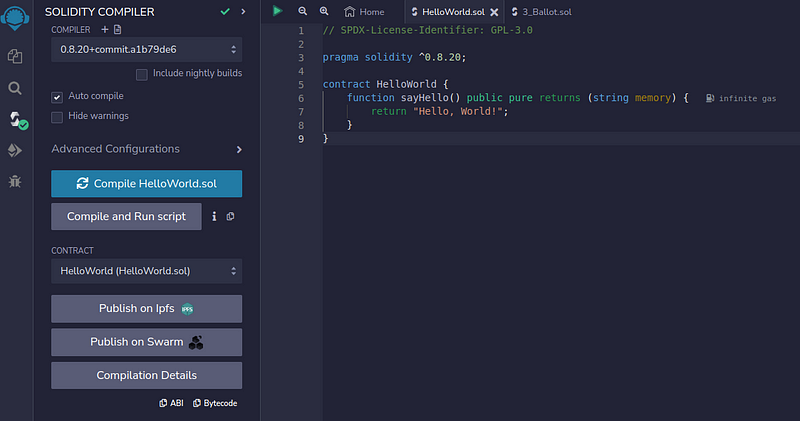
On the left-side panel, click on the “Solidity compiler” tab. Select the same compiler version you used in your code (0.8.20), then click the “Compile HelloWorld.sol” button. If there are no errors, your contract has been compiled successfully!
Step 7: Deploy the Contract

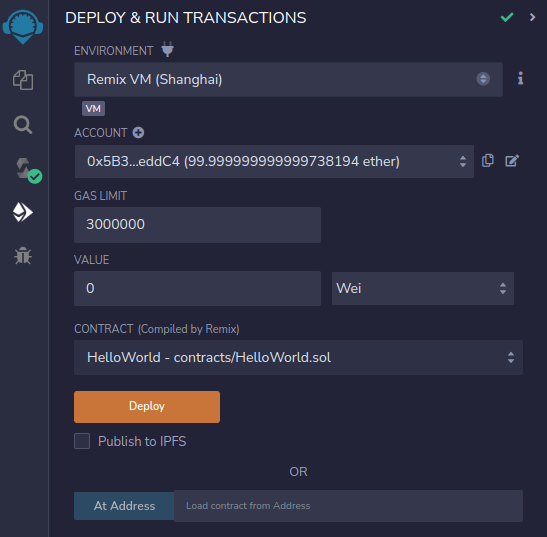
In the left-side panel, click on the “Deploy & run transactions” tab. In the “Environment” dropdown, select “Remix VM (Shanghai)”. This option refers to the Ethereum Virtual Machine (EVM) provided by Remix.

Please note that these options can change over time as the Remix IDE is updated and improved. Always choose the environment that best suits your current development needs.

Under the “Contract” dropdown, select your contract (HelloWorld), and click on the "Deploy" button. Your contract will now be deployed on the Remix VM (Shanghai) test network.
Step 8: Interact with the Contract

Once the contract has been deployed, you’ll see it listed under the “Deployed Contracts” section in the lower part of the “Deploy & run transactions” tab. Click on the small arrow next to your contract name HelloWorld, and a dropdown menu will appear.

Here’s where the fun begins — you get to interact with your smart contract!
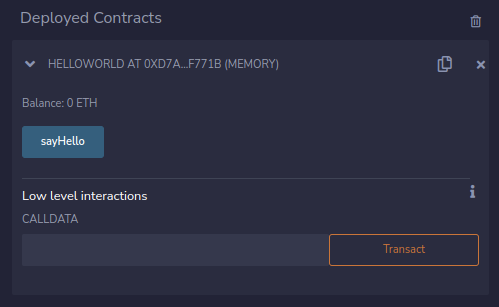
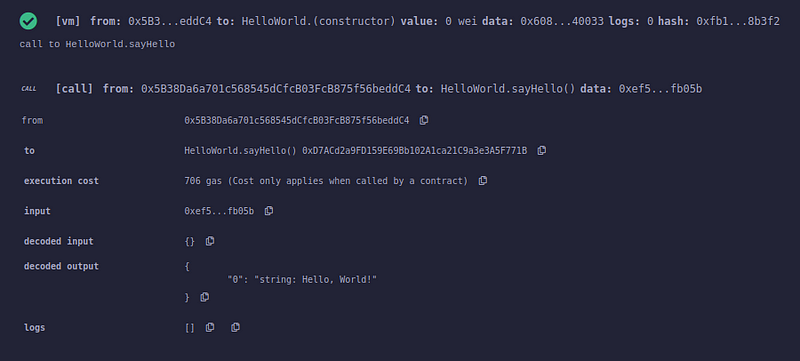
You’ll see your sayHello function listed. Click on the blue button labelled sayHello. This button triggers the sayHello function that we've previously defined in our contract.

Upon clicking, the output will be displayed below in the Remix IDE console. If everything is implemented correctly, it should display “Hello, World!” — the string we instructed our function to return.
Congratulations! You’ve just interacted with your very first Ethereum Smart Contract!

That’s all it takes to write and deploy your first Ethereum Smart Contract! Yes, you read it right. It’s that simple, thanks to the power of the Remix IDE.

Just remember, this is only the beginning. The world of blockchain development and smart contracts is vast and ever-evolving. There’s always something new to learn, be it a new library, a development tool, or even an entirely new concept.

But, with this step-by-step guide, you now have skills to start your journey. So, keep experimenting, keep learning, and keep building. The decentralized future is in the hands of developers like you.

Are you ready to take the leap? Your blockchain adventure awaits!

Here are some resources for you to dive deeper into Solidity and smart contract development:

  1. Solidity Documentation: This is the official documentation for the Solidity language, it covers everything from basics to advanced topics. A must-read for any aspiring Solidity developer. Solidity Docs
  2. Remix Documentation: Learn more about the Remix Ethereum IDE and its many features in their official documentation. Remix Docs
  3. Ethereum and Solidity, The Complete Developer’s Guide: This is a complete bootcamp course offered by Udemy. It covers all things Ethereum, Solidity, Data Structures, and Blockchain development. Udemy Course
  4. Ethereum Developer Tools List: A comprehensive, community-driven list of essential Ethereum development tools, tutorials, and resources. Ethereum Dev Tools
  5. OpenZeppelin: A library for secure smart contract development. They offer reusable Solidity components to help developers build secure contracts. OpenZeppelin Docs
  6. Truffle Suite: Truffle is a popular development framework for Ethereum that provides a suite of tools for smart contracts. Truffle Docs
  7. Create and Deploy Your First Next.js Blockchain DApp with Solidity in Minutes: This step-by-step tutorial on Medium takes you through the process of creating a decentralized application (DApp) using Next.js and Solidity. Medium Article
  8. Master the Art of Ethereum Gas, Boost Your Blockchain Skills, and Save Money on Transactions: Also on Medium, this comprehensive guide provides an in-depth look into the concept of ‘gas’ in Ethereum, and how understanding it can help you optimize your transactions. Medium Article

Enjoyed the read? For more on Web Development, JavaScript, Next.js, Cybersecurity, and Blockchain, check out my other articles here:

If you have questions or feedback, don’t hesitate to reach out at [email protected] or in the comments section.

[Disclosure: Every article I pen is a fusion of my ideas and the supportive capabilities of artificial intelligence. While AI assists in refining and elaborating, the core thoughts and concepts stem from my perspective and knowledge. To know more about my creative process, read this article.]

Solidity
Ethereum
Blockchain
Programming
Smart Contracts
Recommended from ReadMedium