
Addiction | Productivity | Life Lessons | Lifestyle
You Need to Stop Binge-Watching Right Away
What happens to you when you binge-watch
Have you ever sat down to watch just one episode of your favourite Netflix series and ended up watching the entire season and the whole day has gone by? Yes, you have at least one time. That’s the entire point of coming here.
"Why wait a week, a day, even an hour when you could watch new episode straight after the other in quick succession…?"
While our older generation usually partakes ones in a while, we — all the generations starting from millennials — do it way past our bedtime and in some cases all night. Yes, of course, I’m talking about binge-watching.
It’s no surprise that everyone’s doing it — sites like Netflix are practically designed with the genius idea of releasing all the episodes of an entire season at once encouraging you to watch everything in one sitting. So binge-watching has never been easier.
We no longer have to wait one more demanding week for the next episode of our favourite show like our parents. We have a massive library of shows and movies in one place, and you can watch as much as you want during your ‘free time’.
Since this habit of binge-watching has become one of the most popular ways of ‘consuming’ content, it might also be essential to consider how does it affect our mind and body?
More like ‘Netflix and kill’.
A study carried out by Osaka University, Japan with the data of approximately 86 000 Japanese men and women, aged 40 to 79, after a follow-up from 1988 to 2009 has discovered that prolonged television viewing was associated with an increased risk of pulmonary embolism death among Japanese.
According to the results, the people who regularly watched more than five hours of TV a day had a mortality rate two-and-a-half times higher than those who watched just two-and-a-half hours per day.
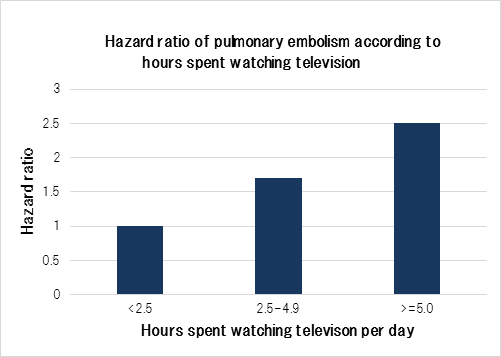
Even though this result is about watching television, and based on a dataset which is older than a decade, that doesn’t mean you have less risk.
Is that it?
Of course not.
According to Nursing Case Study, too much time spent sedentary or watching television will lead to a higher rate of obesity and type 2 diabetes. Every two hours, women spend watching television each day they have a 23% higher risk of becoming obese and a 14% greater chance of developing diabetes.
Also, researchers from the University of Queensland of Australia have found that for every hour you spend in front of a screen, your life shortens by 21.8 minutes.
After all of this information given, with all the screens we currently possess, and the time we spend with these screens chilling on the couch only increases the number of risks.
Simply, it is less ‘Netflix and chill’ and more ‘Netflix and kill’.
Netflix unveils binge statistics.
Netflix is notoriously shy at revealing their figures of viewership since the beginning. But in late 2017, Netflix themselves release surprising statistics about binge-watching. According to them, more than 8.4 million of their subscribers have ‘binge-watched’ an entire season of a show within the first 24 hours since its release.
Their figures also show that the countries with the most number of subscribers doing this are Mexico, Canada, the US, and Denmark.
While binge-watching, we don’t feel like we are distressing. It feels very satisfying to have the next episode waiting on the list for you. But, do you remember what happened last time when you finished watching the entire season last time? I think you do remember. You ended up being stressed out because your body is considering one more episode, which you don’t have.
This is the same feeling that more than 95% of that 8.4 million binge-watchers are going through. If you binge-watch at night, the next morning, you wake up feeling terrible, without the ‘kick’ to continue your habit.
More and more researches and surveys
Our lives may not depend on just how many hours you watch these shows. The people we are interacting with daily; our parents and siblings, friends, co-workers will also drastically shape who we are as a person. This shaping process is not only limited to people. Our food habits and the food we take, our sleep will also affect this process. This theory also applies to the screens we stare at.
For most of the day, the media which fills our minds could influence and define is in ways we never thought possible in this modern world.
Here are some highlights from several pieces of research done which will tell you how this ‘binge-watching’ habit is affecting our lives.
You are what you watch.
Let’s again look at the Netflix statistics of the year 2017 also. That was the same year they released the first series of ‘13 Reasons Why’.
The series revolves around high school student Clay Jensen and the aftermath of high school student Hannah Baker’s suicide, who leaves behind a box of cassette tapes in which she details why she chose to end her life.. — Wikipedia
After the release of the series, several mental health services and charities raised concern over the graphic nature of the series.
According to marketing analytics firm Jumpshot, ‘13 Reasons Why’ which is one of the most viewed Netflix seasons in the first 30 days had played a significant role in chilling 26% increase for the search ‘How to commit suicide?’
Another research was conducted in 1970, experimenting with addressing the effect of television programs we chose to give our attention. This experiment was conducted with two groups of randomly selected children aged 3 to 5.
Stephen Stack at Wayne State university did a little research to analyze the changes in suicide counts after the release of 13 Reasons Why. As a result, they found the rate has been increased by 12.4% for boys and 21,7% for girls when compared to previous months.
Another experiment showed that children who just watched Sesame Street once a month on television had gained 5.4 IQ points compared to the other control group which was given the privilege of continuing their old habit of watching television.
Researchers of the University of Toledo conducted research considering the television viewing habits of people who were identified as binge-watchers. Results showed a higher level of stress, anxiety, and depression than regular television viewers even though we feel great for the moment we are binge-watching.
Sleep is the competition.
Usually, we prioritize our habits. Sometimes we choose to go outside over reading a book inside. We decide to have coffee in the evening. We prioritize these habits, and there’s no doubt that sleep is one of the top five habits of them.
According to a survey published by the American Academy of Sleep Medicine shows a whopping 88% of U.S. adults admitted they had lost sleep due to staying up late to watch multiple episodes of a TV show or streaming series — and this number jumps to 95% when looking at 18–44-year-olds.
This result might not be too far-fetched, especially when the CEO of Netflix Reed Hastings, has publicly stated sleep as their competition.
Being in the Circle.
Watching the latest series has become the new way of participation in the public conversation. Knowing more about a television series is the key to being active in the conversation.
A poll RadioTimes conducted a few years back, 42% of people admitted to pretending they have seen a program when they haven’t seen. Breaking Bad was voted the show most people lied about having seen which is also a Netflix show.
Viewing — Eating.
Research is done at the University of Houston to examine how television use impacts nutritional views made an unsurprising discovery that the more undergraduate students watched television, the more they partook in unhealthy eating.
The real problem here is why we are willing and in fact, yearning to participate in something harmful to our both mental and physical health?
Watching these shows or movies is an increasingly enjoyable experience, and there’s a reason for that.
Science Behind
Let me ask you a question. Can you remember what was the thought came through your mind most of the time during your last binge session? “Just one more”, “Everyone else does it” … — if you had these thoughts, then you might be disturbed to know these are the same thoughts of an addict.
So what do a drug addict and a binge-watcher have in common? The answer is about something triggered in your brain when you are taking part in a fun activity. Indeed I’m talking about ‘Dopamine’.
Taking part in a fun activity triggers the release of dopamine in the brain, which rewards you with pleasure for doing the activity.
So much dopamine can be released when watching your favourite show that you experience a high and even addiction-like craving for the neurotransmitters.
Your brain likes to take a note of what triggered these tasty little dopamine bits and compels you to seek out the same pleasure gain and again and again.
This urge can be powerful and hard to control. So when you are enjoying the latest new series, your brain can’t get enough of this potent chemical. Your brain knows what it has to do to get more of it — makes your watch one more episode.
This process is the same that the brain goes through with addiction to drugs.
“The people we are interacting with on a daily basis; … will also drastically shape who we as a person … This also applies to the screen we are staring at”
How does this work?
In terms of processing data, the brain can react similarly to both real-life events and those being witnessed on screen.
This means that the characters we see on our favourite show are coded in the same way as our friends in real life. The same areas of your brain are stimulated, so you become entirely attached.
There’s a TED-Ed video that explains this process. According to that video, there are several different ways we identify with what we see.
- Wishful Identification: witnessing a world or environment that we wish to live in for excitement, power, prestige, and success.
- Parasocial Identification: Experiencing a one-way relationship with characters we see on screen and starting to feel the same feelings towards them.
- Perceiving Similarity: Events are similar to what we know, so we empathize with the characters or events being played out. (This one is considered as the most powerful one among all of these identifications.)
So, you can’t just say that you are watching your favourite show just for fun. You might be even living in that world unknowingly.
Another reason for binge-watching is for stress relief. If you are busy with things you don’t like, then its more likely for you to binge-watch.
Binge-watching helps us to forget about adverse events or pressure in our lives by immersing ourselves in different realities.
This engrossing feels like a solution to the stress problem from a different point of view. But, this positive effect of binge-watching does come at a cost when the session is over. The increased levels of dopamine can no longer be kept.
Your brain considers this as a loss because there are no more episodes to watch, and this can lead yourself into a situational depression. Your brain stimulation reaches a low point leaving you with an empty feeling.
Unless you regularly binge-watch with your close ones, there’s a risk of you being mentally isolated. This isolation will lead you to a much higher level of stress, anxiety, and depression.
Poor sleep quality which is already mentioned above is also a result of this phenomenon.
Eventually, you get trapped in a vicious cycle which sends your productivity through the floor and stops you from forming proper relationships.
Well, after all of these, you will be pleased to know there are some things you can do to beat this binging habit and combat negative consequences. Some of them may even improve your viewing experience.
But, you should keep in mind that you need an honest effort to beat a habit like this. If you only follow the instructions of those ‘influencers’ who always teach you yo abandon tedious work and always follow your desire and passion, this might be tough for you.
Here are the things you can do,
- Divide your binge-watching time into chunks by episodes. They may be either 30 minutes or 45 minutes long pieces. Remember to take a break. This will train your brain to control your dopamine levels and will prevent negative physical consequences.
- Do some pushups, go for a short walk, or do some stretches. Do something better than doing nothing during those breaks.
- Start ‘Dopamine Fasting’. This is one of the best techniques you can follow if you are already addicted to binge-watching.
If you still can’t control yourself,
- Seek professional support.
Final Thoughts
Finally, I want to convince you of something. There’s nothing wrong with these streaming platforms. There’s nothing wrong with Netflix. Netflix is obviously amazing. The problem is you; yourself.
Every generation had a problem like this. Television, drugs, social media have remained. We see ours as the biggest problem.
Every generation has a group that ends up being addicted. We should be mindful enough to decide where which group we should be in.
If there’s a way, tell someone about it. That’s all we can do.
Thank you.
References
[1]“Long-time Television Viewers have Higher Risk of Fatal Pulmonary Embolism”, ResOU, 2020. [Online]. Available: https://resou.osaka-u.ac.jp/en/research/2016/20160727_1. [Accessed: 03- Sep- 2020].
[2]“The Effect of Television Watching on Obesity”, NursingAnswers.net, 2020. [Online]. Available: https://nursinganswers.net/case-studies/the-effect-of-television-watching-on-obesity.php. [Accessed: 03- Sep- 2020].
[3]“Effect of Television on Obesity and Excess of Weight and Consequences of Health”, US National Library of Medicine National Institutes of Health Search database PMC, 2020. [Online]. Available: https://www.ncbi.nlm.nih.gov/pmc/articles/PMC4555288/. [Accessed: 04- Sep- 2020].
[4]“2017 on Netflix — A Year in Bingeing”, Netflix Media Center, 2020. [Online]. Available: https://media.netflix.com/en/press-releases/2017-on-netflix-a-year-in-bingeing. [Accessed: 04- Sep- 2020].
[5]“Are you still watching?” Correlations between binge TV watching, diet, and physical activity”, ResearchGate, 2020. [Online]. Available: https://www.researchgate.net/publication/323200056_Are_you_still_watching_Correlations_between_binge_TV_watching_diet_and_physical_activity. [Accessed: 04- Sep- 2020].
[6]“New survey: 88% of US adults lose sleep due to binge-watching”, American Academy of Sleep Medicine — Association for Sleep Clinicians and Researchers, 2020. [Online]. Available: https://aasm.org/sleep-survey-binge-watching-results/. [Accessed: 05- Sep- 2020].
[7]Use and Unhealthy Eating: The Mediating Role of Fatalistic Views of Eating Well and Nutritional Knowledge. 2014.[Online]. Available: http://communicationandhealth.ro/upload/number3/TEMPLE-NORTHUP.pdf [Accessed: 05- Sep- 2020].


