avatarTerry Day

Free AI web copilot to create summaries, insights and extended knowledge, download it at here

15410

Abstract

a> Author Marty Bernard Public domain Mel Finzer, the heirs of this work’s copyright holder (the creator), has released it into the public domain. This applies worldwide. <a href="https://en.wikipedia.org/wiki/Public_domain">Public domain — Wikipedia</a> <a href="https://commons.wikimedia.org/wiki/File:SP_5021_San_Bernardino,_CA_February_1972.jpg">File: SP 5021 San Bernardino, CA February 1972.jpg — Wikimedia Commons</a> I made no changes to this picture.</figcaption></figure><h2 id="1c7f">Following is a List of diesel locomotives used by Southern Pacific Railroad Company and its subsidiaries as described within the article series:</h2><h2 id="be33">Diesel locomotives</h2><p id="8762">(https://en.wikipedia.org/wiki/Southern_Pacific_Transportation_Company)</p><h2 id="3a9a">· ALCO PA</h2><p id="59fb">This locomotive was built to haul passenger trains. It was built in the United States in Schenectady, New York, by a partnership between ALCO and General Electric (GE) between 1946 and 1953. Two models were built, Model PA and Model PB; the PB was shorter than the PA.</p><p id="27d8">They shared many characteristics both in looks and machine capabilities. Both cab-equipped lead A unit PA and cabless booster B unit PB were built. The P indicates that they were geared for higher speeds and passenger use. The F noted that the locomotive had been being geared for freight use.</p><p id="bfa0">Many railroads used PA and FA locomotives for both freight and passenger service. Most PAs and PBs were scrapped, but five PAs have been preserved in railroad museums, and a single PB is still in service as a power car. <a href="https://en.wikipedia.org/wiki/ALCO_PA">https://en.wikipedia.org/wiki/ALCO_PA</a></p><figure id="fe9b"><img src="https://cdn-images-1.readmedium.com/v2/resize:fit:800/1*PYJbkn1jgT60rtqGGHK2sQ.png"><figcaption>File: D&H 19 at Newtonville, April 1978 postcard.jpg Description English: 1978 postcard of D&H 19 leading a train at Newtonville station. Source Scanned postcard from eBay auction: “LMH Postcard DELAWARE HUDSON Alco PA-1 D&H #19 Passenger Diesel B&M MBTA 1978 Author Norton Clark This work is in the public domain because it was published in the United States between 1978 and March 1, 1989, without a copyright notice, and its copyright was not registered with the U.S. Copyright Office within five years. <a href="https://en.wikipedia.org/wiki/Public_domain">Public domain — Wikipedia</a> <a href="https://commons.wikimedia.org/wiki/File:D%26H_19_at_Newtonville,_April_1978_postcard.jpg">File: D&H 19 at Newtonville, April 1978 postcard.jpg — Wikimedia Commons</a> I made no changes to this picture.</figcaption></figure><h2 id="db36">· EMC E2</h2><p id="fb8c">This American passenger train diesel-electric locomotive was built as a single unit with 1,800 horsepower from two 900-horsepower prime movers. These locomotives were operated as a unit set (A-B-B) or (A-B-A), where the three-unit lash-up develops 5,400 horsepower. This is almost ideal (6,000 horsepower is best) for a passenger train that pulls the cargo of 15–18 cars and runs the grades of nearly all the mileage between American cities.</p><p id="1f29">Two sets were made for named passenger trains. The first set was made for the City of San Francisco. The Union Pacific, the Chicago and North Western Railway, and the Southern Pacific Railroad owned the motive power sets. There are no E2 locomotives that survived, but there is a pair of Winton Model 201A V12 engines from SF-1 (the lead unit of the San Francisco set that was nicknamed Queen Mary) that were rescued from the scrap and became part of the artifacts at the California State Railroad Museum. One of these engines was transferred to the Illinois Railway Museum in Union, Illinois. <a href="https://en.wikipedia.org/wiki/EMC_E2">https://en.wikipedia.org/wiki/EMC_E2</a></p><figure id="6aea"><img src="https://cdn-images-1.readmedium.com/v2/resize:fit:800/1*QVXcRuJkh4J4roZOgoy5_g.png"><figcaption>File: the City of Los Angeles.JPG Description Postcard photo of the streamliner City of Los Angeles near Sterling, Illinois, and traveling along the Rock River. The train was operated between the Union Pacific and Chicago and North Western railroads until 1955, when the partnership changed to Union Pacific and the Chicago, Milwaukee, St. Paul, and Pacific (The Milwaukee Road) railroads Source eBay item card front card back Author Audio Visual Designs, Earlton, NY/Photo: Chicago and Northwestern Railway This work is in the public domain in the United States because it was published in the United States between 1928 and 1977, inclusive, without a copyright notice. <a href="https://en.wikipedia.org/wiki/Public_domain">Public domain — Wikipedia</a> <a href="https://commons.wikimedia.org/wiki/File:City_of_Los_Angeles.JPG">File: City of Los Angeles.JPG — Wikimedia Commons</a> I made no changes to this picture.</figcaption></figure><h2 id="99b5">· EMD E7</h2><p id="a982">The E7 was a 2,000-horsepower passenger train built by General Motors Electro-Motive Division in LaGrange, Illinois. Four hundred twenty-eight cab versions, or E7As, were built from 1945 to 1949. Eighty-two booster E7Bs were built from 1945 to 1948.</p><p id="e32f">The 2,000 horsepower came from two 12-cylinder model 567A engines. Each engine drove its electrical generator to power two traction motors on one truck. The E7 was the eighth model in a line of passenger diesels of similar design known as the E Model.</p><p id="720e">The Southern Pacific Company owned five of the A units and ten of the B units. The Pennsylvania Railroad E7A #5901 is the single surviving example of the E7. It underwent cosmetic restoration and is displayed indoors at the Railroad Museum of Pennsylvania. <a href="https://en.wikipedia.org/wiki/EMD_E7">https://en.wikipedia.org/wiki/EMD_E7</a></p><figure id="5f5a"><img src="https://cdn-images-1.readmedium.com/v2/resize:fit:800/1*_vnYSKONWgB694wcgQeP1w.png"><figcaption>File: RR76.37 №5901 Front Side.jpg Description English: The Pennsylvania Railroad 5901 at the Railroad Museum of Pennsylvania. The car is listed on the roster as RR76.37. Source Self-photographed Author Photo by and ©2015 Derek Ramsey (Ram-Man) This file is licensed under the Creative Commons Attribution-Share Alike 4.0 International license.<a href="https://creativecommons.org/licenses/by-sa/4.0/deed.en">CC BY-SA 4.0 Deed | Attribution-Share Alike 4.0 International | Creative Commons</a> <a href="https://commons.wikimedia.org/wiki/File:RR76.37_No._5901_Front_Side.jpg">File: RR76.37 №5901 Front Side.jpg — Wikimedia Commons</a> I made no changes to this picture.</figcaption></figure><h2 id="44dd">· EMD E8</h2><p id="3a01">The EMD E8 is a 2,250-horsepower passenger train locomotive built by General Motors’ Electro-Motive Division at LaGrange, Illinois. Four hundred fifty cab versions or E8As were constructed between 1949 and 1954. Of that number built, all went to the United States except three sold to Canada.</p><p id="52b7">48 E8Bs were built between 1949 and 1954 and sold to the United States. Like the E7s, the E8s were powered with the same 12-cylinder motors driving generators to power two traction motors on one truck. An estimate is that a total of 58 E8s have survived. Four Southern Railway E8s are preserved. <a href="https://en.wikipedia.org/wiki/EMD_E8">https://en.wikipedia.org/wiki/EMD_E8</a></p><figure id="a87b"><img src="https://cdn-images-1.readmedium.com/v2/resize:fit:800/1*5WkHh6W0DBkcxA1ewCjD4A.png"><figcaption>File: Rock Island locomotive 652.jpg Description English: Rock Island (CRIP) locomotive #652 Now owned and operated by the Midland Railway of Baldwin City. EMD model E8A — built in April 1952 “Rocket” maroon, orange, and aluminum paint scheme Photo taken by Russell Meier south of Baldwin City, Kansas, on the Midland Railway. This was a photo run by participants of the TRAIN convention charter. Author Russell Meier This file is licensed under the Creative Commons Attribution-Share Alike 3.0 Unported license. <a href="https://creativecommons.org/licenses/by-sa/3.0/deed.en">CC BY-SA 3.0 Deed | Attribution-Share Alike 3.0 Unported | Creative Commons</a> <a href="https://commons.wikimedia.org/wiki/File:Rock_Island_locomotive_652.jpg">File: Rock Island locomotive 652.jpg — Wikimedia Commons</a> I made no changes to this picture.</figcaption></figure><h2 id="f06b">· EMD E9</h2><p id="8489">The E9 is a 2,400-horsepower passenger train-hauling diesel locomotive built by General Motors’ Electro-Motive Division at LaGrange, Illinois. One hundred cab-equipped A units and 44 cabless booster B units were built between 1954 and 1964, all for the United States. This was the tenth and last model of the EMD E unit.</p><p id="8023">The difference between the E8 and the E9 was that the E9 had newer engines and a different flusher-fitting mounting for the headlight glass. The E9 powered American passenger and mail trains from the 1950s into the late 1970s. Southern Pacific’s Coast Daylight and Sunset Limited had E9s pulling them.</p><p id="d2b8">When Amtrak took over passenger services in the United States, they bought 36 E9As and 23 E9Bs from Union Pacific, Milwaukee Road, B&O, and SCL. Amtrak used them until 1979 and converted E9B units into steam generators and head-end power cars. <a href="https://en.wikipedia.org/wiki/EMD_E9">https://en.wikipedia.org/wiki/EMD_E9</a></p><figure id="77b0"><img src="https://cdn-images-1.readmedium.com/v2/resize:fit:800/1*bRgaOHVZ-Ql_6odQKmPFqg.png"><figcaption>File: Southern Pacific 6051.jpg Description The en: Southern Pacific 6051, an en: EMD E9 locomotive, enters the en: transfer table — photo taken by Evan Jennings, Nov 2006, Old Sacramento SP shops. Source Transferred from en. Wikipedia to Commons. Author N2xjk at English Wikipedia This file is licensed under the Creative Commons Attribution-Share Alike 3.0 Unported license. Attribution: N2xjk <a href="https://creativecommons.org/licenses/by-sa/3.0/deed.en">CC BY-SA 3.0 Deed | Attribution-Share Alike 3.0 Unported | Creative Commons</a> <a href="https://commons.wikimedia.org/wiki/File:Southern_Pacific_6051.jpg">File: Southern Pacific 6051.jpg — Wikimedia Commons</a> I made no changes to this picture.</figcaption></figure><figure id="7892"><img src="https://cdn-images-1.readmedium.com/v2/resize:fit:800/1*SI-N9synR2IMJ0rewWa3RQ.png"><figcaption>File: SP 6453 EB Floriston PRS SPC Feb 1971.jpg Description Pacific Rail Society Special from LA to Reno seen at Floriston, CA Feb 1971 Source Flickr: SP 6453 EB Floriston PRS SPC Feb 1971 Author Drew Jacksich This file is licensed under the Creative Commons Attribution-Share Alike 2.0 Generic license. <a href="https://creativecommons.org/licenses/by-sa/2.0/deed.en">CC BY-SA 2.0 Deed | Attribution-Share Alike 2.0 Generic | Creative Commons</a> <a href="https://commons.wikimedia.org/wiki/File:SP_6453_EB_Floriston_PRS_spc_Feb_1971.jpg">File: SP 6453 EB Floriston PRS SPC Feb 1971.jpg — Wikimedia Commons</a> I made no changes to this picture.</figcaption></figure><h2 id="653c">· EMD FP7</h2><p id="0933">The EMD FP7 is a 1,500-horsepower dual-service passenger and freight-hauling diesel locomotive. General Motors’ Electro-Motive Division and General Motors Diesel produced this locomotive between 1949 and 1953. The final build was done at GM-EMDs LaGrange, Illinois, except for locomotives sold to Canada, which had a final build at GMD’s plant in London, Ontario.</p><p id="79dd">This locomotive was the EMD’s F7A, extended four feet to provide further capacity for the steam generator to heat passenger trains. Three hundred eighty-one cab-equipped lead A units were produced. There were no booster B units made.</p><h2 id="8e4b">· GE 70-ton switcher</h2><p id="63bb">The GE 70-ton switcher is a 4-axle diesel-electric locomotive built by General Electric between 1942 and 1955. Seven of the first series of these locomotives were built for the New York Central Railroad in 1942. Two end-cab versions are on display at the Whippany Railway Museum in Whippany, New Jersey.</p><p id="44de">These units were placed in service in 1951 and 1954 and operated through the closing of the shoreline rail business in 1990. The United Railroad Historical Society of New Jersey now owns both. <a href="https://en.wikipedia.org/wiki/GE_70-ton_switcher">https://en.wikipedia.org/wiki/GE_70-ton_switcher</a></p><figure id="6bcb"><img src="https://cdn-images-1.readmedium.com/v2/resize:fit:800/1*Iy4U5VcNlJR5saadPEXchQ.png"><figcaption>File: Ex-Southern Pacific 5100, GE switcher, at ORHC in 2013.jpg Description Former Southern Pacific 5100, a GE 70-ton switcher, on display at the Oregon Rail Heritage Center in Portland, Oregon. Author Steve Morgan This file is licensed under the Creative Commons Attribution-Share Alike 3.0 Unported license. <a href="https://creativecommons.org/licenses/by-sa/3.0/deed.en">CC BY-SA 3.0 Deed | Attribution-Share Alike 3.0 Unported | Creative Commons</a> <a href="https://commons.wikimedia.org/wiki/File:Ex-Southern_Pacific_5100,_GE_switcher,_at_ORHC_in_2013.jpg">File: Ex-Southern Pacific 5100, GE switcher, at ORHC in 2013.jpg — Wikimedia Commons</a> I made no changes to this picture.</figcaption></figure><h2 id="664b">· EMD NW2</h2><p id="cb3a">The EMD NW2 is a 1,000-horsepower switcher locomotive made by General Motors Electro-Motive Division at LaGrange, Illinois. It was made from 1939 to 1949, and 1,145 units were made. In 1948, EMD began manufacturing these units in EMD’s Plant #3 in Cleveland, Ohio.</p><p id="2bab">The way to identify them was that there were two stacks in the middle of the hood, a half radiator grille, no sandbox on the front platform, and no small louvers at the top front corners of the sides of the hood. The “N” in the model number stands for nine in nine hundred horsepower. The” W” in the model number stands for “welded frame.”</p><p id="9d2e">Many of these locomotives are still active and working on different industry applications. Some have been preserved, and some have been scrapped.</p><figure id="2171"><img src="https://cdn-images-1.readmedium.com/v2/resize:fit:800/1*TYwUpuG5-HlbD6ZIUYrktg.png"><figcaption>File: Midland Kansas locomotive 524.jpg Description English: Midland Railway of Baldwin City, Kansas (MLRX) locomotive #524 is owned and operated by the Midland Railway. EMD model NW2 — built in Aug 1946 for the CB&Q as their #9227 Rebuilt by BN and renumbered #524 BN’s green and black paint scheme Photo taken by Russell Meier in Baldwin City, Kansas, on the Midland Railway. Author Russell Meier w: en: Creative Commons attribution share alike This file is licensed under the Creative Commons Attribution-Share Alike 3.0 Unported license. <a href="https://creativecommons.org/licenses/by-sa/3.0/deed.en">CC BY-SA 3.0 Deed | Attribution-Share Alike 3.0 Unported | Creative Commons</a> <a href="https://commons.wikimedia.org/wiki/File:Midland_Kansas_locomotive_524.jpg">File: Midland Kansas locomotive 524.jpg — Wikimedia Commons</a> I made no changes to this picture.</figcaption></figure><h2 id="3fee">· EMD NW5</h2><p id="9428">The EMD NW5 was a 1,000-horsepower road switcher diesel-electric locomotive made by General Motors Electro-Motive Division at LaGrange, Illinois. This locomotive was produced from December 1946 to February 1947. There was a total of thirteen of these produced.</p><p id="049a">Ten locomot

Options

ives went to the Great Northern Railway, while two others were delivered to the Union Belt of Detroit. One of these exists today at the Florida Gulf Coast Railroad Museum. The final locomotive was sold to the Southern Railway, where it became number 2100.</p><p id="cced">This locomotive was the same as what preceded it in the EMD NW2 switcher hood, prime mover (V12 EMD 567 diesel engine), and main generator on a stretched frame and riding on-road trucks, with a short hood on the other side for the steam generator.</p><figure id="8603"><img src="https://cdn-images-1.readmedium.com/v2/resize:fit:800/1*kzLalPf3BPNQcpkvPdiFzg.png"><figcaption>File: GN 192 Duluth.JPG Author Keon McGarvey This file is licensed under the Creative Commons Attribution-Share Alike 3.0 Unported license.<a href="https://creativecommons.org/licenses/by-sa/3.0/deed.en">CC BY-SA 3.0 Deed | Attribution-Share Alike 3.0 Unported | Creative Commons</a> <a href="https://commons.wikimedia.org/wiki/File:GN_192_Duluth.JPG">File: GN 192 Duluth.JPG — Wikimedia Commons</a> I made no changes to this picture.</figcaption></figure><h2 id="c2e3">· EMD SW1</h2><p id="24e9">The EMD SW1 is a 600-horsepower diesel-electric switcher locomotive built by General Motors’ Electro-Motive Division. This locomotive was made between 1938 and 1953. The final build plant was in LaGrange, Illinois.</p><p id="9dc9">This was the start of a long line of SW series switchers produced by EMD. The most significant change from previous models was the use of an engine of EMDs design, the then-new 567 engine. The engine was in production until 1966.</p><p id="8d17">This locomotive had a D.C. generator that gave power to four motors, two on each truck. The company made 661 locomotives of this design, but there was a break in production in 1943, lasting until 1945 due to World War II. There were some differences between what was produced at the start and what was produced starting around 1950. <a href="https://en.wikipedia.org/wiki/EMD_SW1">EMD SW1 — Wikipedia</a> These changes included:</p><p id="ce7b">· The original model had two center cab windows over the hood curved to follow the roofline. These windows became flat-topped after 1950. <a href="https://en.wikipedia.org/wiki/EMD_SW1">EMD SW1 — Wikipedia</a></p><p id="e5d6">· The taper to the cab’s hood was a two-stage taper in the initial model but became a single taper later. <a href="https://en.wikipedia.org/wiki/EMD_SW1">EMD SW1 — Wikipedia</a></p><p id="650d">· The initial model was delivered with a stubby exhaust stack but needed to be changed because the stack did not lift the exhaust clear of visibility for the crew. Later units were delivered with EMDs’ standard conical switcher stack. <a href="https://en.wikipedia.org/wiki/EMD_SW1">EMD SW1 — Wikipedia</a></p><p id="8879">· The initial model had a single large headlight, but the later model had twin sealed-beam headlights. Southern Pacific had 15 of these locomotives. <a href="https://en.wikipedia.org/wiki/EMD_SW1">EMD SW1 — Wikipedia</a></p><p id="c731">Today, there are SW1s in all applications, from regular freight service to industrial settings. Several have been preserved in museums and heritage railways, pulling excursion trains.</p><figure id="e58f"><img src="https://cdn-images-1.readmedium.com/v2/resize:fit:800/1*kONwbZhbf_p8pysTCoptXA.png"><figcaption>File: Hugh Llewelyn 6589 (5961018035 ).jpg Description Penn Central EMD SW1 #8589, still in Pennsylvania RR livery, switching at Penn Central Station, Pittsburgh, 7/70. Oxyman Author Hugh Llewelyn uploaded source 6589. This file is licensed under the Creative Commons Attribution-Share Alike 2.0 Generic license. <a href="https://creativecommons.org/licenses/by-sa/2.0/deed.en">CC BY-SA 2.0 Deed | Attribution-Share Alike 2.0 Generic | Creative Commons</a> <a href="https://commons.wikimedia.org/wiki/File:Hugh_llewelyn_6589_(5961018035).jpg">File: Hugh Llewelyn 6589 (5961018035).jpg — Wikimedia Commons</a> I made no changes to this picture.</figcaption></figure><h2 id="183d">· EMD SW8</h2><p id="18f5">The EMD SW8 is a diesel switcher locomotive made by General Motors’ Electro-Motive Division and General Motors Diesel from 1950 to 1954. Powering this locomotive is an EMD 567B 8-cylinder engine with 800 horsepower. Three hundred nine of this model was built for the United States and 65 for Canadian railroads.</p><p id="512a">During the Korean War, the U.S. Army ordered 41 SW8s for service in Korea. These were all shipped in 1951. After the war, the Army sent some of their SW8s to the South Korean government, and others were kept by the Army and assigned to various Army posts, depots, and ammunition plants.</p><p id="c40f">Most of these were retired around 1990 and replaced in service by rebuilt geeps like the GP10s (another type of switcher locomotive built by rebuilding a GP7, GP9, or GP18). <a href="https://en.wikipedia.org/wiki/EMD_SW8">EMD SW8 — Wikipedia</a></p><figure id="3a7b"><img src="https://cdn-images-1.readmedium.com/v2/resize:fit:800/1*24gciKd_TrAvYR6jDso3kg.png"><figcaption>File: EMDSW8.jpg Description English: EMD SW8 switching locomotive, manufactured 1951. Retired from the United States Air Force Titan missile program, this locomotive is now on display at the end: Air Force Space & Missile Museum, Cape Canaveral Air Force Station, Florida. Source Transferred from en. Wikipedia to Commons by Quatro Valvole. Author Fl295 at English Wikipedia Public domain This work has been released into the public domain by its author, Fl295 at English Wikipedia. This applies worldwide. <a href="https://en.wikipedia.org/wiki/Public_domain">Public domain — Wikipedia</a> <a href="https://commons.wikimedia.org/wiki/File:EMDSW8.jpg">File: EMDSW8.jpg — Wikimedia Commons</a> I made no changes to this picture.</figcaption></figure><h2 id="2fae">· EMD SW900</h2><p id="dc3b">The EMD SW900 is a diesel switcher locomotive built by General Motors Electro-Motive Division between 1953 and 1969. It is powered by an 8-cylinder engine that generates 900 horsepower. Two hundred sixty of these models were built for American railroads, and 97 were built for Canadian railroads.</p><p id="b708">Seven units were sent to Venezuela by the Orinoco Mining Company. Two units were sent to southern Peru to the Southern Peru Copper Company; five were sent to the Liberian American-SwedishMinerals Company. Three hundred seventy-one units were built. <a href="https://en.wikipedia.org/wiki/EMD_SW900">EMD SW900 — Wikipedia</a></p><figure id="3ad0"><img src="https://cdn-images-1.readmedium.com/v2/resize:fit:800/1*bqpUeJ6gm6-qGKSvJAzXJA.png"><figcaption>File: CRIP 907 (SW900) at Seneca, IL on January 28, 1967 (21798162974).jpg Description English: Photo by Roger Puta Source <a href="https://www.flickr.com/photos/129679309@N05/21798162974/">https://www.flickr.com/photos/129679309@N05/21798162974/</a>Author railfan 44 Public domain Mel Finzer, the heirs of this work’s copyright holder (the creator) have released it into the public domain. This applies worldwide. <a href="https://en.wikipedia.org/wiki/Public_domain">Public domain — Wikipedia</a> <a href="https://commons.wikimedia.org/wiki/File:CRIP_907_(SW900)_at_Seneca,_IL_on_January_28,_1967_(21798162974).jpg">File: CRIP 907 (SW900) at Seneca, IL on January 28, 1967 (21798162974).jpg — Wikimedia Commons</a> I made no changes to this picture.</figcaption></figure><h2 id="b793">· EMD SW1200</h2><p id="6cc3">The EMD SW1200 is a four-axle diesel switcher locomotive built by General Motors Electro-Motive Division between 1954 and 1966. The EMD 567C 12-cylinder engine powered these locomotives, generating 1,200 horsepower. Seven hundred twenty-seven of these locomotive models were built for U.S. railroads. 287 were built for Canadian railroads, four for Brazilian railroads, twenty-five for a Chilean industrial firm, and three for the Panama Canal Railway. The locomotive was built between 1954 and 1966. <a href="https://en.wikipedia.org/wiki/EMD_SW1200">EMD SW1200 — Wikipedia</a></p><figure id="b638"><img src="https://cdn-images-1.readmedium.com/v2/resize:fit:800/1*0gxPv06VlkoPCFEWW1zMZw.png"><figcaption>File: BN 251 IL Eola.jpg Description English: BN 251, an EMD SW1200, works the yard in Eola, Illinois (just east of Aurora). Source Photo by Sean Lamb en: User: Slambo Author Slambo at English Wikipedia This file is licensed under the Creative Commons Attribution-Share Alike 2.0 Generic license. <a href="https://creativecommons.org/licenses/by-sa/2.0/deed.en">CC BY-SA 2.0 Deed | Attribution-Share Alike 2.0 Generic | Creative Commons</a> <a href="https://commons.wikimedia.org/wiki/File:BN_251_IL_Eola.jpg">File: BN 251 IL Eola.jpg — Wikimedia Commons</a> I made no changes to this picture.</figcaption></figure><h2 id="2d13">models were· EMD SW1500</h2><p id="9b5d">The EMD SW1500 is a 1,500-horsepower diesel-electric switcher locomotive built by General Motors’ Electro-Motive Division between 1966 and 1974. The 1500 replaced the 1200 in the EMD product line. Many railroads used this model for road freight service regularly.</p><figure id="732b"><img src="https://cdn-images-1.readmedium.com/v2/resize:fit:800/1*7_x2lQDs6FvGBFdVr0u7gA.png"><figcaption>File: Metra4sw1500.jpg Description English: Nirc 4, an EMD SW1500, prepares to perform switching duties near Chicago Union Station. Author FranklinC55 Public Domain This work has been released into the public domain by its author, FranklinC55. This applies worldwide. The copyright holder of this work releases this work into the public domain. <a href="https://en.wikipedia.org/wiki/Public_domain">Public domain — Wikipedia</a> This applies worldwide. I made no changes to this picture. <a href="https://commons.wikimedia.org/wiki/File:Metra4sw1500.jpg">File: Metra4sw1500.jpg — Wikimedia Commons</a></figcaption></figure><h2 id="3ea9">· GE U25B</h2><p id="7a82">The GE U25B is General Electric’s first independent entry into the United States domestic road switcher diesel-electric locomotive railroad market for heavy production road locomotives since 1936. GE became independent from ALCO in locomotive production in 1953. The Cooper-Bessemer Company built the Universal Series locomotives in 1956 and sold 400 export locomotives before the locomotive was offered for sale in the United States.</p><p id="5873">This locomotive was named the U-Boat, putting GE on the road to becoming the top locomotive producer in the United States. The model ran with the FDL-16 engine, and it was very successful. It was the first powered by GE. Many of these models were sold, but the only U25B locomotives that remain are found in museums; most were scrapped by the end of their service life in the 1980s. <a href="https://en.wikipedia.org/wiki/GE_U25B">GE U25B — Wikipedia</a></p><figure id="cfeb"><img src="https://cdn-images-1.readmedium.com/v2/resize:fit:800/1*H6U53gsG3UqjER2IzgWTVg.png"><figcaption>File: New Haven 2520 (U25B) going through Danbury, CT on Maybrook freight line, July 28, 1968 (22366087578).jpg Description English: A New Haven Railroad freight train led by a U25B locomotive passed Danbury Union Station on the Maybrook Line in July 1968 Source <a href="https://www.flickr.com/photos/129679309@N05/22366087578/">New Haven 2520 (U25B) going through Danbury, CT on Matbroo… | Flickr</a> Author Roger Puta Mel Finzer, the heirs of this work’s copyright holder (the creator) have released it into the public domain. This applies worldwide. <a href="https://en.wikipedia.org/wiki/Public_domain">Public domain — Wikipedia</a> <a href="https://commons.wikimedia.org/wiki/File:New_Haven_2520_(U25B)_going_through_Danbury,_CT_on_Maybrook_freight_line,_July_28,_1968_(22366087578).jpg">File: New Haven 2520 (U25B) going through Danbury, CT on Maybrook freight line, July 28, 1968 (22366087578 ).jpg — Wikimedia Commons</a> I made no changes to this picture.</figcaption></figure><h2 id="05ce">· GE U28B</h2><p id="4670">The GE U28B replaced the U25B in 1966, having just 300 horsepower. At the start, the body styling was the same as the U25B. This model was produced for a year and replaced with the U30B.</p><p id="231b">One hundred forty-eight of these models were made, and the builder was GE Transportation Systems. Only two of these models are in preservation. One is at the Illinois Railway Museum, and the other is at the Appalachia Railway Museum but was rebuilt late in its career as a U30B.</p><figure id="12d8"><img src="https://cdn-images-1.readmedium.com/v2/resize:fit:800/1*Ps69A_VVahKoYPQccZT4EQ.png"><figcaption>File: MILW U28B 5505.jpg Chicago, Milwaukee, St. Paul, and Pacific Railroad (“Milwaukee Road”) GE U28B diesel locomotive #5505. The photo was taken by S.L. Dixon at the MILW Roundhouse, Bellingham, Washington, USA, in 1979 and released under the GFDL by the photographer. w: en: Creative Commons attribution share alike This file is licensed under the Creative Commons Attribution-Share Alike 3.0 Unported license. <a href="https://creativecommons.org/licenses/by-sa/3.0/deed.en">CC BY-SA 3.0 Deed | Attribution-Share Alike 3.0 Unported | Creative Commons</a> <a href="https://commons.wikimedia.org/wiki/File:MILW_U28B_5505.jpg">File: MILW U28B 5505.jpg — Wikimedia Commons</a> I made no changes to this picture.</figcaption></figure><h2 id="9e6d">· GE U30C</h2><figure id="f42c"><img src="https://cdn-images-1.readmedium.com/v2/resize:fit:800/1*rVypLtd0636g0kxhgpso8Q.png"><figcaption>File: Colorado and Southern 890.jpg Author Ksamson1 Public domain I, the copyright holder, release this work into the public domain. This applies worldwide. <a href="https://en.wikipedia.org/wiki/Public_domain">Public domain — Wikipedia</a> <a href="https://commons.wikimedia.org/wiki/File:Colorado_and_Southern_890.jpg">File: Colorado and Southern 890.jpg — Wikimedia Commons</a> I made no changes to this picture.</figcaption></figure><p id="d909">The GE U30C is a six-axle locomotive built by General Electric from 1966 until 1976. GE sold 600 units of this model. This model was known for its reliability issues concerning its electrical system.</p><p id="02ee">The U30C served all types of customers, from mining interests to general freight hauling and coal trains, and even served as a power source for the Department of Transportation’s subway-car test tracks. Most U30Cs were retired due to old age and mechanical or electrical problems. Still, GE started a rebuild program for the older Universal Series locomotives that upgraded them with the latest technology and fuel-saving systems. GE would strip the locomotive down to the frame and engine and then completely rebuild it with new components.</p><h2 id="2499">Conclusion</h2><p id="1f3d">This is the end of Article Two of a Five-Article Series. We hope you have enjoyed looking at some of the old trains used by the railroads in times past and some that the railroads may still be using. This article does an excellent job of introducing these locomotives to you; each locomotive type could also be represented in an article.</p><p id="3acb">We enjoyed writing this article and having you along for the trip. We would appreciate it if you provided any positive, constructive comments you may have. We would also love to have you sign up for our email group, so you don’t miss future articles. Please take your seat as we head further down the track in Article Three of a Five-Article series.</p></article></body>

You Need to See — Strong Locomotive Networks Staggering Success

With Revolutionary Focus — Railroad Network One of the Best Article Two of a Five-Article Series.
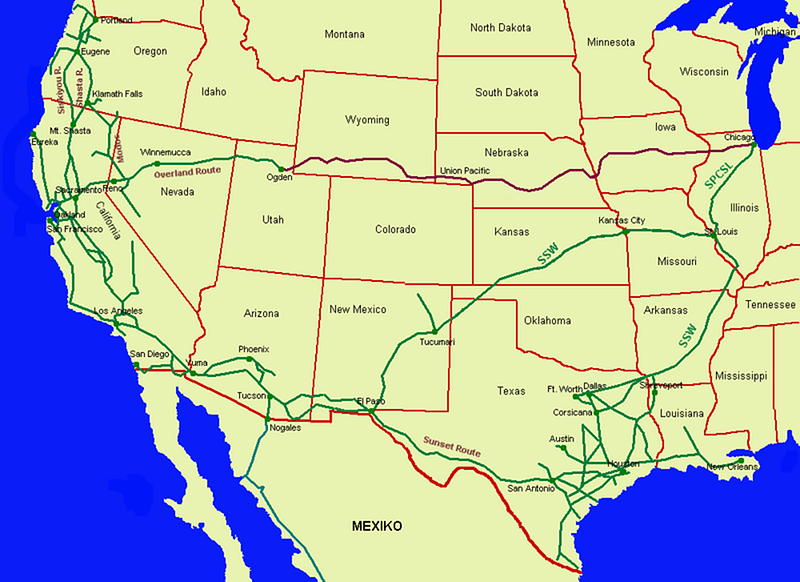
File: SP Map.png Description English: Map of the Southern Pacific Transportation Company before the 1988 DRGW-Merger Source No machine-readable source was provided. Own work assumed (based on copyright claims). Author No machine-readable author provided. Liesel assumed (based on copyright claims). This file is licensed under the Creative Commons Attribution-Share Alike 3.0 Unported license. CC BY-SA 3.0 Deed | Attribution-Share Alike 3.0 Unported | Creative Commons File: SP Map.png — Wikimedia Commons I made no changes to this picture. I made no changes to this picture.

Introduction

Welcome back; this is Article Two of a Five Article Series. This article will provide more information on the steam locomotives used by Southern Pacific and its subsidiaries and the diesel locomotives used. We hope you enjoy the pictures and the words that describe the locomotives.

2–8–2 Mikado
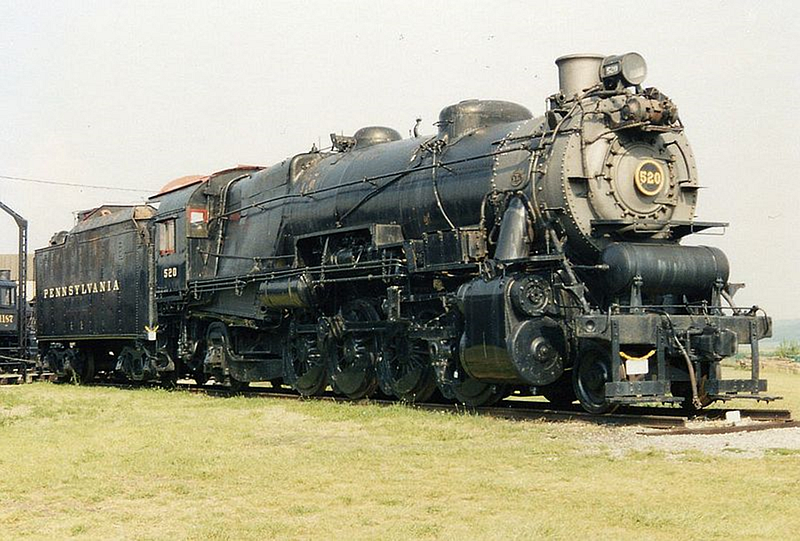
File: PRR 520 19930000 PA Strasburg.jpg Description English: Pennsylvania Railroad 2–8–2 number 520 in the Pennsylvania Railroad Museum, Strasburg, in 1993. Photo by Sean Lamb (User: Slambo) Source Transferred from en. Wikipedia to Commons by Oxyman using CommonsHelper. Author The original uploader was Slambo at English Wikipedia. This file is licensed under the Creative Commons Attribution-Share Alike 2.0 Generic license. Attribution: Sean Lamb CC BY-SA 2.0 Deed | Attribution-Share Alike 2.0 Generic | Creative Commons File: PRR 520 19930000 PA Strasburg.jpg — Wikimedia Commons I made no changes to this picture.

This locomotive had a wheel arrangement that allowed the firebox to be placed behind instead of above the driving wheels. This allows a larger firebox that could be both wide and deep. The first of these locomotives was built in 1884.

These locomotives were built by Baldwin Locomotive, the American Locomotive Company (ALCO), and the Lima Locomotive Works between 1917 and 1944. This locomotive was used for heavy freight traffic. The Mikado was the most common road freight locomotive with most railroad railroads until the end of steam. https://en.wikipedia.org/wiki/2-8-2

4–4–2 Atlantic

This locomotive was configured as a four-wheeled leading bogie, four powered and coupled driving wheels and two trailing wheels supporting the weight of the boiler and firebox. The configuration allowed a larger firebox and boiler. The Atlantic was built for hauling wood-frame passenger cars in the United States. Chicago, Milwaukee. St. Paul and Pacific Railroad used a streamlined Atlantic type on its Hiawatha passenger service.

These were the first steam locomotives ever designed and built to reach 100 miles per hour. These steam locomotives are believed to be the fastest ever built in the United States. https://en.wikipedia.org/wiki/4-4-2_(locomotive)
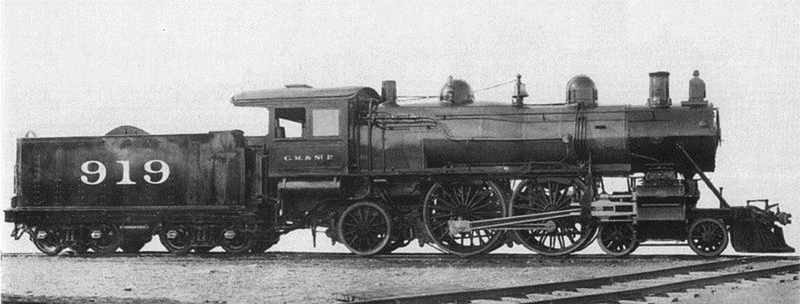
File: MILW №919.jpg English: Milwaukee Road class A2 locomotive #919 (Baldwin #19661 of November 1901, builders’ photo). Renumbered 3106 in 1912, scrapped in September 1929. This media file is in the public domain in the United States. This applies to U.S. works where the copyright has expired, often because its first publication occurred before January 1, 1928, and if not, due to lack of notice or renewal. User Fritz G (talk|contribs) Public domain — Wikipedia File: MILW №919.jpg — Wikimedia Commons I made no changes to this picture.

4–6–2 Pacific — see SP 2472

These locomotives provided the motive power for express passenger trains throughout the start to mid-20th century. The Pacific became the primary express passenger locomotive type on many railroads throughout the 1920s, 1930s, and 1940. These locomotives were built by the American Locomotive Company (ALCO) and Baldwin Locomotive.

Speed was one of the attractions of this machine; the record holder for steam speed belongs to №4468, the Mallard, which ran at a speed of 126 miles per hour in 1938 and has held the record since then. These locomotives were replaced in the 1940s and 1950s by larger types of electric or diesel-electric locomotives during the 1950s and 1960s. https://en.wikipedia.org/wiki/Southern_Pacific_2472
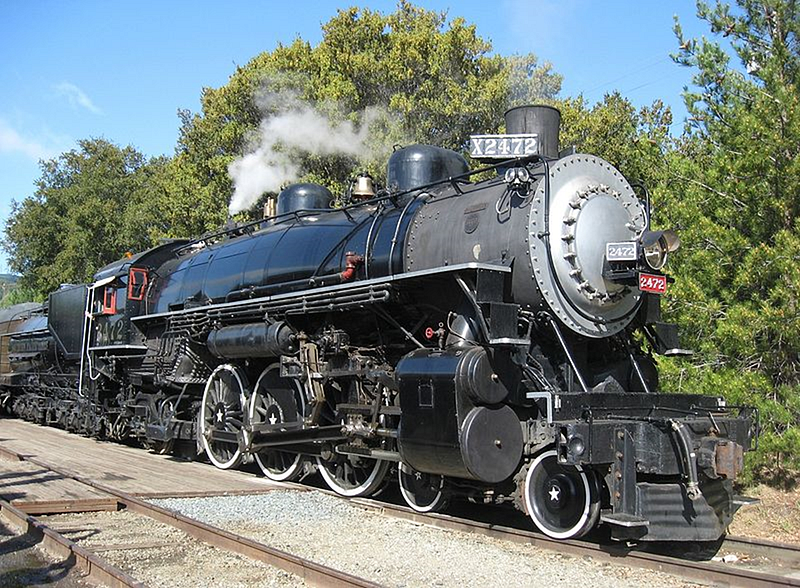
File: Southern Pacific Railroad 4–6–2 -2472 at Sunol California May 2009.jpg Description English: Southern Pacific P-8 Class 4–6–2 #2472 rests at Sunol, California, before an excursion on Memorial Day, 2009. Author Espeeac12 This file is licensed under the Creative Commons Attribution-Share Alike 3.0 Unported license.CC BY-SA 3.0 Deed | Attribution-Share Alike 3.0 Unported | Creative Commons File: Southern Pacific Railroad 4–6–2 -2472 at Sunol California May 2009.jpg — Wikimedia Commons I made no changes to this picture.

4–8–2 Mountain — see SP Mt-5

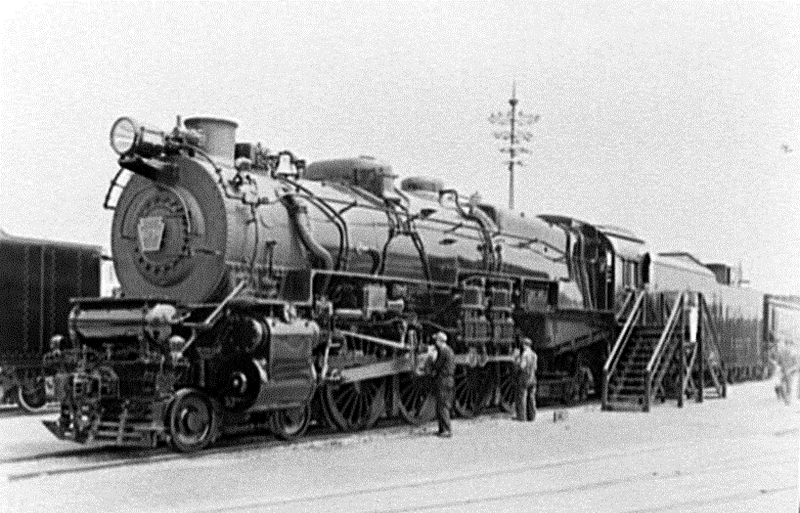
File: PRR M1a.jpg Description English: Pennsylvania Railroad class M1a at the 1939 World’s Fair (1939–06–17). Source: https://www.loc.gov/pictures/collection/gsc/item/gsc1994013438/PP — Search (bing.com) Author Original: Gottscho-Schleisner, Inc. derivative work: Morven at en. Wikipedia Public domain This work has been released into the public domain by its author, Morven at en. Wikipedia. This applies worldwide. Public domain — Wikipedia File: PRR M1a.jpg — Wikimedia Commons I made no changes to this picture.

The 4–8–2 represents four leading wheels, eight powered and coupled driving wheels, and two trailing wheels. The American Locomotive Company (ALCO) built the first of this type. A total of 2,200 Mountain type locomotives were built for 41 American railroads.

The largest user in the United States was the New York Central Railroad. Southern Pacific ordered seventy-five. Southern Pacific Class MT-5 is a class of 4–8–2 Mountain steam locomotives built between 1929 and 1939 by Southern Pacific’s Sacramento shops. A total of ten locomotives were built.

These locomotives were retired between 1953 and 1958. None survived into restoration. These locomotives were used for passengers and the new, faster freight trains. https://en.wikipedia.org/wiki/4-8-2 https://en.wikipedia.org/wiki/Southern_Pacific_Mt-5

4–8–4 Golden State/General Service — see SP 4449

The 4–8–4-wheel arrangement was a progression from the 4–8–2 Mountain type and an example of the Superpower concept in steam locomotive design. It had a larger firebox that could be supported by a four-wheel trailing truck, allowing for more steam production. The 4–8–4 stability meant that driving wheels of up to 80 inches in diameter could be used for high-speed passenger and fast freight services.

This locomotive fell out of favor because the adhesive weight was limited to sixty percent of the engine’s weight, not including the dead weight of the tender. When an EMD F3 diesel-electric consists of three units weighing just under the weight of the 4–8–4 and its tender demonstrated it had almost three times its tractive effort, high-powered steam locomotives were soon retired. https://en.wikipedia.org/wiki/Southern_Pacific_4449
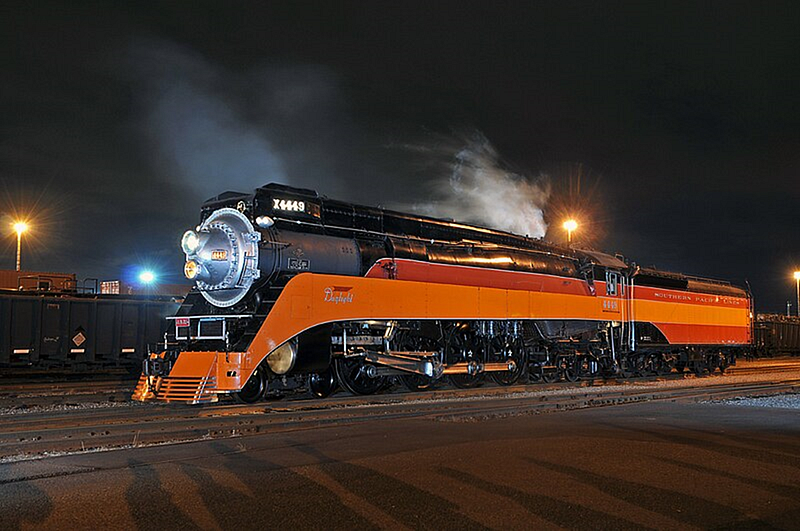
File: Night session June 23, 2011, 033xRP — Flickr — drewj1946.jpg Source night session June 23, 2011, 033xRP SP №4449 under steam at Cascades Rail in Tacoma, Washington on June 23, 2011 Source night session June 23, 2011, 033xRP Author Drew Jacksich from San Jose, CA, The Republic of California This file is licensed under the Creative Commons Attribution 2.0 Generic license. CC BY 2.0 Deed | Attribution 2.0 Generic | Creative Commons File: Night session June 23, 2011 033xRP — Flickr — drewj1946.jpg — Wikimedia Commons I made no changes to this picture.

2–8–8–4

The 2–8–8–4 locomotive has two leading wheels, two sets of eight driving wheels, and a four-wheel trailing truck. The type was called the Yellowstone, a name was given to it by the Northern Pacific Railway, whose lines ran near Yellowstone National Park. Seventy-two Yellowstone-type locomotives were built for four U.S. railroads.

The Northern Pacific Railway was the first railroad to order one of these. The Southern Pacific Railroad’s cab forward articulated steam locomotives were Yellowstone in reverse (instead of 2–8–8–4s, they were built as 4–8–8–2s). https://en.wikipedia.org/wiki/2-8-8-4
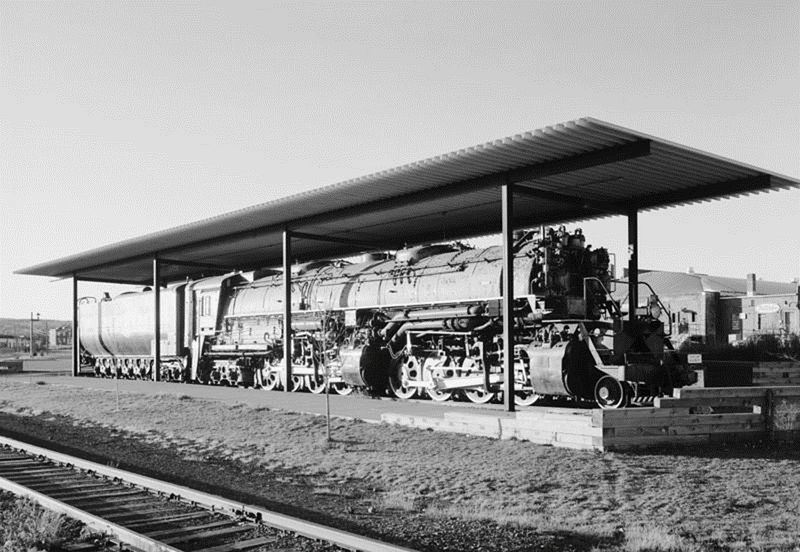
File: Duluth Missabe and Iron Range 2–8–8–4 locomotive.jpg Description Duluth, Missabe and Iron Range Railway 2–8–8–4 (“Yellowstone” type) articulated steam locomotive #229, as preserved at Two Harbors, Minnesota, USA. Source the United States Department of the Interior, National Park Service Historic American Engineering Record HAER MN-34, archived at the Library of Congress. This image is available from the United States Library of Congress’s Prints and Photographs division under the digital ID hhh.mn0144. This image or media file contains material based on the work of a National Park Service employee, created as part of that person’s official duties. As a work of the U.S. federal government, such work is in the public domain in the United States. Public domain — Wikipedia https://commons.wikimedia.org/wiki/File:Duluth_Missabe_and_Iron_Range_2–8–8–4_locomotive.jpg — Search (bing.com) I made no changes to this picture.

4–8–8–2 Cab Forward Articulated

This locomotive has four leading wheels, two sets of eight driving wheels, and a two-wheel trailing truck. The length of this locomotive requires it to be articulated. That means it has a joint between the first and second groups of driving wheels.

The leading truck sits under the smokebox, and the trailing truck is under the firebox. The leading cab supports the firebox, and the trailing truck and smokebox are at the rear of the tender. The locomotive always runs in reverse. https://en.wikipedia.org/wiki/4-8-8-2
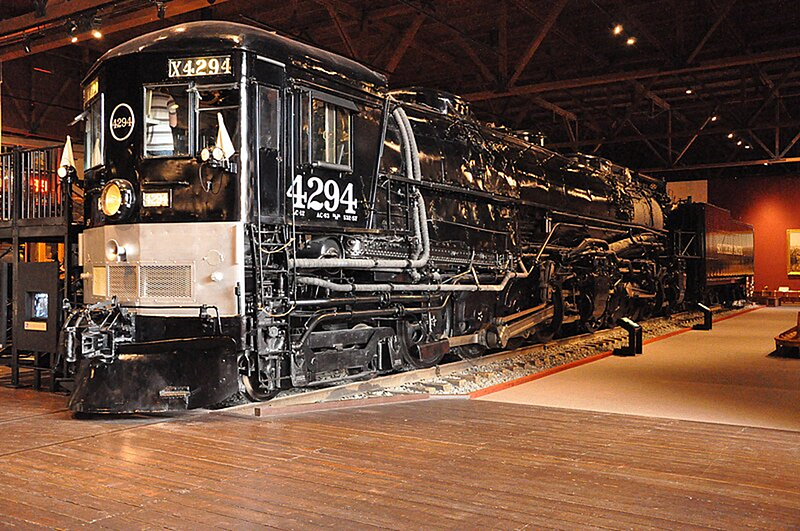
File: Southern Pacific 4294, a cab-forward steam locomotive.jpg Description English: Southern Pacific 4294, a cab-forward steam locomotive, on display at the California State Railroad Museum in Sacramento, California. Source I (Neil916 (Talk)) created this work. Author Neil916 (Talk). This file is licensed under the Creative Commons Attribution-Share Alike 3.0 Unported license. Attribution: Neil916 at English Wikipedia CC BY-SA 3.0 Deed | Attribution-Share Alike 3.0 Unported | Creative Commons File: Southern Pacific 4294, a cab-forward steam locomotive.jpg — Wikimedia Commons I made no changes to this picture.

4–10–2 Southern Pacific

This locomotive represents the arrangement of four leading wheels, ten powered and coupled driving wheels and two trailing wheels. In the United States of America, it was known as the Southern Pacific on the Southern Pacific Railroad and as an overland on the Union Pacific Railroad. These United States railroads were the only railroads that used this type.

The American Locomotive Company built fifty-nine of this type, SP ordered forty-nine, and the Union Pacific ordered ten. The 4–10–2 type ran better and rode smoother than the 2–10–2 type that it had evolved from. The SP locomotives could operate just on straight and heavy-built mainlines. The long service life of 28 and 30 years proved they were good locomotives. https://en.wikipedia.org/wiki/4-10-2
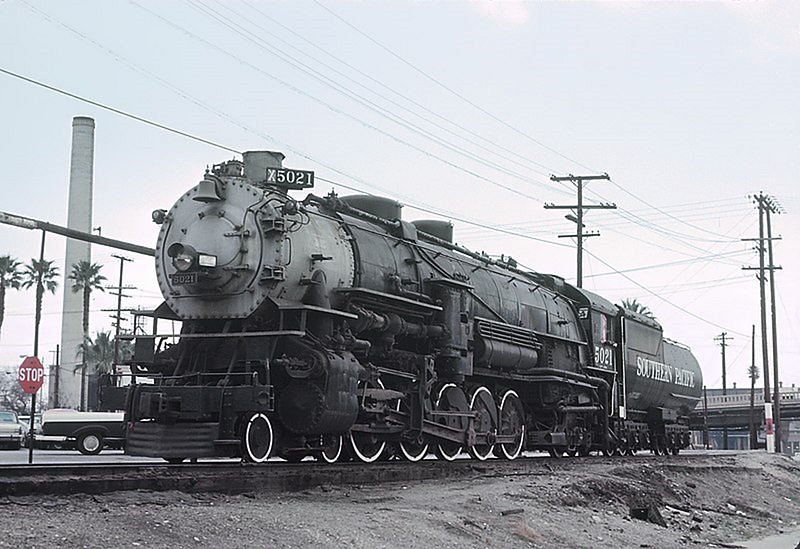
File: SP 5021 San Bernardino, CA February 1972.jpg Description English: SP 5021 while it was stored on the Santa Fe at San Bernardino, CA in February 1972. She is now at the Rail Giants exhibit in the LA C Fairgrounds in Pomona, CA. A Roger Puta Photograph Source Collection: Photographs by Roger Puta (1944–1990) (flickr.com) Author Marty Bernard Public domain Mel Finzer, the heirs of this work’s copyright holder (the creator), has released it into the public domain. This applies worldwide. Public domain — Wikipedia File: SP 5021 San Bernardino, CA February 1972.jpg — Wikimedia Commons I made no changes to this picture.

Following is a List of diesel locomotives used by Southern Pacific Railroad Company and its subsidiaries as described within the article series:

Diesel locomotives

(https://en.wikipedia.org/wiki/Southern_Pacific_Transportation_Company)

· ALCO PA

This locomotive was built to haul passenger trains. It was built in the United States in Schenectady, New York, by a partnership between ALCO and General Electric (GE) between 1946 and 1953. Two models were built, Model PA and Model PB; the PB was shorter than the PA.

They shared many characteristics both in looks and machine capabilities. Both cab-equipped lead A unit PA and cabless booster B unit PB were built. The P indicates that they were geared for higher speeds and passenger use. The F noted that the locomotive had been being geared for freight use.

Many railroads used PA and FA locomotives for both freight and passenger service. Most PAs and PBs were scrapped, but five PAs have been preserved in railroad museums, and a single PB is still in service as a power car. https://en.wikipedia.org/wiki/ALCO_PA
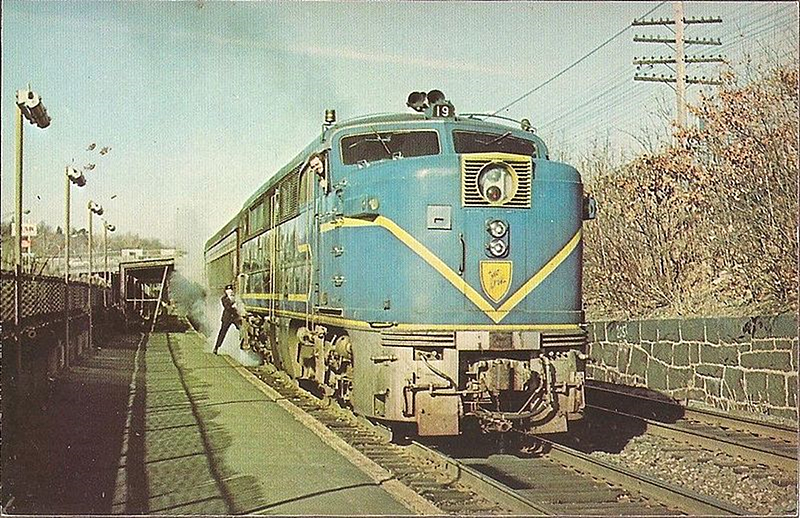
File: D&H 19 at Newtonville, April 1978 postcard.jpg Description English: 1978 postcard of D&H 19 leading a train at Newtonville station. Source Scanned postcard from eBay auction: “LMH Postcard DELAWARE HUDSON Alco PA-1 D&H #19 Passenger Diesel B&M MBTA 1978 Author Norton Clark This work is in the public domain because it was published in the United States between 1978 and March 1, 1989, without a copyright notice, and its copyright was not registered with the U.S. Copyright Office within five years. Public domain — Wikipedia File: D&H 19 at Newtonville, April 1978 postcard.jpg — Wikimedia Commons I made no changes to this picture.

· EMC E2

This American passenger train diesel-electric locomotive was built as a single unit with 1,800 horsepower from two 900-horsepower prime movers. These locomotives were operated as a unit set (A-B-B) or (A-B-A), where the three-unit lash-up develops 5,400 horsepower. This is almost ideal (6,000 horsepower is best) for a passenger train that pulls the cargo of 15–18 cars and runs the grades of nearly all the mileage between American cities.

Two sets were made for named passenger trains. The first set was made for the City of San Francisco. The Union Pacific, the Chicago and North Western Railway, and the Southern Pacific Railroad owned the motive power sets. There are no E2 locomotives that survived, but there is a pair of Winton Model 201A V12 engines from SF-1 (the lead unit of the San Francisco set that was nicknamed Queen Mary) that were rescued from the scrap and became part of the artifacts at the California State Railroad Museum. One of these engines was transferred to the Illinois Railway Museum in Union, Illinois. https://en.wikipedia.org/wiki/EMC_E2
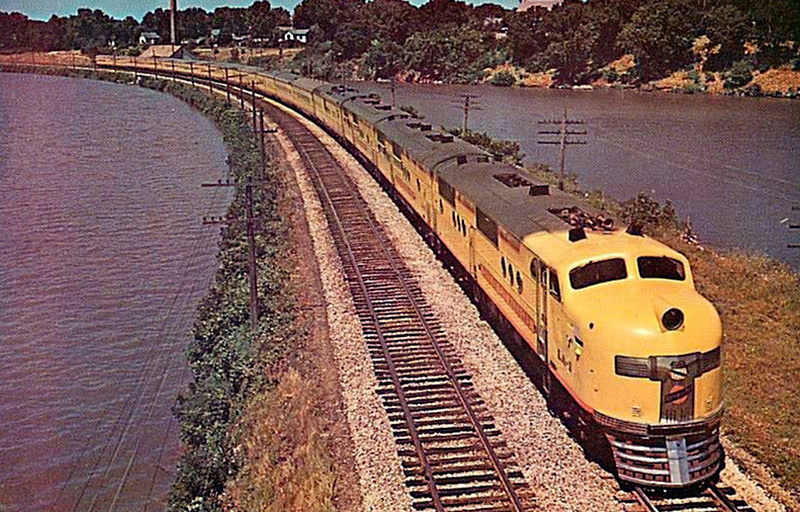
File: the City of Los Angeles.JPG Description Postcard photo of the streamliner City of Los Angeles near Sterling, Illinois, and traveling along the Rock River. The train was operated between the Union Pacific and Chicago and North Western railroads until 1955, when the partnership changed to Union Pacific and the Chicago, Milwaukee, St. Paul, and Pacific (The Milwaukee Road) railroads Source eBay item card front card back Author Audio Visual Designs, Earlton, NY/Photo: Chicago and Northwestern Railway This work is in the public domain in the United States because it was published in the United States between 1928 and 1977, inclusive, without a copyright notice. Public domain — Wikipedia File: City of Los Angeles.JPG — Wikimedia Commons I made no changes to this picture.

· EMD E7

The E7 was a 2,000-horsepower passenger train built by General Motors Electro-Motive Division in LaGrange, Illinois. Four hundred twenty-eight cab versions, or E7As, were built from 1945 to 1949. Eighty-two booster E7Bs were built from 1945 to 1948.

The 2,000 horsepower came from two 12-cylinder model 567A engines. Each engine drove its electrical generator to power two traction motors on one truck. The E7 was the eighth model in a line of passenger diesels of similar design known as the E Model.

The Southern Pacific Company owned five of the A units and ten of the B units. The Pennsylvania Railroad E7A #5901 is the single surviving example of the E7. It underwent cosmetic restoration and is displayed indoors at the Railroad Museum of Pennsylvania. https://en.wikipedia.org/wiki/EMD_E7
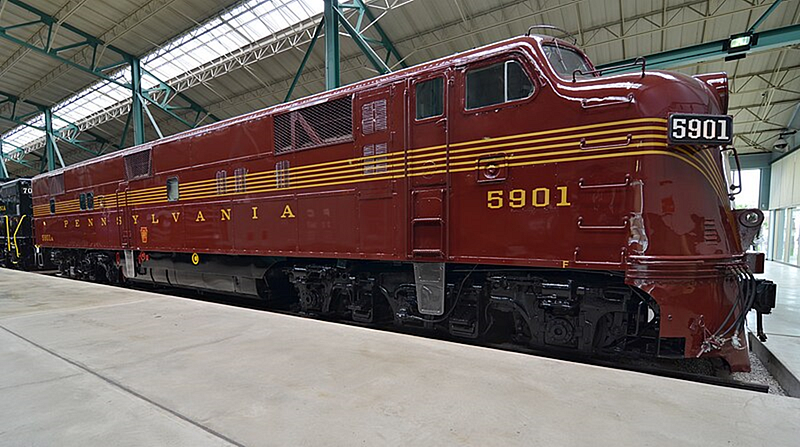
File: RR76.37 №5901 Front Side.jpg Description English: The Pennsylvania Railroad 5901 at the Railroad Museum of Pennsylvania. The car is listed on the roster as RR76.37. Source Self-photographed Author Photo by and ©2015 Derek Ramsey (Ram-Man) This file is licensed under the Creative Commons Attribution-Share Alike 4.0 International license.CC BY-SA 4.0 Deed | Attribution-Share Alike 4.0 International | Creative Commons File: RR76.37 №5901 Front Side.jpg — Wikimedia Commons I made no changes to this picture.

· EMD E8

The EMD E8 is a 2,250-horsepower passenger train locomotive built by General Motors’ Electro-Motive Division at LaGrange, Illinois. Four hundred fifty cab versions or E8As were constructed between 1949 and 1954. Of that number built, all went to the United States except three sold to Canada.

48 E8Bs were built between 1949 and 1954 and sold to the United States. Like the E7s, the E8s were powered with the same 12-cylinder motors driving generators to power two traction motors on one truck. An estimate is that a total of 58 E8s have survived. Four Southern Railway E8s are preserved. https://en.wikipedia.org/wiki/EMD_E8
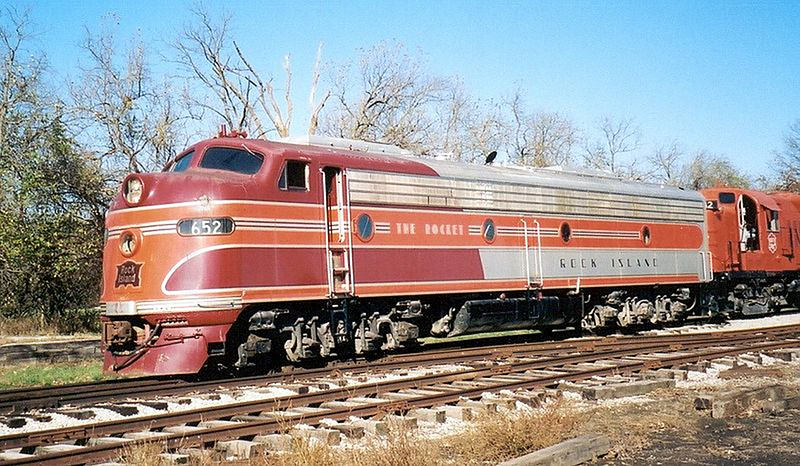
File: Rock Island locomotive 652.jpg Description English: Rock Island (CRIP) locomotive #652 Now owned and operated by the Midland Railway of Baldwin City. EMD model E8A — built in April 1952 “Rocket” maroon, orange, and aluminum paint scheme Photo taken by Russell Meier south of Baldwin City, Kansas, on the Midland Railway. This was a photo run by participants of the TRAIN convention charter. Author Russell Meier This file is licensed under the Creative Commons Attribution-Share Alike 3.0 Unported license. CC BY-SA 3.0 Deed | Attribution-Share Alike 3.0 Unported | Creative Commons File: Rock Island locomotive 652.jpg — Wikimedia Commons I made no changes to this picture.

· EMD E9

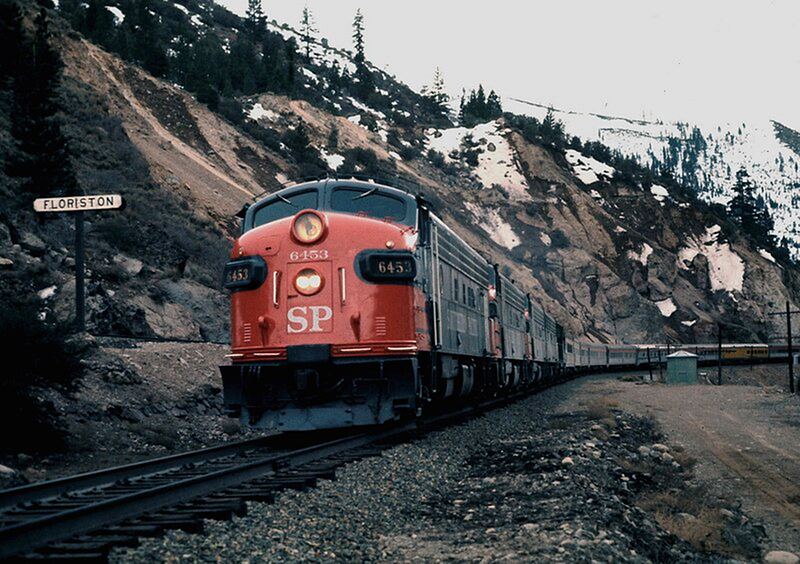
The E9 is a 2,400-horsepower passenger train-hauling diesel locomotive built by General Motors’ Electro-Motive Division at LaGrange, Illinois. One hundred cab-equipped A units and 44 cabless booster B units were built between 1954 and 1964, all for the United States. This was the tenth and last model of the EMD E unit.

The difference between the E8 and the E9 was that the E9 had newer engines and a different flusher-fitting mounting for the headlight glass. The E9 powered American passenger and mail trains from the 1950s into the late 1970s. Southern Pacific’s Coast Daylight and Sunset Limited had E9s pulling them.

When Amtrak took over passenger services in the United States, they bought 36 E9As and 23 E9Bs from Union Pacific, Milwaukee Road, B&O, and SCL. Amtrak used them until 1979 and converted E9B units into steam generators and head-end power cars. https://en.wikipedia.org/wiki/EMD_E9
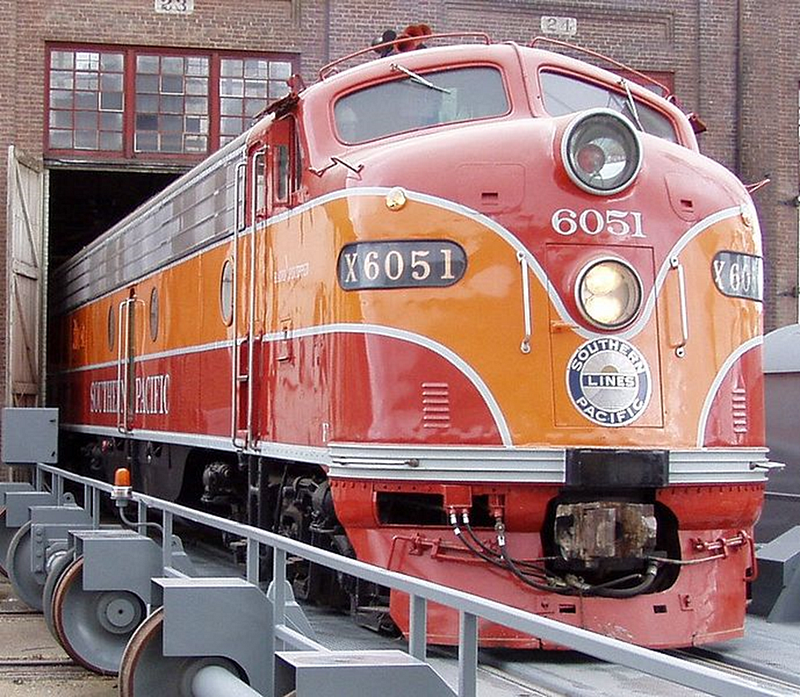
File: Southern Pacific 6051.jpg Description The en: Southern Pacific 6051, an en: EMD E9 locomotive, enters the en: transfer table — photo taken by Evan Jennings, Nov 2006, Old Sacramento SP shops. Source Transferred from en. Wikipedia to Commons. Author N2xjk at English Wikipedia This file is licensed under the Creative Commons Attribution-Share Alike 3.0 Unported license. Attribution: N2xjk CC BY-SA 3.0 Deed | Attribution-Share Alike 3.0 Unported | Creative Commons File: Southern Pacific 6051.jpg — Wikimedia Commons I made no changes to this picture.
File: SP 6453 EB Floriston PRS SPC Feb 1971.jpg Description Pacific Rail Society Special from LA to Reno seen at Floriston, CA Feb 1971 Source Flickr: SP 6453 EB Floriston PRS SPC Feb 1971 Author Drew Jacksich This file is licensed under the Creative Commons Attribution-Share Alike 2.0 Generic license. CC BY-SA 2.0 Deed | Attribution-Share Alike 2.0 Generic | Creative Commons File: SP 6453 EB Floriston PRS SPC Feb 1971.jpg — Wikimedia Commons I made no changes to this picture.

· EMD FP7

The EMD FP7 is a 1,500-horsepower dual-service passenger and freight-hauling diesel locomotive. General Motors’ Electro-Motive Division and General Motors Diesel produced this locomotive between 1949 and 1953. The final build was done at GM-EMDs LaGrange, Illinois, except for locomotives sold to Canada, which had a final build at GMD’s plant in London, Ontario.

This locomotive was the EMD’s F7A, extended four feet to provide further capacity for the steam generator to heat passenger trains. Three hundred eighty-one cab-equipped lead A units were produced. There were no booster B units made.

· GE 70-ton switcher

The GE 70-ton switcher is a 4-axle diesel-electric locomotive built by General Electric between 1942 and 1955. Seven of the first series of these locomotives were built for the New York Central Railroad in 1942. Two end-cab versions are on display at the Whippany Railway Museum in Whippany, New Jersey.

These units were placed in service in 1951 and 1954 and operated through the closing of the shoreline rail business in 1990. The United Railroad Historical Society of New Jersey now owns both. https://en.wikipedia.org/wiki/GE_70-ton_switcher
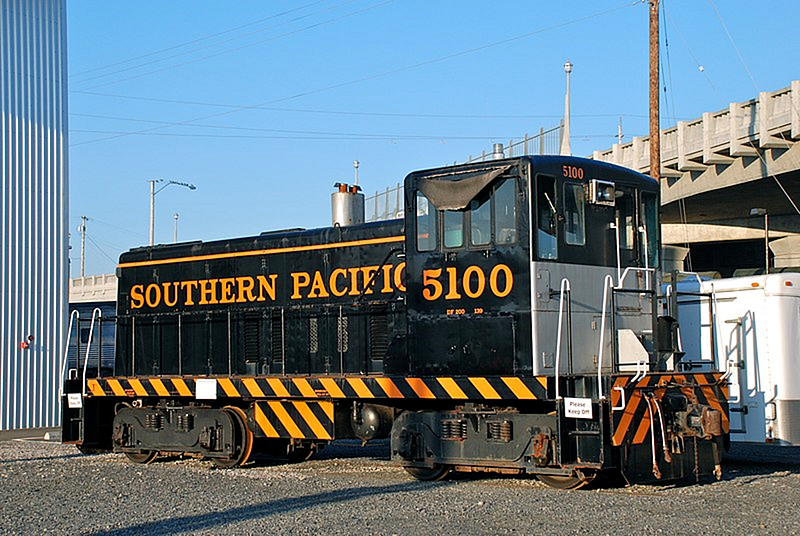
File: Ex-Southern Pacific 5100, GE switcher, at ORHC in 2013.jpg Description Former Southern Pacific 5100, a GE 70-ton switcher, on display at the Oregon Rail Heritage Center in Portland, Oregon. Author Steve Morgan This file is licensed under the Creative Commons Attribution-Share Alike 3.0 Unported license. CC BY-SA 3.0 Deed | Attribution-Share Alike 3.0 Unported | Creative Commons File: Ex-Southern Pacific 5100, GE switcher, at ORHC in 2013.jpg — Wikimedia Commons I made no changes to this picture.

· EMD NW2

The EMD NW2 is a 1,000-horsepower switcher locomotive made by General Motors Electro-Motive Division at LaGrange, Illinois. It was made from 1939 to 1949, and 1,145 units were made. In 1948, EMD began manufacturing these units in EMD’s Plant #3 in Cleveland, Ohio.

The way to identify them was that there were two stacks in the middle of the hood, a half radiator grille, no sandbox on the front platform, and no small louvers at the top front corners of the sides of the hood. The “N” in the model number stands for nine in nine hundred horsepower. The” W” in the model number stands for “welded frame.”

Many of these locomotives are still active and working on different industry applications. Some have been preserved, and some have been scrapped.
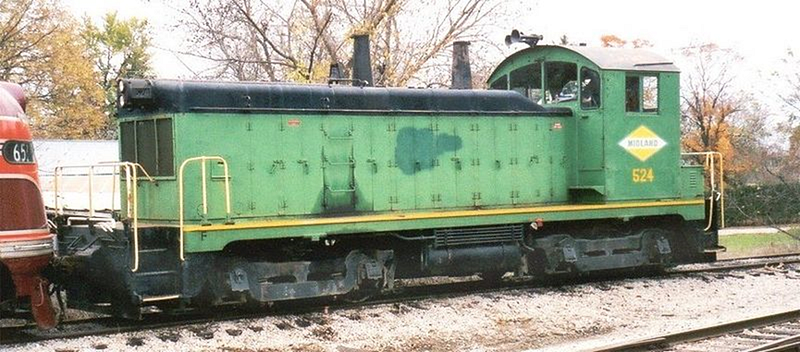
File: Midland Kansas locomotive 524.jpg Description English: Midland Railway of Baldwin City, Kansas (MLRX) locomotive #524 is owned and operated by the Midland Railway. EMD model NW2 — built in Aug 1946 for the CB&Q as their #9227 Rebuilt by BN and renumbered #524 BN’s green and black paint scheme Photo taken by Russell Meier in Baldwin City, Kansas, on the Midland Railway. Author Russell Meier w: en: Creative Commons attribution share alike This file is licensed under the Creative Commons Attribution-Share Alike 3.0 Unported license. CC BY-SA 3.0 Deed | Attribution-Share Alike 3.0 Unported | Creative Commons File: Midland Kansas locomotive 524.jpg — Wikimedia Commons I made no changes to this picture.

· EMD NW5

The EMD NW5 was a 1,000-horsepower road switcher diesel-electric locomotive made by General Motors Electro-Motive Division at LaGrange, Illinois. This locomotive was produced from December 1946 to February 1947. There was a total of thirteen of these produced.

Ten locomotives went to the Great Northern Railway, while two others were delivered to the Union Belt of Detroit. One of these exists today at the Florida Gulf Coast Railroad Museum. The final locomotive was sold to the Southern Railway, where it became number 2100.

This locomotive was the same as what preceded it in the EMD NW2 switcher hood, prime mover (V12 EMD 567 diesel engine), and main generator on a stretched frame and riding on-road trucks, with a short hood on the other side for the steam generator.
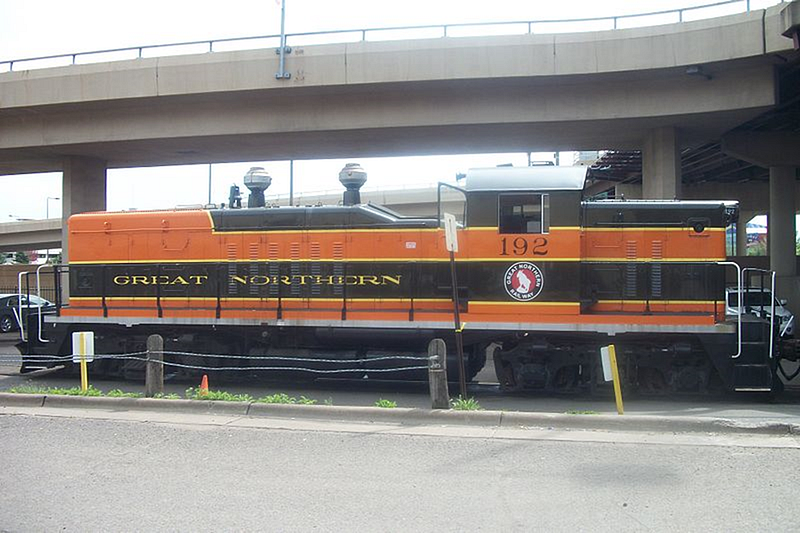
File: GN 192 Duluth.JPG Author Keon McGarvey This file is licensed under the Creative Commons Attribution-Share Alike 3.0 Unported license.CC BY-SA 3.0 Deed | Attribution-Share Alike 3.0 Unported | Creative Commons File: GN 192 Duluth.JPG — Wikimedia Commons I made no changes to this picture.

· EMD SW1

The EMD SW1 is a 600-horsepower diesel-electric switcher locomotive built by General Motors’ Electro-Motive Division. This locomotive was made between 1938 and 1953. The final build plant was in LaGrange, Illinois.

This was the start of a long line of SW series switchers produced by EMD. The most significant change from previous models was the use of an engine of EMDs design, the then-new 567 engine. The engine was in production until 1966.

This locomotive had a D.C. generator that gave power to four motors, two on each truck. The company made 661 locomotives of this design, but there was a break in production in 1943, lasting until 1945 due to World War II. There were some differences between what was produced at the start and what was produced starting around 1950. EMD SW1 — Wikipedia These changes included:

· The original model had two center cab windows over the hood curved to follow the roofline. These windows became flat-topped after 1950. EMD SW1 — Wikipedia

· The taper to the cab’s hood was a two-stage taper in the initial model but became a single taper later. EMD SW1 — Wikipedia

· The initial model was delivered with a stubby exhaust stack but needed to be changed because the stack did not lift the exhaust clear of visibility for the crew. Later units were delivered with EMDs’ standard conical switcher stack. EMD SW1 — Wikipedia

· The initial model had a single large headlight, but the later model had twin sealed-beam headlights. Southern Pacific had 15 of these locomotives. EMD SW1 — Wikipedia

Today, there are SW1s in all applications, from regular freight service to industrial settings. Several have been preserved in museums and heritage railways, pulling excursion trains.
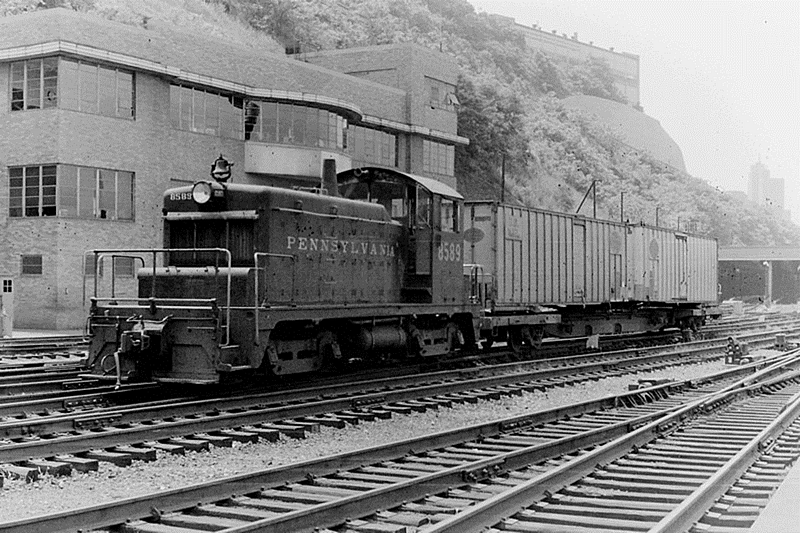
File: Hugh Llewelyn 6589 (5961018035 ).jpg Description Penn Central EMD SW1 #8589, still in Pennsylvania RR livery, switching at Penn Central Station, Pittsburgh, 7/70. Oxyman Author Hugh Llewelyn uploaded source 6589. This file is licensed under the Creative Commons Attribution-Share Alike 2.0 Generic license. CC BY-SA 2.0 Deed | Attribution-Share Alike 2.0 Generic | Creative Commons File: Hugh Llewelyn 6589 (5961018035).jpg — Wikimedia Commons I made no changes to this picture.

· EMD SW8

The EMD SW8 is a diesel switcher locomotive made by General Motors’ Electro-Motive Division and General Motors Diesel from 1950 to 1954. Powering this locomotive is an EMD 567B 8-cylinder engine with 800 horsepower. Three hundred nine of this model was built for the United States and 65 for Canadian railroads.

During the Korean War, the U.S. Army ordered 41 SW8s for service in Korea. These were all shipped in 1951. After the war, the Army sent some of their SW8s to the South Korean government, and others were kept by the Army and assigned to various Army posts, depots, and ammunition plants.

Most of these were retired around 1990 and replaced in service by rebuilt geeps like the GP10s (another type of switcher locomotive built by rebuilding a GP7, GP9, or GP18). EMD SW8 — Wikipedia
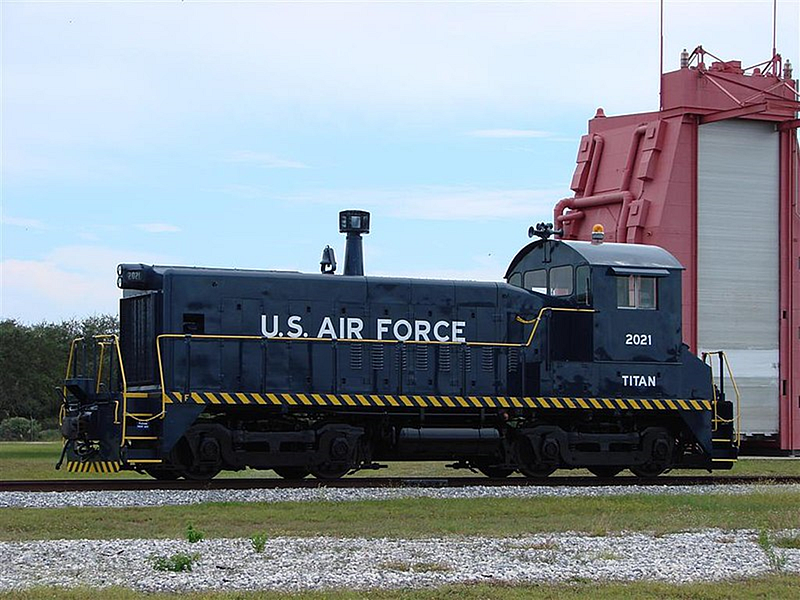
File: EMDSW8.jpg Description English: EMD SW8 switching locomotive, manufactured 1951. Retired from the United States Air Force Titan missile program, this locomotive is now on display at the end: Air Force Space & Missile Museum, Cape Canaveral Air Force Station, Florida. Source Transferred from en. Wikipedia to Commons by Quatro Valvole. Author Fl295 at English Wikipedia Public domain This work has been released into the public domain by its author, Fl295 at English Wikipedia. This applies worldwide. Public domain — Wikipedia File: EMDSW8.jpg — Wikimedia Commons I made no changes to this picture.

· EMD SW900

The EMD SW900 is a diesel switcher locomotive built by General Motors Electro-Motive Division between 1953 and 1969. It is powered by an 8-cylinder engine that generates 900 horsepower. Two hundred sixty of these models were built for American railroads, and 97 were built for Canadian railroads.

Seven units were sent to Venezuela by the Orinoco Mining Company. Two units were sent to southern Peru to the Southern Peru Copper Company; five were sent to the Liberian American-SwedishMinerals Company. Three hundred seventy-one units were built. EMD SW900 — Wikipedia
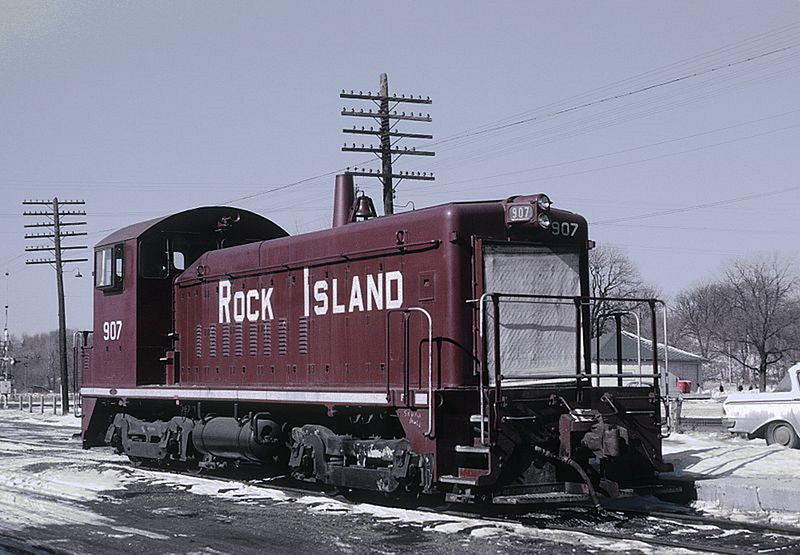
File: CRIP 907 (SW900) at Seneca, IL on January 28, 1967 (21798162974).jpg Description English: Photo by Roger Puta Source https://www.flickr.com/photos/129679309@N05/21798162974/Author railfan 44 Public domain Mel Finzer, the heirs of this work’s copyright holder (the creator) have released it into the public domain. This applies worldwide. Public domain — Wikipedia File: CRIP 907 (SW900) at Seneca, IL on January 28, 1967 (21798162974).jpg — Wikimedia Commons I made no changes to this picture.

· EMD SW1200

The EMD SW1200 is a four-axle diesel switcher locomotive built by General Motors Electro-Motive Division between 1954 and 1966. The EMD 567C 12-cylinder engine powered these locomotives, generating 1,200 horsepower. Seven hundred twenty-seven of these locomotive models were built for U.S. railroads. 287 were built for Canadian railroads, four for Brazilian railroads, twenty-five for a Chilean industrial firm, and three for the Panama Canal Railway. The locomotive was built between 1954 and 1966. EMD SW1200 — Wikipedia

File: BN 251 IL Eola.jpg Description English: BN 251, an EMD SW1200, works the yard in Eola, Illinois (just east of Aurora). Source Photo by Sean Lamb en: User: Slambo Author Slambo at English Wikipedia This file is licensed under the Creative Commons Attribution-Share Alike 2.0 Generic license. CC BY-SA 2.0 Deed | Attribution-Share Alike 2.0 Generic | Creative Commons File: BN 251 IL Eola.jpg — Wikimedia Commons I made no changes to this picture.

models were· EMD SW1500

The EMD SW1500 is a 1,500-horsepower diesel-electric switcher locomotive built by General Motors’ Electro-Motive Division between 1966 and 1974. The 1500 replaced the 1200 in the EMD product line. Many railroads used this model for road freight service regularly.
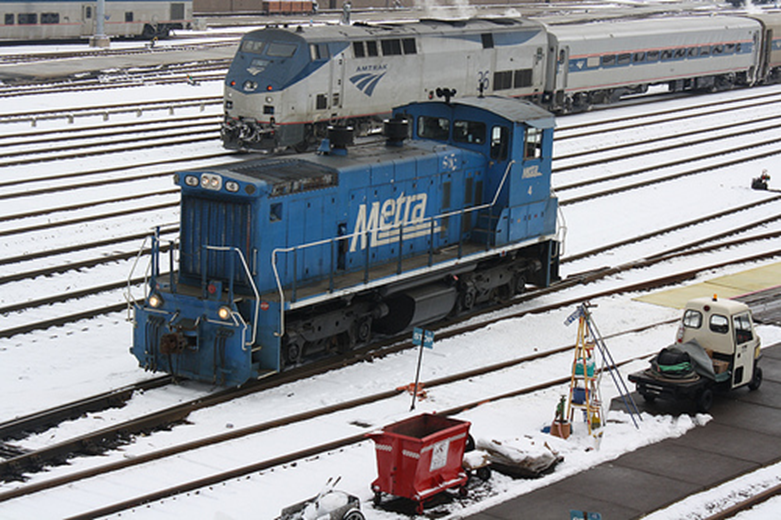
File: Metra4sw1500.jpg Description English: Nirc 4, an EMD SW1500, prepares to perform switching duties near Chicago Union Station. Author FranklinC55 Public Domain This work has been released into the public domain by its author, FranklinC55. This applies worldwide. The copyright holder of this work releases this work into the public domain. Public domain — Wikipedia This applies worldwide. I made no changes to this picture. File: Metra4sw1500.jpg — Wikimedia Commons

· GE U25B

The GE U25B is General Electric’s first independent entry into the United States domestic road switcher diesel-electric locomotive railroad market for heavy production road locomotives since 1936. GE became independent from ALCO in locomotive production in 1953. The Cooper-Bessemer Company built the Universal Series locomotives in 1956 and sold 400 export locomotives before the locomotive was offered for sale in the United States.

This locomotive was named the U-Boat, putting GE on the road to becoming the top locomotive producer in the United States. The model ran with the FDL-16 engine, and it was very successful. It was the first powered by GE. Many of these models were sold, but the only U25B locomotives that remain are found in museums; most were scrapped by the end of their service life in the 1980s. GE U25B — Wikipedia
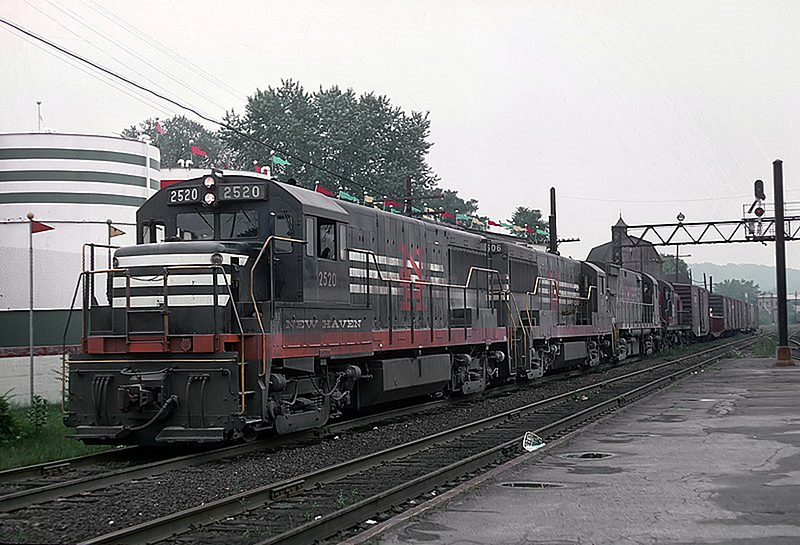
File: New Haven 2520 (U25B) going through Danbury, CT on Maybrook freight line, July 28, 1968 (22366087578).jpg Description English: A New Haven Railroad freight train led by a U25B locomotive passed Danbury Union Station on the Maybrook Line in July 1968 Source New Haven 2520 (U25B) going through Danbury, CT on Matbroo… | Flickr Author Roger Puta Mel Finzer, the heirs of this work’s copyright holder (the creator) have released it into the public domain. This applies worldwide. Public domain — Wikipedia File: New Haven 2520 (U25B) going through Danbury, CT on Maybrook freight line, July 28, 1968 (22366087578 ).jpg — Wikimedia Commons I made no changes to this picture.

· GE U28B

The GE U28B replaced the U25B in 1966, having just 300 horsepower. At the start, the body styling was the same as the U25B. This model was produced for a year and replaced with the U30B.

One hundred forty-eight of these models were made, and the builder was GE Transportation Systems. Only two of these models are in preservation. One is at the Illinois Railway Museum, and the other is at the Appalachia Railway Museum but was rebuilt late in its career as a U30B.
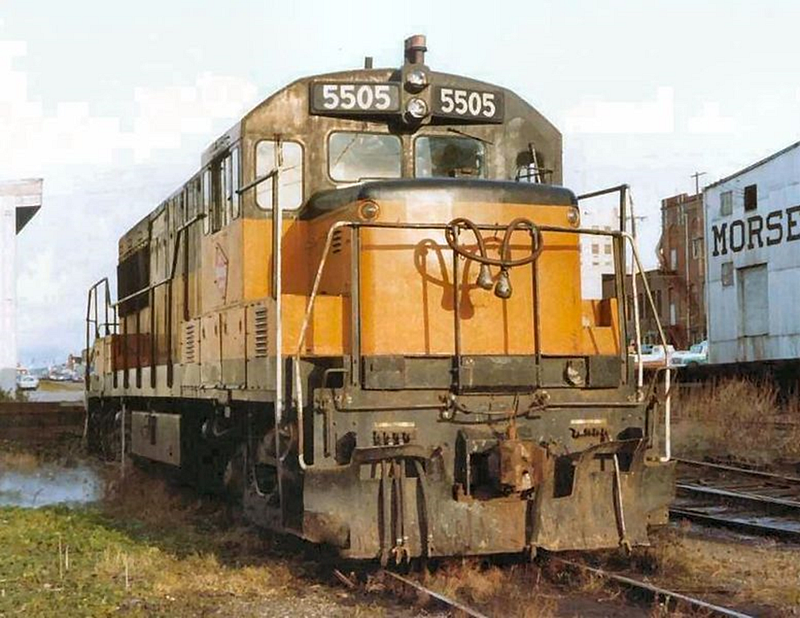
File: MILW U28B 5505.jpg Chicago, Milwaukee, St. Paul, and Pacific Railroad (“Milwaukee Road”) GE U28B diesel locomotive #5505. The photo was taken by S.L. Dixon at the MILW Roundhouse, Bellingham, Washington, USA, in 1979 and released under the GFDL by the photographer. w: en: Creative Commons attribution share alike This file is licensed under the Creative Commons Attribution-Share Alike 3.0 Unported license. CC BY-SA 3.0 Deed | Attribution-Share Alike 3.0 Unported | Creative Commons File: MILW U28B 5505.jpg — Wikimedia Commons I made no changes to this picture.

· GE U30C

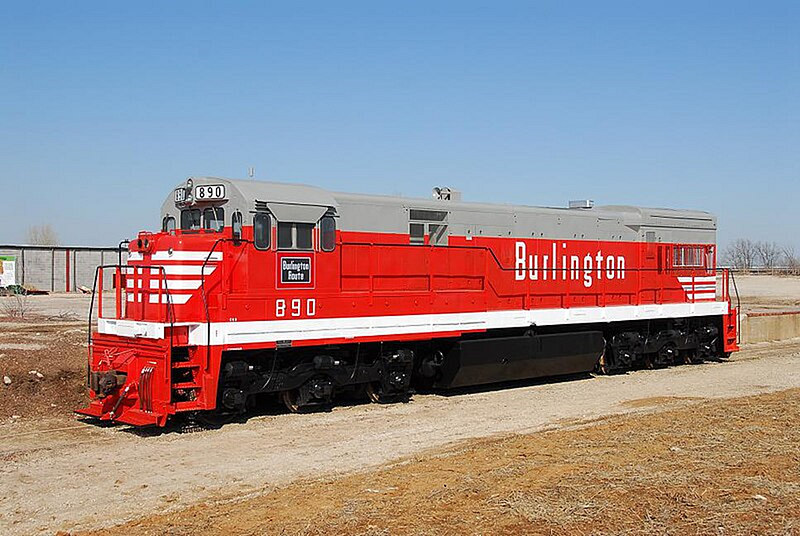
File: Colorado and Southern 890.jpg Author Ksamson1 Public domain I, the copyright holder, release this work into the public domain. This applies worldwide. Public domain — Wikipedia File: Colorado and Southern 890.jpg — Wikimedia Commons I made no changes to this picture.

The GE U30C is a six-axle locomotive built by General Electric from 1966 until 1976. GE sold 600 units of this model. This model was known for its reliability issues concerning its electrical system.

The U30C served all types of customers, from mining interests to general freight hauling and coal trains, and even served as a power source for the Department of Transportation’s subway-car test tracks. Most U30Cs were retired due to old age and mechanical or electrical problems. Still, GE started a rebuild program for the older Universal Series locomotives that upgraded them with the latest technology and fuel-saving systems. GE would strip the locomotive down to the frame and engine and then completely rebuild it with new components.

Conclusion

This is the end of Article Two of a Five-Article Series. We hope you have enjoyed looking at some of the old trains used by the railroads in times past and some that the railroads may still be using. This article does an excellent job of introducing these locomotives to you; each locomotive type could also be represented in an article.

We enjoyed writing this article and having you along for the trip. We would appreciate it if you provided any positive, constructive comments you may have. We would also love to have you sign up for our email group, so you don’t miss future articles. Please take your seat as we head further down the track in Article Three of a Five-Article series.

Illumination
Nonfiction
Transportation
Travel
Productivity
Recommended from ReadMedium