
Music
You Need to Listen to This Song Right Now #35
Heavy Rotation — Theme for Great Cities, Simple Minds (Sister Feelings Call, 1981)
Heavy Rotation was a music industry term for songs that, one way or another, got incessant airplay. It referred to the large amount of rotations that a particular record was given on turntables at radio stations. Since, until the 1980s, this was the only way to get new music into the ears and brains of listeners, heavy rotation meant increased sales. These were good for record companies and artists alike.
Today, some of us still put records on at home and give them a spin. Most of us don’t. However, the term still applies, just in a different way. Streaming services like Spotify sell subscriptions to listeners and then pay artists based on listens. At least, that’s the way we think it works.
For me, heavy rotation means a song that is in my head for some reason. Maybe for a moment, maybe for a day, maybe for longer. It’s a song that you come back to from time to time and still feels just as good.
This series of articles is dedicated to these songs.
Here, I aim to highlight a particular song by a particular band or singer. We should know a bit about the band, a bit about where the song fits into its history, and where the song fits into what was happening in music at that time.
Then there’s the song itself. Who’s playing on it, what are the lyrics getting at and why is it so good? How does it still occupy sonic space in our lives?
I’ll (try to) keep it short. It shouldn’t take you any longer to read this than the song itself. To that end, I’ll put a Youtube clip of the original recording at the top of the article so you can listen as you read. Or not. And because a song is often much different live than in the recording studio, I’ll stick a live clip on at the end.
What song is in your head right now? Here’s the one that won’t leave mine today:
#35 — Theme for Great Cities, Simple Minds (Sister Feelings Call, 1981)
By the late 1980s, Simple Minds were already a few years past their mid-decade high water mark, in North America at least. But for me, they formed part of a triumvirate of massive global bands (along with U2 and INXS) that I had to see one day.
Live in the City of Light, a double live album recorded in Paris in 1987, was full of epic sonic energy in front of a gigantic audience. I’ve seen the other two aforementioned bands, but I am still waiting for my moment to be part of a Simple Minds show, though their arena and stadium days are long over.
At the time, most of us who became fans came to them honestly, via their massive hit “Don’t You Forget About Me” which featured on the soundtrack of the John Hughes-directed classic film “The Breakfast Club” in 1985.
As a result of that breakthrough, their simultaneous next album, Once Upon a Time, was a worldwide smash with songs like “Alive and Kicking” and “Sanctify Yourself,” keeping the ball rolling.
For a while, anyway.
They’ve made thirteen more albums since, and though the production of hits slowed following the initial explosion, they have continued touring. They are still a great live show, I am told. I remain determined to find out for myself.
However, the music of their pre-radio-friendly popularity is swirling around in my head today. There were seven albums before “The Breakfast Club” between 1979 and 1984 that included such standout tracks as “The American,” “Love Song,” “Waterfront,” and “New Gold Dream,” that I probably would never have heard of, had it not been for the aforementioned live album.
What strikes me now is how futuristic they still sound over forty years later, and I can only imagine what they’d have sounded like to me had I heard them in the early 80s. It wasn’t punk, that’s for sure. Was it New Wave? Hard to say. Was it rock and roll? Yes and no.
Interestingly, since these songs have been remixed repeatedly, they are staples in many discos in Europe to this day.
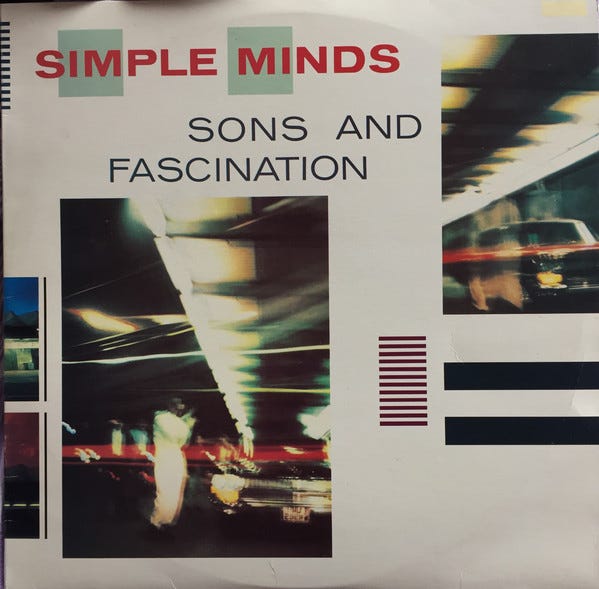
One song in particular sounds so far ahead of its time that it still boggles my mind when I put it on now. “Theme For Great Cities” is that song, and it comes from their fifth album, Sister Feelings Call, which was released at the same time as their fourth, Sons and Fascination, in late 1981.
But here’s something different: there are no lyrics, and therefore there is no dissection of them and trying to discern what they are trying to say. That’s right…this is an instrumental.
Just put it on, and you let it move through you while you dance around the kitchen. But unlike many instrumentals, it refuses to be relegated to being background noise. It demands to be front and centre of your consciousness for just under six minutes and, I’d argue, wants to get a bit in your face.
Much like a great city would. They don’t say which one — perhaps their hometown of Glasgow, Scotland — but more likely somewhere bigger and more imposing on the kinds of senses that one might feel ascending from a metro station and stepping onto a busy street for the first time.
As a result, there is a pace to this song that borders on frenetic, much like the nature of any city. After a lonely spare keyboard introduction — perhaps like a lonely, spare individual entering a crowded space — things start for real at 00:17 when an insistent, pulsing beat provided by the drums and the bass and a single staccato guitar note pushes us in until 1:03. Starting here, other distant, lonely voices can be heard. We are surrounded, but we are alone, even when others brush up on us.
There is constant movement, and this causes dislocation. And yet there is flow; there is a groove, and there is the clear-eyed determination that one might have, walking up and down the familiar streets of a city one knows well. You are a part of it, but the 1980s foam headphones kept you insulated from the world outside of your bubble and isolated from it as well.
They knew this then. And our isolation while walking city streets has only increased since.
I don’t think that lyrics would have improved this song. In fact, lead singer Jim Kerr said it best: "one of the best moves I ever made was not to sing on ‘Theme for Great Cities.’ I remember walking around with that in Glasgow on my new Sony Walkman, thinking this is fucking perfect.”
No argument here, Jimmy.
Here they are, live in Glasgow in 2015 or so. After a brief introduction of band members, Jim Kerr exits the stage, and the band does what it does.
If you have made it this far, it will occur to you that if this is #35 in this series, then there must be 34 previous ones. This is a correct assumption, and here I will link #34. At the bottom of it, you will find a link to #33; at the bottom of that, you can — if you so choose — be taken to #32. This ingenious system that I thought up all by myself continues all the way to #1.