
Music
You Need To Listen To This Song Right Now #31
Heavy Rotation — Never Let Me Down Again, Depeche Mode (Music for the Masses, 1987)
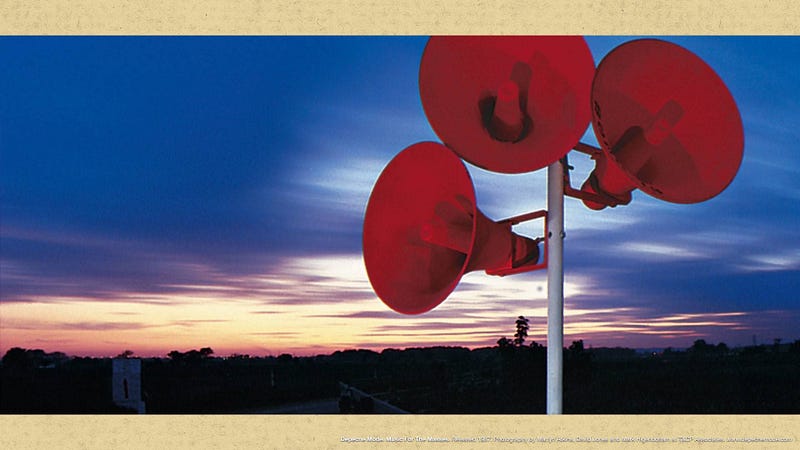
Heavy Rotation was a music industry term for songs that, one way or another, got lots of airplay. It referred to the large amount of rotation that a particular record was given on turntables at radio stations. Since, until the 1980s, this was the only way to get new music into the ears and brains of listeners, heavy rotation meant increased sales. These were good for record companies and artists alike.
Today, some of us still put records on at home and give them a spin. Most of us don’t. However, the term still applies, just in a different way. Streaming services like Spotify sell subscriptions to listeners and then pay artists based on listens. At least, that’s the way we think it works.
For me, heavy rotation means a song that is in my head for some reason. Maybe for a moment, maybe for a day, maybe for longer. It’s a song that you come back to from time to time and still feels just as good.
This series of articles is dedicated to these songs.
Here, I aim to highlight a particular song by a particular band or singer. We should know a bit about the band, a bit about where the song fits into its history, and where the song fits into what was happening in music at that time. Then there’s the song itself. Who’s playing on it, what are the lyrics getting at, and why is it so good? How does it still occupy sonic space in our lives?
I’ll (try to) keep it short. It shouldn’t take you any longer to read this than the song itself. To that end, I’ll put a Youtube clip of the original recording at the top of the article so you can listen as you read. Or not. And because a song is often much different live than in the recording studio, I’ll stick a live clip on at the end.
What song is in your head right now? Here’s the one that won’t leave mine today:
#31 — Never Let Me Down Again, Depeche Mode (Music for the Masses, 1987)
The rock music landscape in the late 1980s in suburban North America was dominated by radio-friendly unit shifters such as Bryan Adams, Van Halen, and Def Leppard.
There was no Grunge and no Britpop yet — those were still a few years off. There was a lot of sameness. But if you knew people who knew people, then other things managed to find their way in.
Music from the UK, in the form of the Pet Shop Boys, Frankie Goes to Hollywood, and New Order might find your ears if you knew where and when to listen.
They all provided an antidote to the suburban sameness of everything. For no band was this more true than Depeche Mode.
Things start for them innocently enough with the bouncy pop classic “Just Can’t Get Enough” in 1981. The song just sounds like bubblegum now, compared to what would come later. Many groups at the time were doing exactly the same thing, and that probably would have been it for Depeche Mode had they not shifted to a decidedly darker tone and set of themes detailing the underbelly of their existence over their next four albums, deeper into the 80s.
Songs like “Master and Servant,” “Stripped,” “Everything Counts,” and “People are People” examined sexuality, homosexuality, depression, obsession, power relationships, racism, capitalism, and addiction in equal amounts.
By the time they arrived at Music for the Masses — their sixth full album — in 1987, Depeche Mode had cemented its status as a worldwide band to be taken seriously. It was an uncommon mix of electronic music, samples, loops and guitar, drums, and bass rock and roll created by the songwriting and electrifying live performance that featured David Gahan on vocals and Martin L. Gore on guitar and synthesizer.
It’s here on this album things get really dark. Never Let Me Down is a song about addiction. Addiction to heroin specifically. Gahan’s addiction.
The near-death experience and eventual reckoning with that addiction would come on later albums Violator (1990), Songs of Faith and Devotion (1993), and Ultra (1997). But on Never Let Me Down, despite the song's dark, insistent, and menacing sound, the high of the high is still sought after, but increasingly is something to be feared.
It all foreshadows Gahan’s overdose and suicide attempts later in the 1990s.
The song comes in with an instantly recognizable guitar intro provided by Gore and the booming bass and snare drum beat that pounds ceaselessly throughout the song with little in the way of fills, frills, or ornamentation comes in at 00:08. It’s here where during the live show, the crowd will lose its collective mind in a heaving group euphoria.
The synthesizer theme coincides with this and is equally insistent. You cannot escape it once it starts, a metaphor for the grip that heroin will increasingly have over Gahan.
His vocal comes in first at 00:35 with this distinctive voice:
“I’m taking a ride
With my best friend
I hope he never lets me down again”
I get the sense that Gahan knows that he is no longer taking this ride of his own free will and that he hopes against hope that he will be taken care of, even though experience tells him that this friend has already taken him off a cliff.
“He knows where he’s taking me
Taking me where I want to be
I’m taking a ride with my best friend”
He knows he is in trouble, having passed the point of no return, and it’s almost as though he realises that there is no going back, so he might as well give in and enjoy it.
“We’re flying high
Watching the world pass us by
Never want to come down
Never want to put my feet back down on the ground”
The opening riff comes around again at 1:40, and the lyrics repeat, adding, “Promises me I’m as safe as houses, as long as I remember who’s wearing the trousers,” two idiomatic phrases from British English in which the drug is insisting that everything is going to be fine, but that Gahan must remember that he is no longer in charge, that he has given himself over.
An operatic backing vocal comes in at 3:10 that guides us to the song's climax, reaching ever higher. “Never let me down” is repeated, and you can feel Gahan pleading with the drug to go easy on him, though he knows that doing this is useless. He is in its grip.
Gore, perhaps as the voice of heroin comes in at 3:45, offering a reassuring “See the stars that shine at night / Everything’s alright tonight.” Just…give me your hand and trust me. And shhh…there is nothing that you can do about it anyway.
It would get much worse before it got better. They bounced off rock bottom only to hit it again on this tour and during the recording of the next album and the one after that as well.
However, bizarrely, the music of Depeche Mode would only benefit from it on the following albums, reaching what, for me, are their lean, muscular, sinewy creative heights in the 90s. They are still making powerful, dark music for the masses today.
Here they are live in 2009, with Gahan in fine, if subdued, form
If you have made it this far, it will occur to you that if this is #31 in this series, then there must be 30 previous ones. This is a correct assumption, and here I will link #30. At the bottom of it, you will find a link to #29, and at the bottom of it, you can — if you so choose — be taken to #28. This ingenious system that I thought up all by myself continues all the way to #1
I really do hope that you like what you have just read. If you want unlimited access to thousands of writers, consider a subscription to Medium. It will set you back $5 a month and if you use the link below, then I get a slice of that that I will put towards buying this record on vinyl. Just as soon as I get a record player.


