
Music
You Need to Listen this Song Right Now #28
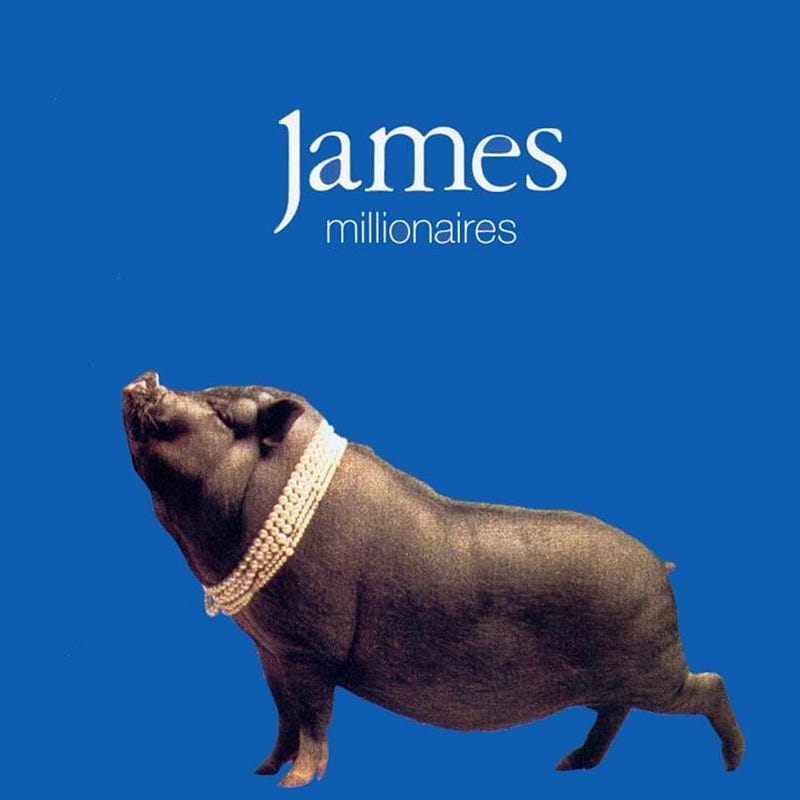
Heavy Rotation — We’re Going to Miss You, James (Millionaires, 1999)
Heavy Rotation was a music industry term for songs that, one way or another got lots of airplay. It referred to the large amount of rotation that a particular record was given on turntables at radio stations. Since, until the 1980s, this was the only way to get new music into the ears and brains of listeners, heavy rotation meant increased sales. These were good for record companies and artists alike.
Today, some of us still put records on at home and give them a spin. Most of us don’t. However, the term still applies, just in a different way. Streaming services like Spotify sell subscriptions to listeners and then pay artists based on listens. At least, that’s the way we think it works.
For me, heavy rotation means a song that is in my head for some reason. Maybe for a moment, maybe for a day, maybe for longer. It’s a song that you come back to from time to time and still feels just as good.
This series of articles is dedicated to these songs.
Here, I aim to highlight a particular song by a particular band or singer. We should know a bit about the band, a bit about where the song fits into its history, and where the song fits into what was happening in music at that time. Then there’s the song itself. Who’s playing on it, what are the lyrics getting at, and why is it so good? How does it still occupy sonic space in our lives?
I’ll (try to) keep it short. It shouldn’t take you any longer to read this than the song itself. To that end, I’ll put a Youtube clip of the original recording at the top of the article so you can listen as you read. Or not. And because a song is often much different live than in the recording studio, I’ll stick a live clip on at the end.
What song is in your head right now? Here’s the one that won’t leave mine today:
#28 — We’re Going to Miss You, James (Millionaires, 1999)
Full disclosure: James has been my favourite band going on thirty years. They may temporarily occasionally swap spaces with the other two in my permanent Top 3 (the Charlatans and the Rolling Stones), but I come back to this band over and over again. The sound and feel of James — their whole aesthetic — is always emotive and overflowing with passion, and coming right at you either full force or elegiacally with a distinctive sound has always transported me to another place. Their albums have always been meant to be listened to from start to finish, and in the order they intended.
There has to be something in the water in the city of Manchester in the northwest of England. It can justify being home to many of the greatest bands in the last part of the 20th century. I’d argue that between 1980 and 1995, three distinct waves of popular music and rock and roll came out of that city.
The first, in the early 80s, featured such luminaries as Joy Division (and later New Order) and the Smiths. The third was the stadium-sized mid-90s lad rock of Oasis and the Verve. It is the second one, in the late 80s and early 90s- that has always been the most interesting to me, and it featured, among others, The Stone Roses, the Charlatans, and James.
These all started coming into my ears when I was in Grade 12 and then during my subsequent first year of university, by serendipitous virtue of the fact that there was a new radio station in the city where I grew up. College rock, they called it, though shortly the branding would change to “alternative.”
Either way, it saved us from the steady diet of Mötley Crüe, Van Halen, and Bryan Adams that we were subjected to at the time.
Originally formed in 1986, by the time I got to them, James were on their third album, titled Gold Mother. The first two didn’t make any inroads outside of the UK, but this one received a push from MTV in America and MuchMusic in Canada on the back of such classics as “Sit Down” and “Come Home.” These two still lift the roof off of any James live show. This was followed by the brilliant Seven in 1992 that featured “Born of Frustration,” and it all culminated with the incomparable Laid in 1993. Most people who have never heard of James will find the title track instantly recognizable.
Momentum was on their side. And then it stopped. The same fighting, addiction issues, and creative disagreements that have derailed countless bands marred the recording of Whiplash in 1997. It was overlooked, but not criminally so. It did have a lot of great songs on it, but it was not their best work, and James had clearly run its course.
But not so fast.
Somehow, despite all this and clear signs that they should break up, James soldiered on. A few founding members left, and new ones were added, and somehow the sound stayed true, perhaps even more exuberant on Millionaires in 1999, by then their eighth album.
The standout track for me on this album is We’re Going to Miss You. The song itself seems to represent a sort of talisman, a shield, an amulet of sorts to be held up as a protection to deflect the slings and arrows of the critics, both within and without. The push and pull contrast between the verses — sung/spoken in Tim Booth’s uncharacteristic deadpan — and the soaring choruses lift the song out of its seat.
The tone and mood of the song are set right away, with a hypnotic and mesmerising drum and bassline that brings the listener in for a good half minute with a background keyboard for minor key colour.
We first hear the crystal clear and borderline menacing vocal from Tim at 00:34, when he tells us exactly what this is all about
“This is not, this is not a song
This is a shield, this is a charm with your name on
By this beat, by this verse I’m protected
From your heat and your curse is reflected
If anybody hurts me, if anybody hurts me”
And just as we get as comfortable as we can with Tim almost looking directly at us with his voice, as if to say “Yeah, you,” at 1:16, the rest of the band sweeps in the chorus soars into a major key.
“Here’s a mirror with your name on
Singing, we’re gonna miss you when you’re gone”
And just as we quickly, we are taken back to the start in the next verse, in which Tim spares no venom for the critics, whom he believes will get theirs sooner or later. He’ll let it go and forgive them for everything eventually, but first, he will be a little more honest with himself and us….there needs to be a little payback. Let’s get real here.
“Your green eyes, poison pen, serpent’s tongue
Will return to the source that they came from
Revenge is the wine, forgiveness is fine
Forgiveness divine, revenge is more human”
And when he drops that “human” — the pause before that single word at 2:24, we know that Tim knows he’s won. And off goes the chorus again, into the sky. “No more words, all’s been said and done.” Once more into the chorus and the melodies of a band incredibly in sync and woefully in disarray.
Despite everything and against long odds, they made another album in 2001, Pleased to Meet You, which was to be their last.
But not so fast.
It took until 2008 to bring the original lineup back together for Hey Ma. They’ve made six more albums since. They will, apparently, not be stopped.
Here they are live in Gateshead in northern England in 2011
If you have made it this far, it will occur to you that if this is #28 in this series, then there must be 27 previous ones. This is a correct assumption, and here I will link #27. At the bottom of it, you will find a link to #26, and at the bottom of it, you can — if you so choose — be taken to #25. This ingenious system that I thought up all by myself continues all the way to #1
I really do hope that you like what you have just read. If you want unlimited access to thousands of writers, consider a subscription to Medium. It will set you back $5 a month, and if you use the link below, then I get a slice of that that I will put towards buying this record on vinyl once I get a record player.


