
Music
You Need to Hear this Song #19
Heavy Rotation — Stars of Warburton, Midnight Oil (Blue Sky Mining, 1990)
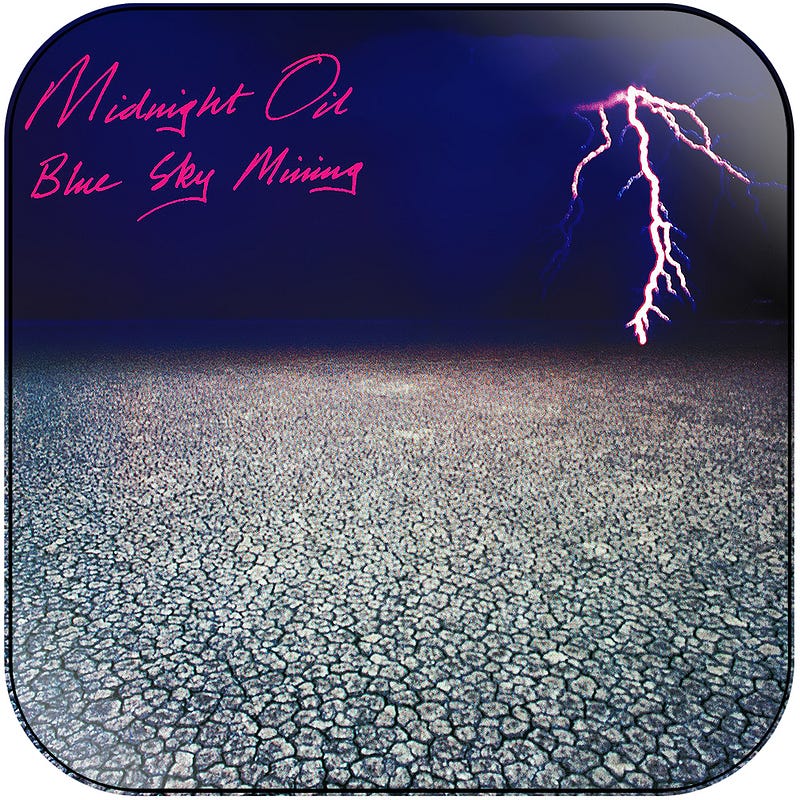
Heavy Rotation was a music industry term for songs that one way or another got a lot of airplay. It referred to the large amount of rotation that a particular record got on turntables at radio stations. Since, until the 1980s, this was the only way to get new music into the ears and brains of listeners, heavy rotation meant increased sales. These were good for record companies and artists alike.
Today, some of us still put records on at home and give them a spin. Most of us don’t. However, the term still applies, though in a different way. Streaming services like Spotify sell subscriptions to listeners and then pay artists based on listens. At least, that’s the way we think it works.
For me, heavy rotation means a song that is in my head for some reason. Maybe for a moment, maybe for a day, maybe for longer. It’s a song that you come back to from time to time and still feels just as good.
This series of articles is dedicated to these songs.
Here, I aim to highlight a particular song by a particular band or singer. We should know a bit about the band, a bit about where the song fits into its history and where the song fits into what was happening in music at that time. Then there’s the song itself. Who’s playing on it, what are the lyrics getting at and why is it so good? How does it still occupy sonic space in our lives?
I’ll (try to) keep it short. It shouldn’t take you any longer to read than the song itself. To that end, I’ll put a Youtube clip of the original recording at the top of the article so you can listen as you read. Or not. And because a song is often much different live than in the recording studio, I’ll stick a live clip on at the end.
What song is in your head right now? Here’s one that won’t leave mine today:
#19 — Stars of Warburton, Midnight Oil (Blue Sky Mining, 1990)
Midnight Oil first hurtled their way into my ears around 1987 or 1988, thanks to their 1986 album “Diesel and Dust”, their sixth. Straight ahead, pounding yet melodic rock and roll from Sydney, Australia, with lyrics that focused on nuclear weapons proliferation, the environment and especially on the impacts of their government’s policies on Aboriginal culture for at least two centuries. “Warakurna”, “Bullroarer”, “Beds are Burning”, “the Dead Heart”, are all great angry songs about just that. The stage presence of a bald and 6 foot 6 front man Peter Garrett pushed them forward in the immediacy of their message.
They won themselves a lot of fans with their vocal stance and attempt to speak up for the voiceless, but this made them a lot of enemies too.
I recall a conversation with an Australian fellow traveller at a hostel in Prague in 1997, in which he told me “he liked their music, but hated their politics”. I was taken aback, having thought all Australians were on board with what they were talking about. Wrong. Some still preferred the AC/DC approach to things, I guess.
By 1990, they had hit the big time outside of Australia and put out “Blue Sky Mining”, a more slickly produced record with a somewhat toned down sound — although not on songs like “King of the Mountain” and “Forgotten Years”. Their rage was only slightly dimmed by success and middle age.
It was on Stars of Warburton that they’d hit their most accessible stride. I’d always loved this album and this song in particular, but it had faded out of my heavy rotation in recent years. However, it was while recently reading “Tracks: A Woman’s Solo Trek Across 1700 Miles of Australian Outback” by Robyn Davidson about her epic journey in 1980 during which she made a stop in this particular small settlement called Warburton, on the edge of the Gibson Desert in Western Australia.
She describes the out in the back of beyond place in this way, “Warburton was a hole. After the magnificence of the country, and the charm of the tiny settlements that I had passed through, it came as an unpleasant shock. Every tree for miles had been knocked down for firewood. Cattle had eaten out the country around the waterhole and dust rose in suffocating billowing clouds. The flies carpeted every square inch of skin, even though it was mid winter. And in the middle of this desolation, surrounded by the lean tos and shanty town humpies of the Aboriginal people, was a hill where the whites buildings clustered together, fortified (presumably against Aboriginal aggression) by high cyclone fences and barbed wire.”
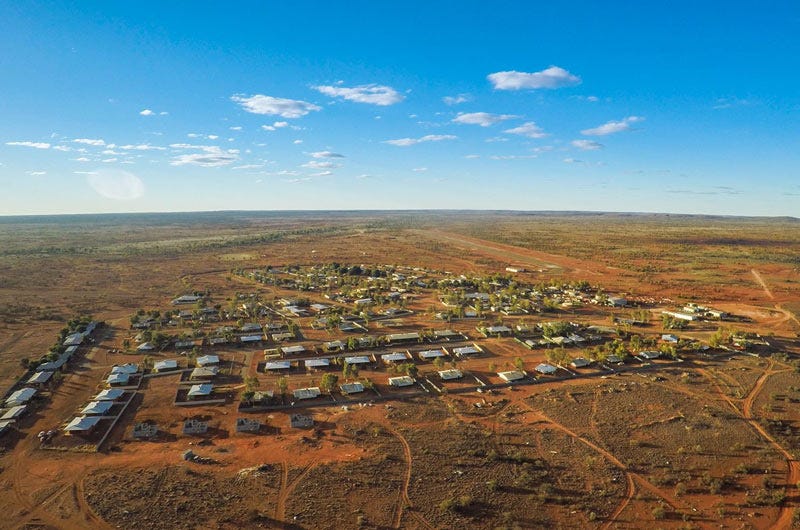
But a page later, she says, “I spent a week in Warburton, floating with happiness.”
Maybe Midnight Oil read this book too and despite her description, or perhaps because of it, the song writers were entranced by the place. And so, as I galloped through the pages of this gripping book, this song immediately came back to mind.
It starts with a shimmery guitar intro by Jim Moginie and Martin Rotsey, but quickly settles into a beat that chugs along courtesy of Bones Hillman on bass and Rob Hirst on drums. You can imagine yourself behind the wheel of a Landrover Defender as the red ground drifts by on your way to the endless horizon as Peter Garrett first chimes in at 00:16.
“I, I was shaken down in a toy town.
You know it’s Kennedy’s shadow from White Cross to Michigan
ATM’s, are in the air, oh yeah machines they are spinning out everywhere.”
Here is the first American reference in the song and it might have something to do with the uranium mines in the area that are being opened and the dangers associated with it that will come to the Aboriginal community there. Warburton might be a case study of what happened to countless Aboriginal settlements when the exploitation of natural resources began in the surrounding area.
“Don’t want to talk about Elvis Presley
Don’t want to see his white shoes walking around
And around and around over here”
An American reference again, Presley and his shoes might be symbolic of the mining company surveyors that are planning to dig up the resource that will power their nuclear arsenal. Midnight Oil wants nothing to do with it. And they want to speak up for Aboriginal communities that no one is listening to.
“Over the hills and mountains we go, so far, so far away
For the ring of the axe on the ironbark, for the smell of the wallaby stew
From the golden reefs to the sandstone cliffs
Came the sheep of the Mallee plain
The wind blew the soil to the Orient, we’ll be shouting to the skies again”
This paints a different picture of the place than Davidson’s description in her book did. Midnight Oil sees Warburton as “what happens in this place, happens to us all”, in their desire to paint a picture of a desolate dot on a map that most Australians (I’m guessing) have never heard of, much less have a reason to ever be in.
Davidson, in her book, details the fact that Aboriginal people have a much different relation to the land than Western settlers or resource exploiters do. To put it simply, a piece of land cannot be owned. It does not belong to the people or any one person, since the people belong to it. To force an aboriginal person off of the land is to commit a kind of genocide. This is the case whether in Australia or in Canada, where I am from and this message is finally getting the attention it deserves.
“It belongs to them, we gotta give it back”, sang the Oils in 1986 on “Beds are Burning”. Davidson was already saying so in 1980.
The song drives and builds to its logical conclusion, “I, I couldn’t believe the Stars of Warburton were living in me, raining down on me, washing over me.” A beautiful coda rounds out the song when the lyrics end. The connection to the place by putting yourself there and looking up at what must be an absolutely dazzling night sky and feeling your own insignificance in the knowledge that it has always been there and has never changed.
To me, Midnight Oil in the 1980s and 1990s were singing about issues that were on the horizon then, but are now immediately in front of us. That alone makes this album and the 6 before it and 6 after it worthy of a relisten. A listener will find a band that has the courage to shed some light on topics that we’d rather avoid, like the bolt of lightning on this album cover. That they always did just that while keeping the human touch with hands on hearts means that they’ll be in my heavy rotation at my house for years to come.
Here they are, in their ragged glory in Toronto in 2017. Bruce Springsteen aside, Midnight Oil is the best live show I have ever seen. They are touring for the last time this summer.
If you have made it this far, it will occur to you if this is #19 in this series, then there must be 18 previous one. This is a correct assumption and here I will link #18. At the bottom of it, you find a link to #17 and the bottom of it, you can — if you so choose — be taken to #16. This ingenious system that I thought up all by myself continues all the way to #1


