
You Need Some Serious Self-Talk About Your New Year’s Resolution
Don’t trip over unrealistic goals when 2024 begins.

If there’s something that I don’t like about New Year, it’s the guilty feeling of giving up my previous New Year's Resolution in just the first 2 months.
One study by Edith Cowan University found that about 64% of people abandoned their New Year’s Resolution within the first month. Perhaps you’d join that 64% too, if you are not careful planning one.
It turns out there’s this odd psychology behind the practice that when we examine it more closely, the less it makes sense. Clinical psychologist Sabrina Romanoff shared her insight regarding this:
The New Year serves as a cyclical marker of time during which we reevaluate and take inventory on our lives. The drive for making resolutions is motivated by this punctuation in time. [It] activates hope and expectations for what we hope to achieve going forward.
Indeed, for many, a new year coming is like throwing away that washing machine with a broken motor or a shattered TV and placing it with a new one. Brimming with excitement, you crack open a new diary and start filling out the first page with your ‘glorious’ goals for yourself.
As Sabrina said, this action is influenced by the year's ‘punctuation in time’. We humans love this punctual sense of renewal, but deep down, it’s simply a blank slate feeling.
Don’t get me wrong; the practice would benefit you; it allows you to spend time in quiet reflection on the past year and plan your objectives, preparing a pathway for your new-year selves.
New Year's Resolution marks the turning of a page of what feels like a finite adventure. After all, it’s another year of your life, and you want a fresh self for it.
According to Forbes Health, the top 5 New Year’s resolutions for 2024 are:
- Improve fitness
- Improve finances
- Improve mental health
- Lose weight
- Improve diet
These goals sound awesome, but they are lofty and vague. Overshadowed by the New Year excitement, people often focus on the results of these goals instead of the rocky path they have to take to get there.
Surely, such excitement will not help you achieve the lofty goals you eagerly set for yourselves on the first day. And, unless you meditate a lot and learn to forgive yourself, failure to achieve those goals can prove much worse than spring allergies.
Consequently, it’ll leave you disappointed and frustrated; it’ll get you off to a bad start already when the new year has just begun.

Establishing The Right Mindset
By now, you probably have heard about the S.M.A.R.T goal, which promotes the idea that for a goal to be impactful, it needs to be Specific, Measurable, Achievable, Relevant, and Timely.
We will return to it later, but keep it in mind as you continue.
Reflecting on the past year
Many people are eager to write down all the things they want to achieve in 2024. But you are to do something different. If you have a new-year diary nearby, return it to your drawer or put it in a corner of your bedside table. Then, look at your diary of the previous year.
This is important, as trauma specialist and author Britt Frank said:
Without examining where we are resistant to change … the cycle of resolve, relapse, repeat continues year after year.
Thus, a diary perfectly serves as a source to look at when you don’t know where to change. You may remember it is to reflect on your thoughts, feelings, and experiences. It allows you to release your emotions in the face of difficulties/uncertainty and even helps you develop goals.
One of the traps people fall into is making unrealistic goals. They don’t even leave themselves enough time to achieve them. That’s why you need to look at what works and what doesn’t, especially the part that you are resistant to.
So, ignore the new-year excitement, get down to Earth, reflect on past experiences, and think critically before creating your goals. Remember, your goals need to be S.M.A.R.T.
Focus more on the battles (not the war)
Fun fact — The term ‘resolution’ comes from the Old French word “resolution” and the Latin word “resolutionem,” both of which mean “a breaking into parts” or “a process of reducing things into simpler forms.”
Just as you should focus on victories of the small battles instead of the war, you need to pay attention to and build gratitude for small victories along the path of your endeavor.
Now we are getting to the ‘measurable’ part of a SMART goal. Goal planning is good, but not all goals deserve all of your attention. For instance, getting in shape is an admirable goal, but you may not want to work with it.
Instead, slice it down; make it a bit more measurable. Instead of ‘getting in shape’, you may plan to, ‘lose 10 pounds in 2 months’. That sounds better, but it can be even more measurable. What about ‘exercise for 30 minutes every day’?
The lesson here is to quantify your goals as much as possible. You don’t want to hook your mind to lofty, infeasible goals. And it is for a simple reason, we achieve long-term goals bit by bit, not a whole chunk.
Research suggests that 92% of people who set goals fail to achieve them. One of the reasons for this is because the goal is too hard or doesn’t make them happy.
Celebrating small victories will mold your mindset and establish resilience. When you conquer a day (which feels like a battle), you are more likely to stay happy and step up to conquer more. If everything is done right, the road may get paved for you.

How to write a S.M.A.R.T goal
Now is the time to fill out the first page of your new-year diary. George T. Doran, the man who invented the SMART goals, wants you to consider these important points when writing down your goals.
I also want to share my personal goal for 2024, which is to achieve $100/month writing on Medium (I know it’s silly. Don’t laugh). So I will compare my goal with another example side by side as I explain these important points.
(S)pecific
Usually, your goal is nonspecific because of the way you word it, leaving the words you use open to many interpretations.

(M)measurable
It’s easy to slide off the track if you can’t assess your progress after some time. Adding words like ‘increase’ and ‘earn’ will put you in the quantifiable territory, making it easier to track your progress and locate the finish line.

(A)chievable
Again, goals should be realistic. Don’t let the new-year excitement blind you; assess your situation and formulate a plan that’s compatible with your goal in the ‘specific’ section.
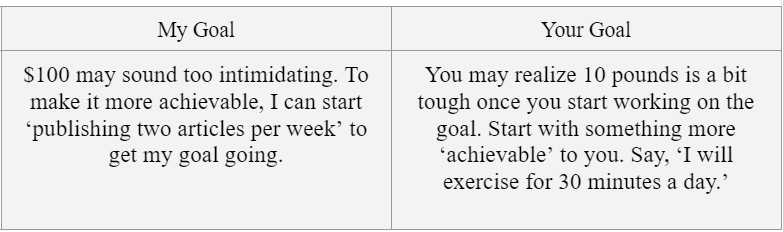
And I get it, exercising for 30 minutes would fall short of your objectives, but you can always reflect on your progress and push yourself harder in reasonable doses.
(R)elevant
Think back to when you decided to set this goal. Ask yourself, ‘Does this goal align with my values? Does it conflict with my habits and such?”
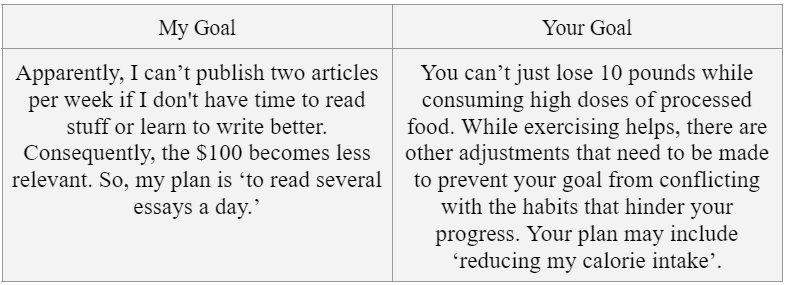
(T)ime-bound
Your mind and body need to be on the same page about when the goal should be reached. A goal with a clear timeline helps you make necessary adjustments to stay on track and, most importantly, stay away from procrastination.

Result
In the end, you may have a layout like this in your diary:
Specific — I want to lose (#) pounds.
Measurable — I want to lose 10 pounds.
Achievable — I will exercise for 30 minutes a day.
Relevant — I will stay hydrated and reduce my calorie intake.
Time-bound — I will achieve my goal in 1 month.
My Statement — My goal for the next month is to lose 10 pounds. I will begin by exercising for 30 minutes a day while staying hydrated and reducing my calorie intake.
You can word it however you feel like, but the statement should adhere to the five aspects of the acronym.

Now that you have a goal, time to put it in the wild and get it rolling.
And happy new year!


