
You Need 4 Systems to Build a Strong Business
Raise your efficiency, reduce your costs, and cure your headaches
A bad entrepreneur only works for his own company. A fortunate one has his company working for him.
If you discovered this article, it means you have some entrepreneurial blood in your veins. Subscribe to my YouTube channel, Small Business Hacks, and unleash your inner entrepreneur.
This is a piece of wisdom I heard during business school. My grandfather, father, and brother, all of them entrepreneurs later endorsed it. I also confirmed it when opening my first and second businesses. In fact, this is one of these aphorisms that every time we tested it, it proved to be true.
It is natural that we expect hoteliers to know about hospitality, car dealers to understand cars, or marketing agency owners to grasp Google Ads. But would we be wrong to assume that these same hoteliers are the best in receiving guests, car dealers are the best sales agent, and agency owners would be the best in creating Ad campaigns.
What differs a strong, scalable business from a firm doomed to stagnation (or worse) is the ability of its managers to create systems, adapt, and innovate. This makes an enterprise. Firms that neglect it, stagnate and disappear.
Why You Need Systems
Ask yourself these two sets of questions:
1st — What would happen with your business if during the next two months you were in a coma or had complete amnesia? Would the core activities happen normally, would the firm struggle but keep going, or everything would just stop after a few days?
2nd — Imagine your business as being ten times the size it is now. What roles would exist, and how would you hire and train everyone? Would you have someone taking care of the marketing online, a sales area, a customer-satisfaction supervisor, etc? Peter Thiel suggested that anyone wanting to build a successful business should do this exercise.
Once you realized the major value of systems, there are other benefits to have in mind.
Benefits of a systematic approach
Allan Dib, in his book The 1-Page Marketing Plan: Get New Customers, Make More Money, And Stand out From The Crowd, stated:
You’re almost guaranteed to make a fortune, if you can create scalable and replicable systems.
While I believe systems will only make a fortune if they are together with good execution and a profitable business idea, there are a myriad of extra advantages.
- Empower your staff: Nobody loves repetitive tasks. Nobody fancies to execute them, learn or teach other people about them. That is why a business system works to reduce boring chores or even eliminate them. Once this happens, your team can spend less time and brainpower on insignificant matters and use their talents to benefit your business and their career. Even the US Navy got this lesson.
- Happier customers: One result of a systematic approach is data-consistency. With data-consistency, you will know the changes affecting customer satisfaction. With this information, you can invest in what clients enjoy and eliminate what causes dissatisfaction.
- Training is faster and more efficient: Imagine needing to answer exactly the same thing a dozen times, every day. This happens when training and onboarding do not have systems for knowledge transmission. This demotivates recruitment staff and results in inconsistent answers. With knowledge-replication systems, your new team members will fly in the learning curve and quickly achieve the efficiency apex.
- Consistency is key: What Toyota Corollas and Big Macs have in common? Both are products that, while not the best in their respective areas, achieved global success because of their consistency. Everyone knows what to expect from a Corolla and a Big Mac, no matter if you are buying one in the USA or New Zealand. This is possible because both Toyota and Mcdonald’s are models of systems-oriented companies. When customers know what to expect from a product, they feel safer buying it instead of heading to the competition.
- Let your child grow: By eliminating repetitive tasks, streamlining the knowledge transmission, and giving autonomy to your staff, you will be able to replicate your business. Systems give companies the ability to expand to different geographical areas or markets. You can even franchise or license your systems.
To achieve all the benefits mentioned above, there are four central types of systems you need to design (or implement, if you decide to adopt from another business). This is valid for any sector or activity.
Marketing system
This is the system that will attract prospects to your company. Other systems can later convert them into paying customers. It will also handle the communication between your firm and the world.
Major functions of the marketing system:
- Promote products and solutions
- Generate a consistent flow of leads for your business
- Damage-control when needed (recall announcements, for example)
- Gathering prospect insights and market intelligence.
Example of marketing system: In one of my businesses, we generate leads by offering free perks (like a 15-minute consultancy or an illustrated guide) for anyone interested in our services. This is an automated process. The person interested can, for example, schedule his free consultancy using an app called Calendly.
Sales system
This system is what will turn a prospect into a paying customer. Some marketing authors may argue that sales are part of the marketing system, but this is a discussion for another article. The major functions are:
- Pricing — using the insights gathered by the marketing system.
- Customization — In the cases where it applies. For example, Tesla allows the Model S customers to design their cars.
- Billing
- Payment and Processing
Example of sales system: In my other business, a touristic hostel, customers can select their room, pay, and do online check-in in a few minutes. They will already know their room (and other hostel facilities), so they have can arrive straight at their door if they are not in the mood to talk to anyone. This was very useful to comply with the COVID-19 social distancing rules.
Fulfillment system
This is where you deliver the goods or perform the services for which your customer paid. It is often the most labor-intensive of the four, and the one with the highest potential for automation.
The major functions of this system are:
- Packaging (for physical goods)
- Scheduling
- Delivery
- Logistics
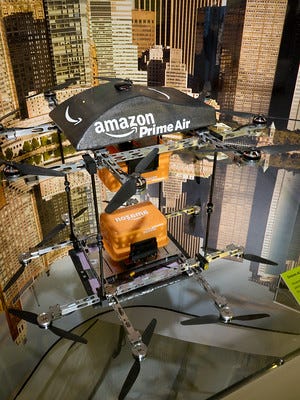
Example of Fulfillment system: Intel under Andy Grove and, more recently, Amazon. After rolling out the Amazon Prime Air, they pioneered full delivery automation for selected markets and products. According to themselves, Prime Air is designed to safely get packages to customers in 30 minutes or less using unmanned aerial vehicles, also called drones. Prime Air has great potential to enhance the services we already provide to millions of customers by providing rapid parcel delivery that will also increase the overall safety and efficiency of the transportation system.
Administration system
It comprises all the back-office processes and activities. Here too there is a possibility of discussion since some authors include fulfillment as part of the administration system, although is common to have it separated. The good news is that there are plenty of free tools to help you automate your administration.
- Accountancy
- Reception
- Training
- Information Technology
- Finance and Treasury
Example of Administration System: In my first business, we automated the sub-system of accountancy by using a solution called FakturaXL (available only in few markets), where all the invoices go to our accountant in real-time. It eliminated the need for human intervention, for printing papers or sending couriers with physical documents. When I implemented this system in a firm that I took over, it impressed the staff how it saved so much of their time.
Explore the outstanding gains of building and improving your business systems. It is such a powerful tool that it can bring destruction if used for the wrong purposes — Eike Batista proved that when he designed a scheme to delude investors.
Once you do that, you’ll never return to the old ways of running a firm. I tell that from experience. With all the time savings, entrepreneurs will have extra hours to dedicate to other activities, like I am doing writing this article while both my businesses are running, not with me but powered by their systems.
If you liked this article then you may also find this one useful:
Levi Borba is CEO of expatriateconsultancy.com and a best-selling author. You can check his books here, his other articles here, or his Linkedin.