
You Must Reward Missed Deadlines, or How Motivation Really Works.

What do you do, as a manager, when a team member misses a deadline?
Shit sandwich, one-to-one meeting? Toyota way, root cause analysis? Open-office sarcastic praise (I personally loved that one, as it pleased my inner insecurities)
Recent neuroscience research shows that you should praise and reward their efforts regardless of the lateness. The more behind, the higher the reward.
Let’s see why this incongruous statement makes total sense.
Why do we work at all?
Did you ever completed all the small and easy tasks on your to-do list but didn’t have the courage to start the one that matters?
I would answer all emails, rather than start reading through 120 pages of requirements from a client’s project.
I would check LinkedIn rather writing a long email.
It’s not procrastination, it’s your brain, trying to avoid spending his most precious resource: mental energy.
Every time you’re facing a new task, anything from opening the fridge to writing your Ph.D. memorandum, your brain, makes estimates.

- It analyses the available mental energy at his disposal (that’s why it’s better to start your day with the most challenging tasks when your mental energy is the highest).
- Then, it makes assumptions about the potential reward (aka: not being killed in a gun robbery, fresh beer from the fridge, or getting a Ph.D.)
- Finally, it estimates the costs in mental energy units to complete the tasks, and it usually assigns the minimum possible amount, constantly underestimating tasks.
If the costs/benefits are not met, you will have all the difficulties to start the tasks.
Mental energy is a new concept that is not well defined yet, but is of public interest. It is the ability or willingness to engage in cognitive work. It can be assessed using different methods, such as tests of cognitive performance, mood questionnaires, brain scanning technologies, and ambulatory monitoring.
It makes total sense, from an evolutionary point of view: If the time for tracking that animal is wrongly estimated and you spend more energy than planned, you might simply die in the middle of the bush.
But it only gets more interesting…
Now, imagine your brain decides that the task is worth completing and you start working on it.
The mental energy is then loaded into your immediate memory and gives your brain everything needed to complete the task: you feel that “flow” or focus, you mentally see the goal, and you’re energized.
During task completion, because your brain tricks you and underestimates the mental energy needed, it often occurs that you need more of it.
You end up with a mental energy deficit, which you need to replenish, but only under certain conditions.
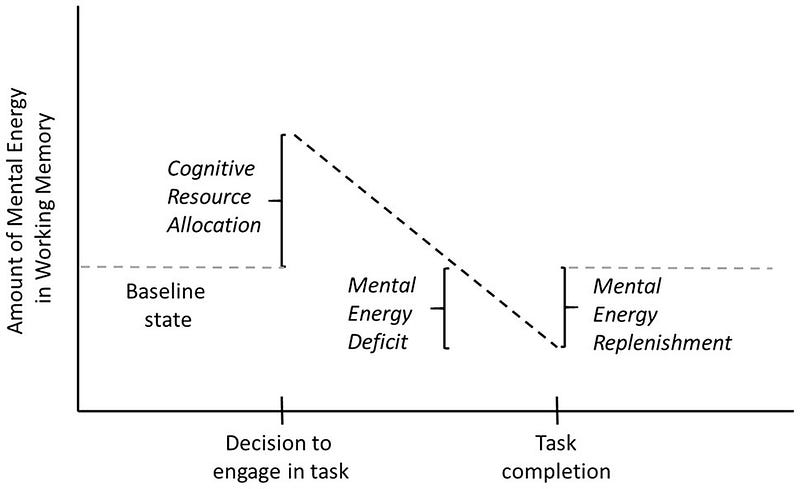
That’s the exact moment you feel exhausted, and need a break, a coffee, or a walk.
But how do you feel afterward?
Imagine you’ve started a 1000 pieces jigsaw puzzle.
You thought it would be a nice time to spend with your partner for the next 2 hours before going to sleep.
You poured a glass of white wine and started assembling little red pieces red with the reds, greens with the greens, and those strange ones altogether.
As time goes on, your progress is terrible.
You start checking notifications and turn on your TV. Maybe at some point, you’ll ask your partner to go to bed. Every new piece is irritating you more. Finally, you decide to stop.
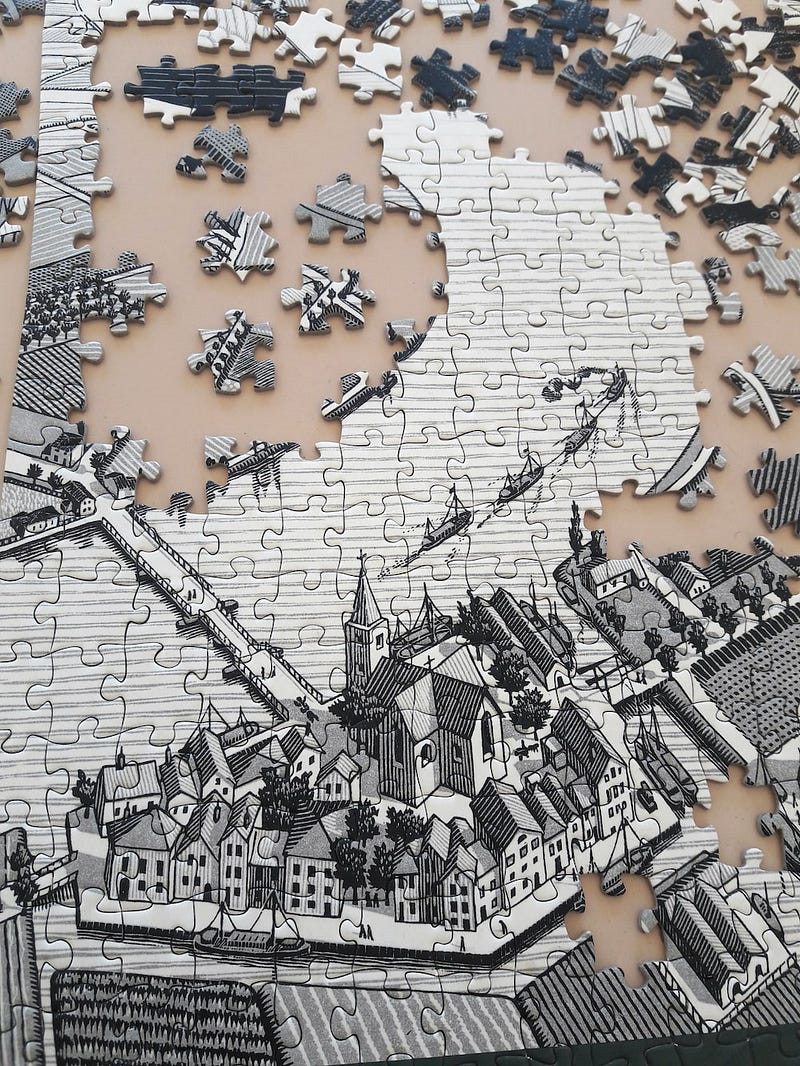
How do you feel at that specific moment?
Probably slightly ashamed, hating puzzles. There are chances you’ll not get back to that puzzle until a few days.
Well, we know now why you feel that way.
When you started that puzzle, you estimated (wrongly, as usual) it would take only 2 hours, and your brain allocated your mental energy accordingly.
At some point in, your brain continued to fuel you with mental energy. But as you understood you’ll not be able to complete your goal, your brain sent you signals to stop this behavior immediately (TV, checking phone) and your motivation dropped.
Once you finished you felt bad.
That’s the learning phase. Your brain analyzed the total invested mental energy, compared it to the bad reward (you absolutely didn’t finish the puzzle, unlike the bottle of white wine), and punishes you by trying to make you a lesson so you avoid engaging in similar activity later on (that’s why you’ll probably not finish that puzzle tomorrow and it will remain on your table for the week).
Back to the deadlines.
Now, remember your last small victory.
For me, it was the last RFP for a big project. I’ve spent countless hours on the response for several nights in a row. When we finally won that project with my company, code.store, I felt amazing, and despite those sleepless nights, I was ready for another round.
I felt replenished.
Learning phase again.
As the reward was worth the total invested mental energy, my brain pushed me towards more similar activities. I was learning that efforts for that specific kind of task are worth the energy consumed. Remember, your brain uses up to 20-30% of your body’s total energy.
Now you might start seeing why you should praise and reward your teams when they miss deadlines.
When they gave you estimates, they probably underestimated the work (check my article about how to estimate time for projects).
If they are late, they invested way more mental energy in completing the task. If you blame them for the lateness, their brain will learn them to avoid those tasks together. It will not replenish their mental energy and they will be voided for several days in a row.
But, if you actually praise them for their efforts more than usual, you’ll trick their brains. They will feel replenished, and energized and will start working even harder the next day.
You can read the full scientific paper here.
And if you want fully motivated people working on your next project, ping code.store :)


