
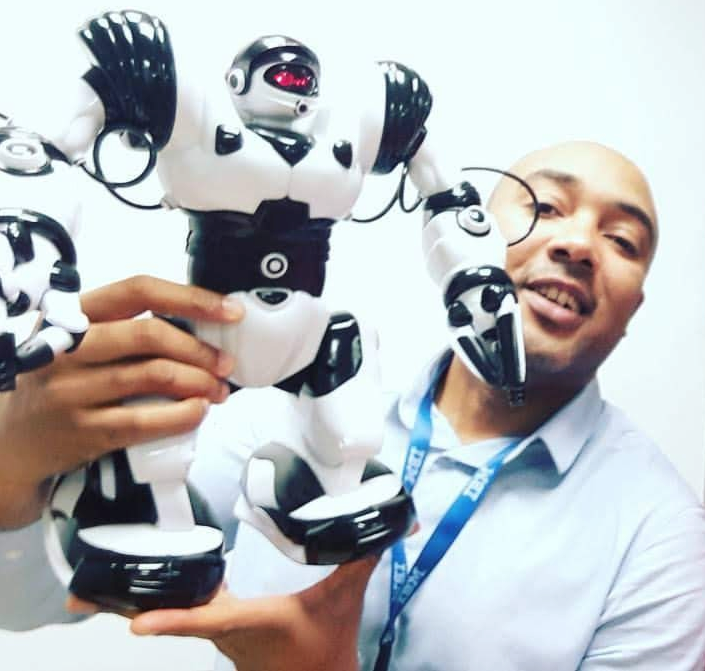
We should learn how to collaborate with robots before it is too late!
A brief guide to thriving in the new era of humans and machines.
Much has been said about how automation processes can render a large number of jobs obsolete.
After all, the opportunities for technologies involving robotics and artificial intelligence have grown exponentially. Workers worldwide have been anxious about how this new era of automation can affect their careers.
The concerns of shrinking jobs during the rise of robotic automation and AI it’s a real thing, and it can be contrasted with three main approaches:
The first is related to continuous learning. The second is associated with accessing and analyzing information in the right way. The third is linked to the importance of uniquely human skills.
Let’s face it: to be prepared for future jobs, we should be less concerned with choosing a secure job position and devoting ourselves more to the continuous learning of new skills.
Automation and the future of work
Numerous studies try to predict the risk of job losses due to automation.
For example, Oxford University published a survey in which it estimates that 47% of jobs in the United States are at risk of being automated, and McKinsey estimates that up to 800 million workers worldwide can be displaced from their jobs because of automation by 2030.
Some professions, as we know them today, will change dramatically, while others will disappear completely.
As machines take on repetitive tasks and the human work becomes less routine, many jobs will evolve into a new model of work, so-called “superjobs” — jobs that combine parts of different traditional roles into integrated functions, adding significantly human skills to automation technologies such as robotics, cognitive technologies and AI.
Entering the era of integration between Humans and Machines
We are coming in the age of a conceptual approach centered on people, which values significantly human skills (such as creativity, empathy, etc.) and emphasizes the need to better understand the highly technological world around us.
To be prepared for future jobs, we must dedicate ourselves to a continuous learning culture based on three main dimensions: Technical, Human, and Data capacity.
Technical capacity: we must understand how machines work and continuous learning about them.
We must ensure that we are trained adequately in the use of new systems and technologies. After all, learning how the technology works and improving our technical capacity is one of the factors that will make us prosper in the future.
To do this, we can use different formats of learning and knowledge sharing systems that massively relies on Group training, Online Education, Webinars, and Lectures by consultants, for example.
In this new era, when we talk about the future of work, we should not feel obliged to adopt any new technology that appears, but be aware of the news in your industry and understand how we can work proactively.
The most important thing is to adopt a culture of innovation and learning present in our daily lives.
Data capacity: we must learn how to analyze and interpret information generated by machines.
Considering this rapid technological advancement scenario and digital transformations, it is essential to avoid becoming hostage to information volume.
Data analysis must be productive, generate useful insights and innovative ideas to improve our company's product and service and internal processes.
We will be called to foster a proactive culture of data management and knowledge sharing in our company. This is nothing more than understanding how the information and statistics developed through new technologies can work for our organization, improve decision-making processes, or provide our team with valuable information that was previously difficult to access.
Human capacity: developing the fundamental human capabilities that machines cannot imitate, or soft skills.
In the era of collaboration between humans and machines, there will be skills that only human beings have and that robots will not be capable of imitating, the so-called “life-skills.”
These skills can be abilities or character traits that are more difficult to learn “in the classroom,” but that improves with time and experience.
Among these skills, we have created our capacity to use imagination and original ideas to create something and find new ways to use existing resources.
Also, we have empathy; that is the capacity we demonstrate when we put ourselves in the other’s shoes to understand and relate to other people’s feelings and emotions.
And, undoubtedly will be very significant to differentiate us from the machines, the ability to find solutions by taking information from a known context and applying it in another context with which it does not necessarily have a connection, something that at least today, machines have a real hard time to do.
These capabilities are very similar to soft skills, that is, the intangible skills of human beings, such as the ability to communicate, empathy or the ability to adapt to changes, for example, as opposed to the hard skills, which designate technical skills, such as knowing how to operate software or a machine.
In the future, employers will consider soft skills as relevant or more relevant than hard skills when hiring since they combine sophisticated knowledge and abilities that are more difficult to be taught.
How to cooperate and collaborate with machines at work
To include technical, data, and human capacity in our work today and in the future, we must undergo a change in culture and practices, rethinking several internal processes in our workplace.
We will need to rethink how we gather data and generate reports of easy access to all, discovering new ways for both humans and robots to thrive collectively.
Ultimately, we aspire that technology can facilitate our day to day activities. Still, neither humans nor machines alone can efficiently support us on the complex task of work in the swiftly evolving world.
We have an excellent opportunity to pursue a healthy balance between humans and machines. We will need adequate frameworks to make it happen in a human-centered workplace and our efforts to build a better society.
Are you ready?


