
You Must Denounce Hamas — and Nat Turner, Quanah Parker, Jean-Jacques Dessalines, Spartacus….
When conquerors break people, some break in horrifying ways.
— Why I finished writing this post
If you hate this post, thank a Zionist. I had started it, then set it aside because the subject of rape and massacre is enough to make me hate humanity. I was planning to delete it half-written when someone left a comment with a link to a photo of the naked corpse of a woman ostensibly raped and killed in Hamas’s October 7 attack, and I knew had to finish this.
But first I left this reply to the comment:
Sharing the picture of a dead person is a powerful way to appeal to emotions and a terrible way to appeal to reason. It is the tactic of lynch mobs and explains why so many Zionists are cheering as women and children and non-combatants are being killed by Israel’s bombs at this very moment.
Who has denied that some members of Hamas committed rape and murder? The question is whether Israel has done comparable things while it steals land that the UN gave to Palestine.
The commenter responded with “The answer is no, and certainly not on the scale of what happened on Oct 7.” I replied,
Scale? Israel has killed and wounded far, far more people than Hamas.
“The data collated by CNBC shows that more than 18,600 Palestinians in Gaza and the occupied West Bank have been killed in conflicts with Israel since 2008. That compares with at least 1,500 killed in Israel over the same period.
Since 2008, at least 183,500 Palestinians have been wounded due to the conflicts, while approximately 11,700 in Israel have been injured, according to the UN data.”
The commenter, like so many partisans, writes as though everyone on the other side is the same, yet that is never true. For example:
Lt Tamar Bar Shimon, who survived the attack at the Erez military base attached to the Gaza Strip’s only civilian crossing into Israel, has testified that a Hamas man tried to take her clothes off, another stopped him, and they left the room in which she was hiding.
At Deir Yassin, Lehi members testified against Irgun members who raped and murdered. At My Lai, some American soldiers protected Vietnamese from their fellow Americans. Massacres are rarely as simple as they seem afterward to people who want life reduced to “We’re God’s chosen ones; they’re demons.”
— The hypocrisy of partisans
“Now kill all the boys. And kill every woman who has slept with a man, but save for yourselves every girl who has never slept with a man.” — Moses, Numbers/Bemidbar 31:17–18
“Where did [members of the IDF] come by such a measure of cruelty, like Nazis? … Is there no more humane way of expelling the inhabitants than by such methods?” — Yosef Nachmani, a senior officer in the Haganah, writing about the massacres at Safsaf, Eilaboun, Farradiyya, and Saliha
If you know any history, you know rape and slaughter are committed by both sides in every major conflict. But people who do not want to talk about the reasons for war will rant about the horrors done by the other side and ignore those done by their own. They pretend history does not exist, so instead of calling for a critical look at what led to war, they call for denouncing the people they hate.
Their demands are a deflection. They do not want us to denounce every group with members who have given into massacre and rape because then we would have to denounce everyone who violently resisted occupiers and slavers.
You could begin with denouncing Spartacus. Consider this, from Sexual Violence in Republican Slave Revolts:
In his account of the Spartacus Slave War (73–71 BCE), the fifth-century CE historian Orosius reports a strange event at the rebel camp: a funeral staged by the rebel slaves for a prisoner of war, a formerly free woman, who killed herself “out of anguish over her violated sexual honor” (dolore uiolati pudoris, 5.24.3). Orosius does not refer to the exact circumstances of her violation, but the story follows an account of the rebels’ attack on the Italian countryside, a frenzy of “slaughter, fire, plunder, and rape [stuprum].” The implication is clear: this woman was sexually assaulted by the rebel slaves. This passage is unusual — not for its reference to rape in conflict, which was as ubiquitous in antiquity as it is today, but for the identities of the perpetrator and victim. In literature from the Roman period, enslaved people are only rarely represented as the agents of a sexual act, be it rape or consensual sex. Instead, they appear in hundreds of references from every genre of literature as the objects of sexual violation. In fact, sexual vulnerability is often treated as synonymous with slave status; to be raped is to be treated “like a slave.”1 Free women, on the other hand, especially those categorized as matronae (respectable married women), were meant to be inviolate.2 This incident from the Spartacus Slave War, in which a matrona is treated like a slave by a slave, is a perversion of the normative sexual order. This is not the only such incident in revolt narratives. The sexual threat posed by rebel slaves is a theme that runs through accounts of slave revolts from the republican period….
Do not forget to denounce Jean-Jacques Dessalines, who has been called the father of Haiti. As noted in The Slaves Who Defeated Napoleon: Toussaint Louverture and the Haitian War of Independence, 1801–1804 by Philippe R. Girard:
In the following days, as his soldiers found several survivors who had been hidden by sympathetic Jeremians, an exasperated Dessalines insisted that local soldiers, particularly those of mixed racial ancestry, serve as executors to make it impossible for them to deny their involvement in the massacre. White women were also targeted at this stage and were often raped or pushed into forced marriages under threat of death. Dessalines finally offered amnesty to surviving whites — only to kill them as they got out of hiding — and left the town with eighty-seven mules laden with specie and silver plate…
The rest of Dessalines’ campaign unfolded with remarkable similarity as he moved from Petit Goave to Logan and beyond. Everywhere, he reminded indecisive countrymen of French atrocities and forced the more reluctant to participate in executions. Everywhere, massacres were accompanied by plundering and sexual exactions…
In Cap as elsewhere, most white women and children survived the initial massacres, which were presented as a retribution for slavery and French atrocities and targeted primarily planters and guardsmen. White and mixed-race women were instead abused sexually… As the massacre in Cap reached its end, however, members of Dessalines’ entourage told him that the white population would never be fully extirpated unless white women died as well… On his orders most women were killed in the following days unless they agreed to marry officers of color. In all, estimates about the total number of white colonists killed after independence range from three thousand to five thousand people.
And you must denounce Quanah Parker, along with many other Native American leaders. From The Rise And Fall Of The Comanche ‘Empire’:
GWYNNE: Well, what happened was what happened in every Plains Indian raid going back for centuries. In other words, it was — this is what Indians did to Indians, and this just happened to be Indians meeting whites.
But the automatic thing in battles, adult males would be killed. That was automatic. That’s one of the reasons that Indians fought to the death. The white men were astonished at it, but they were assuming — assumed that they would be killed.
Most — the small children were killed, very small children were killed. A lot of the, say, children in the, I don’t know, three-to-seven or three-to-10 range were often taken as captives. The women were often raped and often killed.
And so it was an extremely brutal — and it was when — all of the people in the settlements back in those years knew what it was, knew what a Comanche raid meant, which was the same as a Kiowa raid or an Arapaho raid or another kind of raid.
But they were grim. They were grisly. Captives were usually involved. and it’s an interesting kind of moral question that you have to — as an historian about Plains Indians or about American Indians in general, you have to come to terms with this, with torture, which they practiced all across the West — and in fact, all across the East — and these kind of grisly practices that scared white people to death.
GROSS: I mean, you’re talking not only about scalping. You’re talking about various forms of mutilation, cutting off fingers and toes, gang…
GWYNNE: Torture by fire, torture by all sorts of different things — I mean, putting, you know, hot coals on your stomach. I mean, there were lots and lots of imaginative tortures that were indeed practiced by Indians all across the Americas.
GROSS: And this includes gang rape.
GWYNNE: It includes gang rape.
…
GWYNNE: Comanches were incredibly warlike.
They swept everyone off the Southern plains. They nearly exterminated the Apaches. They were warlike by nature. And you know, if you look at, say, the Comanches, and then you look back in history at, for example, you know, Goths or Vikings or Mongols or Celts — or old Celts are actually a very good parallel — in a lot of ways I think we’re looking back at earlier versions of ourselves. We — we being white Europeans — did all of those things. Not only that, but torture was institutionalized in things like the Counterreformation, the Spanish Inquisition. It was part of, you know, the Russian empire. I mean, torture is not the exclusive province of the Indians.
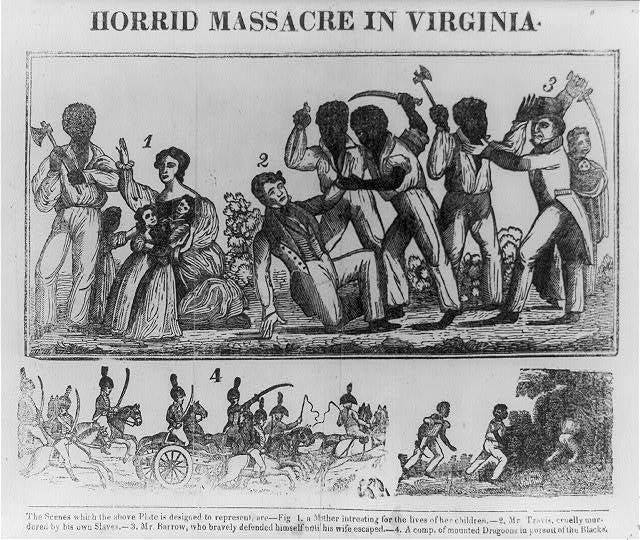
And Americans especially need to denounce Nat Turner. A Woodcut Depicts Nat Turner’s Rebellion provides an explanation:
The event known as Nat Turner’s Rebellion was the largest slave uprising in the antebellum South. Beginning in the early morning hours of August 21, 1831, Turner, a literate slave who claimed to be guided by religious visions, led a group of slaves in a series of attacks in Southampton County, Virginia. Over the course of two days, they killed approximately 60 white men, women, and children. This woodcut depicts the murder of Turner’s owner, Joseph Travis (#2), as well as a nameless mother and children (#1), and a “Mr. Barrow” (#3), shown resisting the attack. The bottom panel (#4) shows a company of soldiers in pursuit of the rebels. In the rebellion’s aftermath, Turner and his co-conspirators were captured, tried, and executed, and hundreds of other local slaves were punished or killed by panicked whites. This woodcut, originally captioned “Horrid Massacre in Virginia,” was published in an 1831 account of the uprising.
On This Day in 1831, a Bloody Uprising in the Virginia Countryside has this introduction to an article about Turner’s rebellion written thirty years later, in 1861:
The author, Thomas Wentworth Higginson, was an ardent abolitionist and soon-to-be colonel of the Union’s first black regiment. He told Nat Turner’s story with empathy and understanding, emphasizing the reasons why the rebel slaves felt justified in committing mass murder. While many Southerners argued that white planters treated slaves well, Nat Turner’s rebellion suggested a different story. Writing just four months after Confederate forces fired on Fort Sumter, it’s likely that Higginson aimed to inspire readers to take a stand against slavery, and join the Union cause.
Higginson saw through the demands to condemn Nat Turner. What matters most is understanding the injustices that break people who give in to the madness of slaughter.
So, ask me to condemn Hamas and I will ask what your real question is.
Do you want me to condemn massacres and rape? That’s easily done — even the people who commit massacres and rapes will condemn them in their sane moments.
Do you want me to condemn the Palestinian desire for the land that the United Nations promised them in 1947? That I will never do.
Either Palestine must have a viable state, which Israel has never offered them, or Palestinians must be made equal citizens in an Israel that allows every victim of the Nakba to return, which Zionists will never agree to. Israel has the power to do either. It must choose, or it will force the world to choose for it.
Related:
Rape and the Israel Defense Forces
Zionists and Rape: the Deir Yassin Massacre and its Deniers
Update:
Many of the original claims have been dropped, but the rape investigations continue. I recommend Here’s what Pramila Patten’s UN report on Oct 7 sexual violence actually said, which begins:
The UN report on sexual violence on October 7 has found no evidence of systematic rape by Hamas or any other Palestinian group, despite widespread media reporting to the contrary. But there are deeper problems with the report’s credibility.