
You Must Answer This Question Before Your Mind Gets Serious About Enlightenment
Millennia of seekers have stumbled over it
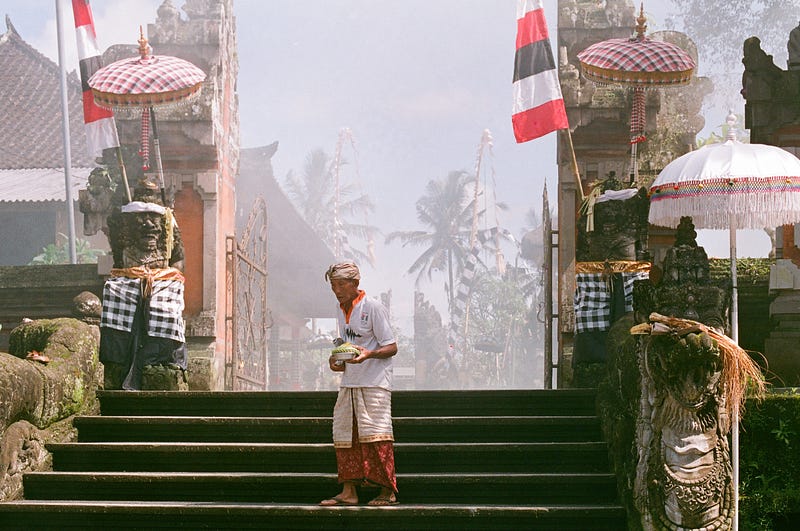
For centuries before, during, and after the Buddha, people have been stuck by the following puzzle.
Does enlightenment happen due to divine grace, or personal effort?
Ancient India was practically a factory for philosophies of liberation, so it’s important to take a closer look at how they were thinking through this.
The oldest Dharmic tradition, other than the Vedic one, belongs to the Jains (the son of the first Jina was Bharat, after whom India itself was named, in Sanskrit).
Jains are curiously the only lineage in India that carry no belief in any divine force, other than human effort. It is to be direct toward uncovering the powers of the soul within – no godhead exists, no deities are venerated for cosmic union.
The Vedas proclaim a divine consciousness that can be reached by infinite methods – but which is ultimately the supreme illuminator, not ‘blind’ human exertion for spiritual progress.
In the midst of this dichotomy, a Buddha appeared.
He never denied the Vedic notion of the divine, but never accepted it either.
He simply ignored the question of its existence altogether!
At the same time, his attitude toward the Jain practices of intense meditation & asceticism was critical. He chastised some of them for trying to “purify” an entire mental continuum of karma that was endless – like a caveman trying to split atoms with rocks.
The Buddha emphasized knowing, radiant, lucid wisdom, above all else.
Seeing your inner reality so clearly that you don’t multiply your misery ever again.
Knowing yourself so intimately that your karmic baggage simply drops away, because the selfhood clinging to it is dissolved.
While Mahayana and Vajrayana developed notions of the Buddhas’ divine powers within the Trikaya (triple body) doctrine, early Buddhism kept it simple.
And today, Mahayanists (myself included) would do well to remember how special it was.
There is no God coming to save you. No matter how hard you pray.
Because from Her/His/Its perspective, you are saved, totally enlightened.
You just can’t realize it, because of all the confusion, dualism, conceptualization, and affliction you’re throwing on top of your primordial nature.
So you don’t have to ‘chase’ something which is already there.
You just have to stop doing a whole lot, transforming your habit patterns to support the underlying nature, instead of covering it!
So you focus on your own actions, not those of something “above.“
Not to become enlightened, but to stop becoming everything else!
- You’re not your desires, changing by the moment.
- You’re not your body, borrowed for a life and recycled.
- You’re not your mind, a mere collection of ideas fed to it.
Permanent purification is not merely digging up the unconscious & letting go of its crap.
It’s the emergence of blazing wisdom, which embraces both itself and what it illuminates, until it can never forget.
You are divine, and so is the world.
This is where it gets uncomfortable.
What if the ideas about divinity that we bring to our Dharma practice don’t come from Dharma at all?
The Abrahamic notion of an all-powerful separate God is not to be found in most Indic philosophical schools (if any).
In fact, they’d laugh at the very idea of it, at best – or call it intolerant imperialism at worst.
Sure, there is a mind that all the enlightened beings are in touch with. It’s unitary. Primordial. But it can’t do everything, because you are clearly doing things right now.
The ancients knew that blind belief leads to atheism.
And reason-supported practice leads to lasting theism.
Religion comes from the Latin root religare, which means to restrict or bind.
It’s not about freedom from concepts and identities; it’s a way to deal with the chaos of the world, by tethering yourself to something.
Dharma, on the other hand, comes from the Sanskrit root dhara which means to hold or sustain. Reality is what does that – and it’s not always kind to our illusions.
Because it functions to dissolve them totally.
This isn’t to say praying is useless, though.
In Tibet and ancient India before it, Buddhists would make pranidhanas (Skt.) or monlam (Tib.), which would be great aspirations, voiced or unvoiced.
They functioned more to place one’s consciousness in a certain orientation than to simply call on an all powerful God-figure to do the work.
‘May this stream of awareness reach an infinity of compassion and knowing, to benefit and bless my precious fellow sentient beings for all time!’
One’s consciousness made contact with the rest of existence by itself, without an intermediary deity, because the entire universe is said to be made up of consciousness.
In aspiration prayers, you activate and tune your awareness to bring forth a resonance from the rest of consciousness, by very strong prayer. But then you actually go out and do the work.
This middle path is one that’ll be increasingly needed in todays age where not only different Dharmic paths are mixing in people’s minds, but the Western (Abrahamic) and Eastern (Dharmic) styles of religion themselves.
Great thinkers who studied both, like Sri Aurobindo and Mira Alfassa, are uniquely poised to guide us out of the mess of infinite teachings available at our fingertips.
And they echoed the Buddha’s attitude when asked about this tricky question.
“Progress depends entirely on one’s personal effort, until one is able to sense the presence of beneficent energies in the universe helping us along.”
But ironically, that’s when personal effort snowballs enough to really get us somewhere.