
You Might Be Living With Hidden Trauma: Here’s My Story
A Survivor’s Tale

“If you are experiencing strange symptoms that no one seems to be able to explain, they could be arising from a traumatic reaction to a past event that you may not even remember. You are not alone. You are not crazy.”
Goosebumps broke out over my skin while reading these words in the prologue of Peter Levine’s “Waking the Tiger.” I felt someone finally understood and could make sense of my pain, as it summarized what I’d been going through for the past half a year. I want to share my story with you, one that may resonate with your own experiences, struggles, and perhaps your silent battles.
My Story Begins
It all started overnight during a vacation in Spain. I woke up with slight discomfort in my shoulder, which soon turned into excruciating pain. This pain prevented me from sleeping and led to the loss of function in my arm. The symptoms quickly spread throughout my body. Over the next couple of months, I was tossed between clinics, but after numerous dismissals by doctors who found no physical cause for my symptoms (besides possibly questioning my sanity), I was left adrift, feeling hopeless and helpless. For months, I lived with debilitating, ever-increasing pain and a wide range of strange symptoms, constantly feeling on the verge of a breakdown.
Initially, a psychotherapist I consulted for pain management suggested that my symptoms might be psychosomatic. To me, it sounded as credible as astrology or fortune cookies. Skeptical, I dismissed this idea as nonsense, assuming that to this therapist, everything appeared psychological. However, I was profoundly mistaken. After exhaustive medical tests, including MRIs, brain scans, blood work, and electromyography, yielded no answers, I had to accept this conclusion.
A New Perspective
Subsequently, I began working with another psychotherapist who echoed the same diagnosis. And when my pain crossed from acute to chronic (beyond 3 months), I started accepting that my issues were psychological in nature. I turned away from conventional medical clinics and sought healing through complementary therapies, including chiropractic, acupuncture, osteopathy, craniosacral therapy, massage therapy, and cupping. You name it, I tried it. I also read extensively on the subject, finding books like Bessel van der Kolk’s “The Body Keeps the Score” enlightening. However, Peter Levine’s works, starting with “Waking the Tiger,” were particularly transformative in understanding how trauma affects the body.
When my therapist first mentioned the possibility of psychosomatic symptoms, I was incredulous. I initially dismissed the idea as “witchcraft.” However, reading about how trauma is stored in the body and nervous system changed my perspective. Levine’s comparison of post-traumatic behaviors in animals to human responses was eye-opening. I realized that trauma, often hidden in plain sight, is intuitively understandable and common sense.

The Science Behind Trauma
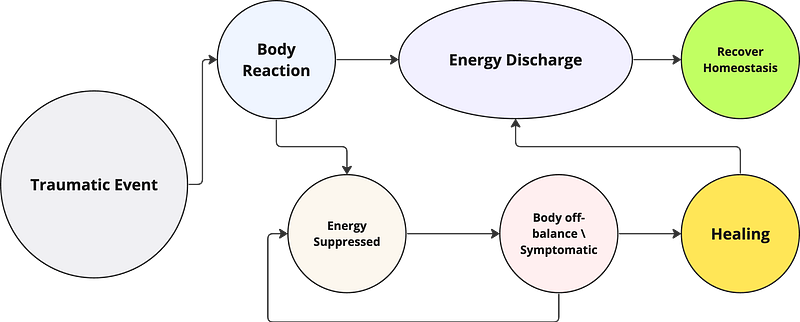
My current understanding is that in tough situations, our bodies prepare for fight, flight, or freeze responses. The energy provided by our nervous system for these actions, if not utilized, can become trapped, leading to various symptoms. Even suppressed subtle emotions can accumulate, storing intense energy in the body.
When the energy generated in response to trauma persists over time, it can significantly impact the autonomic nervous system (ANS) and the myofascial system. The ANS, which regulates many of the body’s involuntary functions, can become dysregulated, leading to symptoms like a heightened stress response or difficulty relaxing. Additionally, the myofascial system, involving the connective tissues enveloping our muscles, can be affected, potentially leading to chronic pain and tension.
This realization shifted my healing strategy. Instead of seeking external solutions, I recognized the importance of looking inward. My craniosacral therapist’s insight that “your body is so intelligent” now resonates deeply with me.
Lessons Learned
Here are the key points I’ve learned so far in my ongoing healing journey:
- Trauma doesn’t necessarily stem from extraordinary events; it can arise from what might seem ordinary or commonplace in certain social contexts.
- Trauma can result from a single intense event (like an accident or surgery) or a series of uncontrollable, inconvenient events.
- Trauma symptoms can be overt (flashbacks, nightmares, sensitivity, hyper-vigilance, etc.) or more subtle and insidious (agreeableness, promiscuity, insecurity, etc.) and they can delay to appear months or years after the exposure to trauma.
- Many traits we’ve long considered intrinsic to our personalities might actually be persistent trauma responses (Perfectionism, Overachieving, People-Pleasing, Emotional Numbnes, etc.).
- Our bodies possess an innate ability to heal, a trait shared across the animal kingdom.
- Humans often develop maladaptive responses to trauma, resulting in mental illnesses like depression, anxiety, or PTSD, partly due to our rational brains and societal norms that often undervalue our innate healing capabilities.
Each lesson learned along this journey holds enough depth to warrant its own dedicated story.
Understanding all this took time, but it was like putting on glasses for the first time. Our modern human brain (neocortex) struggles to intuitively grasp the ancient wisdom embedded in our brain and body, developed over billions of years. Thus, we can’t “think” our way out of mental health issues; solutions don’t solely come from the thinking brain. It’s like trying to use a hammer to fix a computer.
The Healing Path

“Trauma victims cannot recover until they become familiar with and befriend the sensations in their bodies.”
I cannot stress enough how pivotal this realization, quoted from Bessel van der Kolk, was in my journey.
And this is not just cliché; it really necessitates switching gears to our body and instincts, along with letting go of our thoughts, our pain, and the variety of symptoms that come with it. Healing isn’t just about chanting “let it go” like a Frozen mantra. It’s about unlearning a lifetime of misconceptions and having those lightbulb moments that feel like mini epiphanies.
This is the key insight I gained from Peter Levine, which I plan to explore further in a subsequent article, detailing how somatic experiencing and other healing modalities have aided my journey, which, at times, was as unexpected and intriguing as the initial discoveries themselves.
The Silver Lining
The bright side is that trauma hides great potential that is often overlooked or undervalued before healing. An individual, like myself, might feel helpless and constantly question their worth under the power of trauma, but the silver lining is that healing from trauma is transformative by all means. A healed person experiences incredible freedom and peace, while compassion builds up in their heart with every step throughout this journey. I am still experiencing more and learning more, as my journey is a continuous path of learning, unfolding new insights every day.
Checkout my podcast “Life’s Multiverse” to learn more about my story and gain insight on the takeaways I’m learning throughout the journey.