
You Lost Your Brother, Your Pain Can’t Be That Bad?
Or how sibling grief is not acknowledged
My entire world was caving in around me. One minute my oldest brother Boris was laughing at me at the dinner table as I attempted to convince myself I liked the veggie burger I was trying for the first time, the next he was in a coma.
How could it be? He was big and strong, that’s what he had always been my whole life. How could he seem so fragile and vulnerable now? He was lying in the hospital bed, in a deep sleep, it had been almost a month since the heart surgery. They had put him in an induced coma to help him recover. He never woke up.
The day the doctors decided to unplug the many machines plugged into him, I screamed a primal, guttural scream. I wanted to stop them, fight them off, beg them to keep him alive. I wanted to beseech them to give him one last day, one last chance.
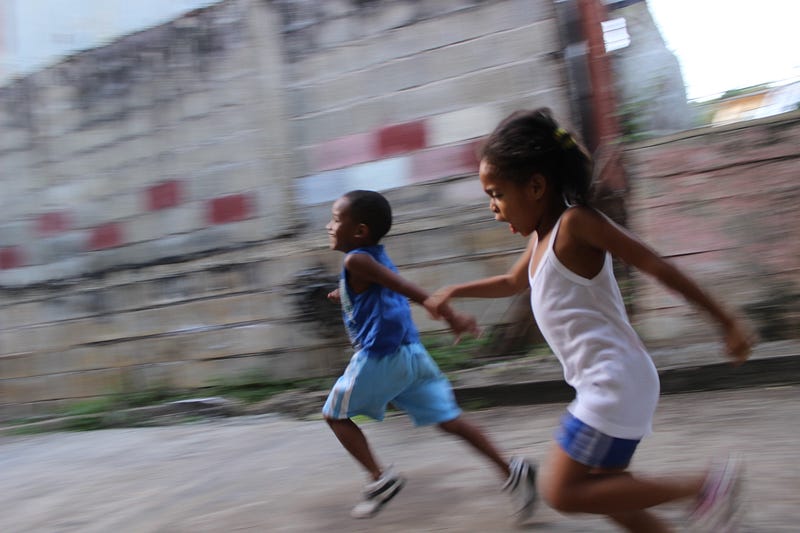
I wanted to conjure up all the energy in the universe, to breathe air into his lungs that had once been so strong, so unexpendable. Those same lungs that helped him beat me in every race we ran when we were little children growing up in Sierra Leone, West Africa. I didn’t want to give up on him, I didn’t want him to die. But it was out of my control. For once, I couldn’t fix the situation. He was going to die.
It was 9:48 pm. We were on our way out of the hospital, each of us lost in our thoughts, my mother, his wife, my sister, and his two young children.
I was on autopilot, moving forward but not feeling my feet hit the ground. I felt utterly helpless. Inside my head, that voice kept on screaming in anguish — a cacophonous, desolate cemetery of despair and disbelief. This couldn’t be happening to us, this was a bad dream. I would awaken and all this would fade into the day like the nightmare that it was.
But no, I didn’t awaken from this because it wasn’t a dream. It was raw and painful and too damn real. My brother Boris had died.
The next days were spent making funeral arrangements. My phone rang off the hook and almost every caller issued the same instructions:
“ Be strong, you’re the oldest now. You need to be strong for your mum, your sister-in-law, your niece, and your nephew”.
The message was clear, your pain as a sibling can’t be as deep as those of his mother, his wife, and his children. You need to put aside your pain, and your grief and help others.
I was screaming inside. I had lost my oldest brother. I had never lived in a world without him in it. He was my role model, my guide, and the person I had always looked up to. He had taught me so much, and as most siblings do, I had often measured myself against him. If he did it well, I wanted to do it better. It was healthy competition, it was how I had built, my identity.
Now he was gone, and everyone was telling me to de-prioritize my grief or that my grief was secondary, not as important.
At first, I thought, “They are right, I shouldn’t be selfish”.
And then I sought to suppress my feelings, push them away to the furthest corners of my mind.
The reality is that sibling grief is often de-prioritized in favor of a mother’s grief, a wife’s grief, or a child’s grief. Why should that be the case? I loved my brother very much and dealing with his death and absence is the most difficult thing I have ever had to do. I miss him every.single.day.
As a sibling, my grief is present, my grief is alive and my grief is legitimate too. There is no hierarchy to grief, where there is love, there is grief.
As a sister, I should be given the time and the space to grieve my brother. I can help others process their loss and their grief, but I can’t only do that. I need to think about myself too, I need to heal too. I have lost a brother, a brother that I always thought I’d get to see older, with a beautiful grey beard.
My children have lost a big, strong uncle who played wild judo with them, my husband has lost a brother who understood his sense of humor and laughed unabashedly at his jokes. I have lost a soul so precious and dear to me in every single way.
I need to grieve in peace. I need to grieve what could have been but will no longer be. I need to come to terms with Boris’ death, and for that, my grief needs to be acknowledged and respected because it is legitimate, and it is real.
This article is dedicated to my youngest brother Unblind and my sisters: Yvette and Yvonne.
Thank you for reading my perspective.


