
You Have the Right to Remain Fat.
“We must axiomatically reject the idea that being fat is only ever a product of trauma, mental illness, or imbalance.”- Virgie Tovar
“ Being thin represented a lot of things to me — but it mostly represented access to straight men and heteronormativity, which I thought of as *love*” — Virgie Tovar
“I myself was someone who [once] didn’t see the value of feminism because I didn’t understand what misogyny looked like and I couldn’t see how it affected my life.” — Virgie Tovar
“Fatness disrupts the cultural obsession with sexual differentiation, the gender binary, and the idea that women need to be clearly and visibly distinguishable from men “— Virgie Tovar
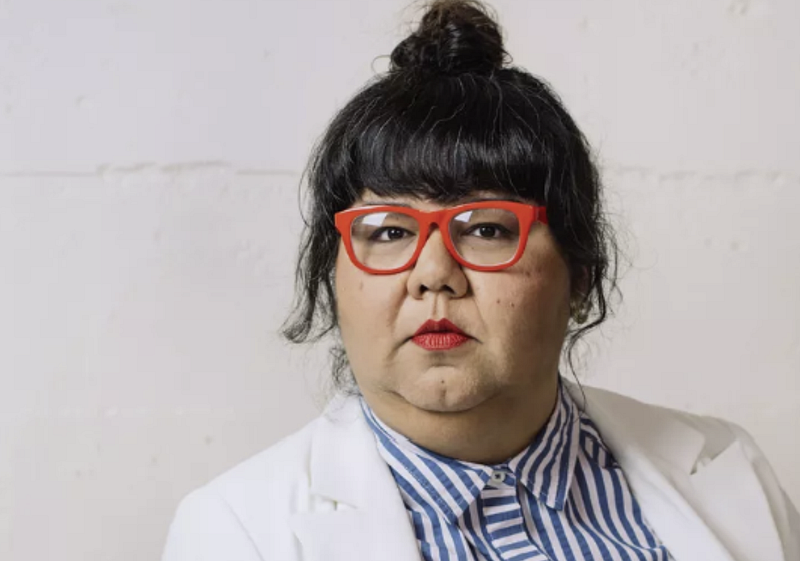
Tovar has stated that one of her goals publishing this book was to piss people off, and she certainly pissed this one off.
In her book, “You Have the Right to Remain Fat,” Virgie Tovar thoughtfully and deftly cuts through common talking points related to weight. She denounces dieting, and she connects fatphobia to feminism, misogyny, gender binaries, and heteronormativity through thorough logic and research.
Individualism, the United States, and Fatphobia
In her book, Tovar explores the notion of individualism in American society. She notes how, in many societies throughout the world, fate is considered something outside of an individual’s control. It is a uniquely American concept to believe individuals alone can create their own fate. Some may also know this concept as bootstrapping. This concepts enables fatphobia.
What is Fatphobia?
On a podcast with Laverne Cox, Tovar has defined Fatphobia as “the pervasive fear of fat people and that fatphobia is enabled through diet culture — which encourages losing weight at any cost.” “Heal With Kailin” is a YouTube channel I follow. Kailin also did a great video explaining fatphobia.
Fatphobia gives the impression that fat people are in a prison of their own making — that the way society treats fat people is justified because it’s something they did to themselves — and something that is bad. Tovar emphasized diet culture discourages people from admitting there is anything “wrong or sick about a culture that teaches you to hate yourself [because your body looks a certain way].” In her book, Tovar emphasized that diet culture forced her to believe “that the trouble and the problem resided within me, not outside of me.”
After she introduces the concept of Fatphobia, Tovar revisits the concept of bootstrapping and how it seeps its way into other aspects of life. Tovar emphasizes that concepts like “earning your food, earning love, and earning freedom,” are wrong.
Tovar emphasizes that her belief is that certain things — food, freedom, and love — are not things that should be earned in a progressive society, but things that are every human’s birth right.
Tovar references misogyny by touching on the idea of freedom being marketed — to women specifically — as something that comes through “being thin and being lighter…” This is interesting because freedom is an American ideal. It’s interesting that freedom is marketed towards women with caveats —and furthermore towards many marginalized groups with caveats.
The Effects of Weight Stigma
Tovar discusses the effects of weight stigma at length in her book. Weight stigma results in people internalizing their bodies’ perceived “failures.” Tovar pointed out how weight stigma would result in Tovar thinking of her body as a space she was temporarily occupying. Tovar explains how she would erase herself in her future — it seemed to her that in any future she would be free only because she would be thin and not herself.
Tovar pointed out that she had to learn that “any future that doesn't center the eradication of oppression and collective freedom is not a future worth imagining.” Erasure was an effect of weight stigma and fatphobia.
Aside from erasure, another effect of fatphobia is the demonizing of fat bodies. The campaign to equate fatness with greed and laziness has been long — centuries long in fact. In 2021, Holly Fletcher published an article in the Journal of German History that explored the history of criticizing fatness — among other things. She traced fat criticism to the 16th century. Fletcher’s article is nuanced and also explores the descriptions and perceptions of fatness in religious texts — which is one form of historical reference.
The final forms of the effects of weight stigma I will reference include fat people not receiving proper medical care and the powers that be considering charging bigger people more for coverage.
In 2016, The U.S. Equal Employment Opportunity Commission (EEOC) was considering whether to charge obese people more for coverage. The Hill reported the considerations as “contrary to American values by institutionalizing prejudice and blaming the victim.” While I disagree with The Hill’s characterization of fat people as “victims,” The Hill did a good job of coming to the conclusion that obesity has no cure and is a complex condition. Are you a victim because you were born with a certain trait? That’s a question for philosophy I suppose. Are you a victim of genetics?
Fatphobia and Misogyny
“Fatness disrupts the cultural obsession with sexual differentiation, the gender binary, and the idea that women need to be clearly and visibly distinguishable from men.” — Virgie Tovar
In our current patriarchal society, men are seen as the approvers of culture and people. Weight is seen as a way to police people, but particularly women. This policing is seen clearly through an ad campaign Tovar references in her book.
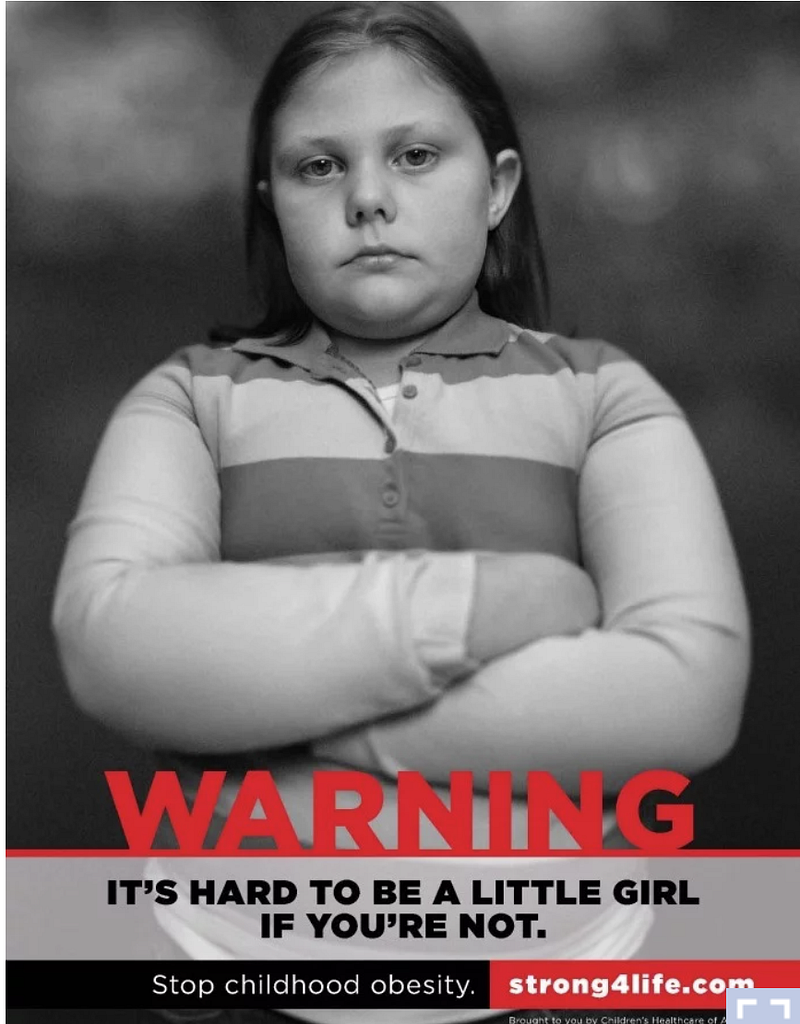
The ad campaign was initiated by Children’s Healthcare of Atlanta and its goal was to “stop childhood obesity.” One of the ads featured the image of a girl, splayed across her belly was the phrase “it’s hard to be a little girl if you’re not.” Tovar emphasizes the ad tells the story of gender anxiety, (inadvertently) questioning whether a fat girl is even a girl at all. Horrifying, right?
Tovar also brings up white feminity and its role in the ad. Tovar states that the “chubby white girl in the ad creates tension between ideal femininity and fat embodiment…”
Through referencing a Men’s Health article, Tovar, again, demonstrates her ability to draw connections between the enforcement of gender binaries, heteronormativity, and fatphobia. The article was titled “Banishing Your Man Boobs.” The author wrote “you probably love a great set of breasts — as long as you’re not the one sporting them..”
Tovar wrote- and I quote- “this language draws parallels between compulsory heterosexuality, masculinity, and body size….by pointing out only women should have breasts and that men should be attracted to them.”
Virgie stated “fatness in a way disrupts the cultural obsession with sexual differentiation.” It disrupts the binaries we create and derive pleasure from adhering to.
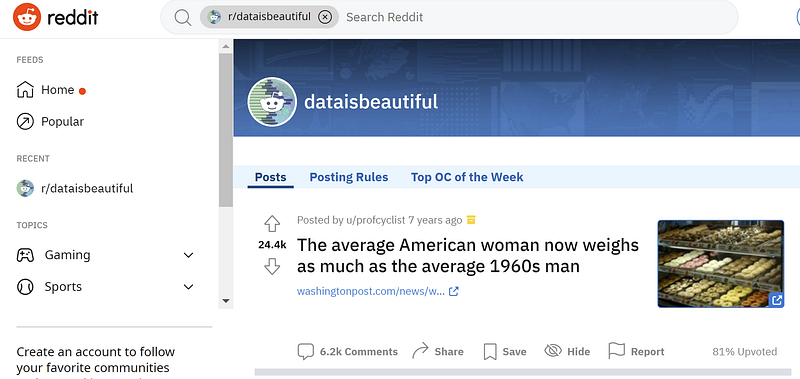
The screenshot I included above illustrates how newsworthy women’s weight is. That title, while posted 7 years ago, did gain 24.4 thousand upvotes. Furthermore, the post illustrates the interests people have in speaking of women’s weight in relation to men’s, again the binaries.
Dieting Leads to Weight Gain Overtime
This is one of Tovar’s main points in her book. Dieting leads to weight gain overtime. Tovar cites Dr. Janet Tomiyama, an associate professor at UCLA, who has done vanguard research regarding low calorie dieting. Tomiyama has been consulted by the U.S. Department of Health and Human Services.
For her research, Dr. Tomiyama posed the question “why people would still pursue dieting in order to lose weight when there was overwhelming evidence that dieting did not lead to weight loss in the long term?” Tomiyama came to the conclusion that people continued to pursue dieting because of “the high levels of anti-fat bias and weight stigma that exists in our society…”
Tomiyama has emphasized that health is not associated with weight, and weight does not need to be involved in a discussion regarding health. She further goes on to discuss actual indicators of health — blood sugar, cholesterol, and blood pressure etc.
In Tomiyama’s research, her team investigated people who had BMI’s in the “overweight and obese” categories. Tomiyama found there were millions of people who were classified as overweight and obese, however they still looked healthy in terms of blood sugar, cholesterol, and blood pressure.
I would like to add that, even given Tomiyama’s research, it is dangerous to believe our health is 100% in our control. Aubrey Gordon has pointed this out
Diet culture — to me — made me believe that weight was the root of all health problems, that losing weight was a lifelong journey — one I was doomed to always be on because my body failed me — my body made me gain weight too easily and my body was deviant. At the same time, diet culture insulated me from new research and facts related to weight and health, weight stigma, and fatphobia. In a way, I was existing in a vacuum while I was in my deepest diet culture spiral.
I approached this book as a part of my healing journey from an eating disorder. I found healing, I found knowledge, and I found a fire that was lit inside me. Thank you Virgie Tovar.
If you got some semblance of joy or satisfaction from reading this, consider supporting me and my work via Ko-Fi ❤️


