
You Have an Ethical and Moral Obligation to Get Vaccinated
Shut up and get vaccinated.
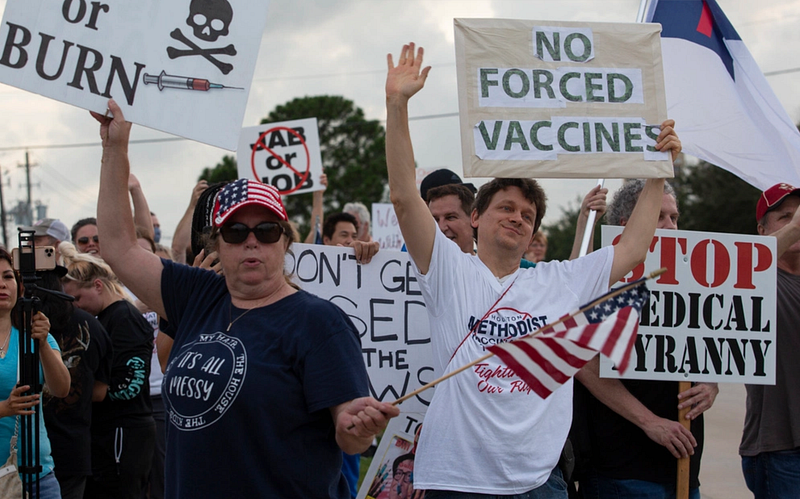
A teen can’t drive a car with other teens riding in the same car because many teens in one car with an inexperienced driver increases the chance of collision. One can’t smoke inside because smoking causes cancer, even second-hand smoke. One can’t text and drive because driving while texting puts others in danger.
Until enough people are vaccinated, the spread of the virus, and other variants, are imminent. Sometimes we have to think about the whole, the collective, and not the individual.
Sometimes you have to think for yourself and not wait until a vaccine is fully FDA approved and instead, say to yourself, huh, most people I know who are vaccinated haven’t had adverse reactions. No one has died from the mRNA COVID-19 vaccination.
Sometimes we have to think about the whole, the collective, and not the individual.
Sometimes common sense is required.
There are three deaths that appear to be linked to blot clots that occurred after people got the J&J vaccine. Since we now know how to correctly treat people who develop these blot clots, future deaths related to this very rare side effect can be prevented.
I received the J&J vaccine. I had no side effects. Not one.
The Trolley Problem
When my daughter entered sixth grade, one of her teachers introduced “The Trolley Problem,” an ethical problem presented to her class (and later to the adults at Back to School Night).
The trolley problem is a series of thought experiments in ethics and psychology involving stylized ethical dilemmas of whether to sacrifice one person to save a larger number.
The classic trolley problem involves deciding between doing nothing and letting a train kill five people or flipping a switch and redirecting the train to kill one person.
Basically, is it more ethical to kill one person to save five?
Normative theories in contemporary philosophy
Is one person’s life more valuable than hundreds of thousands of lives?
I don’t think so.
The collective is more important than the individual.
If we don’t look out for each other in the society in which we live, life will be unbearable and unmanageable.
John Stuart Mill, one of the most crucial thinkers of the 19th century, coined the term “the greatest happiness principle.” It determines whether an individual action is good or bad.
- If an individual act promotes happiness for the most amount of people, it is good.
- If an individual act decreases overall happiness for the most amount of people, it is bad.
Out of this thinking came utilitarianism, a philosophy that seems to appeal to a broad spectrum of people because it prioritizes the interests of the many over the few.
Mill’s work, utilitarianism, provides a way of thinking that promised those who employ it to maximize their happiness because they keep the larger community in mind.
The goal of our actions is to create the greatest happiness for the most amount of people.
Since everyone’s happiness counts equally, utilitarianism considers maximizing the good from an impartial perspective, meaning that the interest of the people close to you should not matter more to you than those of strangers.
Utilitarianism is focused on the consequences of an action to the whole.
Most of us won’t give up the life of our child, even to save five people. That’s where the dilemma comes in for many, the intersection of morality, ethics, and philosophy. In the trolley problem mentioned earlier, when you replace the stranger for a loved one, allowing one person (a person you are close to) to die to save five becomes more complicated.
Most people won’t kill a friend, a parent, or their own child to save five strangers.
When you present this problem to a group of people, it leads to all sorts of discussions about ethics and morality.
Vaccinations
When it comes to the COVID-19 vaccine, you don’t have to make a hard choice, as in the trolley problem. You don’t need to choose between the life of a stranger and a loved one.
You can save both, as well as your own.
When you get the vaccine, the individual action of receiving the vaccine means you’re looking out for those closest to you *and* maximizing the good of strangers or increasing the happiness and well-being of the collective whole.
Rule utilitarianism takes into account the rights of the individual.
For example, stealing from the rich or banks to give to the poor à la Robinhood is still wrong; even though it increases the happiness of others, it infringes on the rights of the people who keep their money in the bank. You have to consider the individual’s rights even if infringing on those rights would increase the happiness of the whole.
Even though Robinhood is helping a large amount of people in society, the poor, if everyone stole from each other, society would collapse, and overall happiness would plummet. In rule utilitarianism stealing is wrong even if it increases overall good. But when applying this principle to vaccinations, the individual is not affected because the mRNA COVID-19 vaccination is proven safe to use.
Even when considering autocrats and racists like Trump or Hitler, rights violations aren’t morally acceptable.
In civil society, we aim to have a trial and prove someone “guilty” before handing down punishment (although it’s tempting to want to violate some people’s individual rights since Hilter/Trump had no problem violating the rights of millions of people).
An eye for an eye, so to speak.
Justice should be served, but justice is served under the rule of law.
As tempting as it would be to put Trump in the woods alone surrounded by wild animals or drop him into a tank of sharks as an act justice, it would violate his individual rights.
Utilitarianism causes us to think about how our individual daily actions affect the greater community and whether what we do is worth the negative implications on the world.
The logical choice to get vaccinated saves lives.
High vaccination rates save lives.
If enough people get vaccinated (putting the whole before the individual), we stop covid so we can live without death and masks and increase the happiness of the greater community. The greater good in this situation is not just Americans but also the global and international community we live in.
The societal effect of people who will not get vaccinated
We can see the effect of anti-vaxxers in real-time with the Delta variant, a more dangerous and easily transmissible mutation of COVID-19.
New variants of the virus will affect populations in states where vaccination rates are low, like the Delta variant spreading rabidly in southern states.
You will most likely not get the new strain if you are fully vaccinated. Even those partially vaccinated are at risk, but not if you’ve received the second dose. Southern states will, probably in the next three to five weeks, see the spread of this new variant.
This decreases the happiness and well-being of the whole.
When an unvaccinated person in Arkansas carries the new variant onto a plane and travels to California, he is not only affecting people in Arkansas (and putting unvaccinated people in his own household at risk) but people in California and those residents of any state he travels to.
The whole suffers because the spread of the virus goes up.
If everyone gets the vaccine, we lookout for the whole and stop the virus in its tracks. If we don’t reach herd immunity (80–90% of the population vaccinated), we will be dealing with some version of the virus for the next two decades or more.
Viruses don’t mutate if they can’t replicate.
If we stop transmission and replication, we won’t get any more variants.
Herd Immunity
According to the The World Health Organization,
‘Herd immunity,’ also known as ‘population immunity,’ is the indirect protection from an infectious disease that happens when a population is immune either through vaccination or immunity developed through previous infection.’
The former (vaccination) results in less death.
The latter (immunity from getting the virus) results in more death.
The former is the strategy of the Biden Administration — put vaccines into the arms of as many Americans to reach herd immunity.
The latter was the Trump Administration’s strategy — put Americans at risk of illness and death to reach herd immunity by killing everyone.
The states most vulnerable to COVID are also some of the least vaccinated.
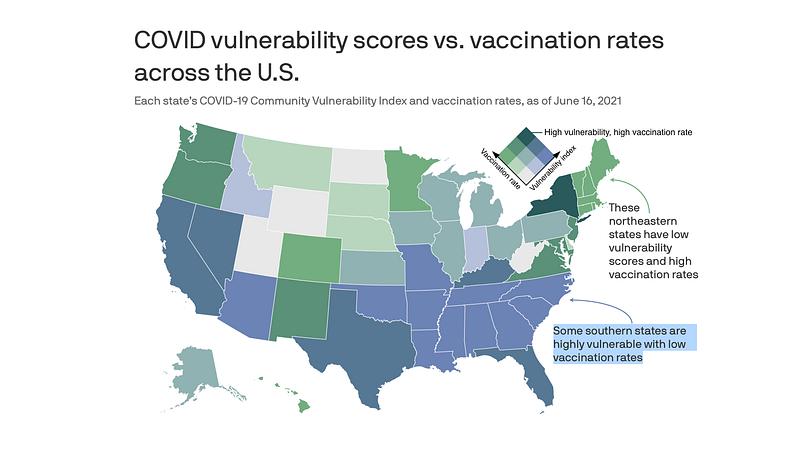
Some southern states are highly vulnerable with low vaccination rates.
Here are some things/facts to think about:
- Fully vaccinated means that you completed a COVID-19 vaccine series. This is protection against severe complications like death and hospitalization and a breathing tube.
- A person is considered fully vaccinated two weeks after receiving the second dose of Pfizer’s or Moderna’s vaccine or one dose of the J&J vaccine. It would be wise to keep wearing a mask during the two weeks after the second dose.
- Being vaccinated gives you a better chance to fight off the infectious consequences of being exposed to the CoV2 virus.
- It is still possible for a fully vaccinated person to transmit the virus to others, including vaccinated people, but at a much lower rate. Those with weakened immune responses and underlying health conditions may not have the best protective response to vaccines. If they wear a mask, it doesn’t necessarily mean they didn’t get the vaccine.
- The complications of the disease for those not vaccinated yet have been of greater magnitude.
- “We don’t know exactly how long the vaccines will protect us after being fully vaccinated.” Science and the CDC, and experts are still working to determine the answer to this question.
- We do know getting vaccinated is still the safe choice for preventing serious illness for you, your loved ones, and for the benefit of our communities.
- On June 7, the CDC issued a press release regarding their status of the effectiveness of vaccines in fully vaccinated people. The study found that the mRNA COVID-19 vaccines authorized by the FDA reduced the risk of infection by 91% for fully vaccinated people.
- The Delta variant spreads much more easily from person to person.
- Missouri currently has the highest percentage of COVID cases from the Delta variant.
- The Delta variant, which was first identified in India and caused a deadly surge there early in 2021, makes up about 10 percent of U.S. COVID cases nationwide.
- The variant is the most contagious yet and, among those not yet vaccinated, may trigger serious illness in more people than other variants do, say scientists tracking the spread of infection.
- The Delta variant apparently already accounts for at least 14% of all new infections, according to the research the analysis posted online Monday of more than 242,000 infections nationwide over the last six months.
- All the vaccines authorized for use in the U.S. appear, in general, to provide powerful protection against all the variants, including Delta. But the rapid spread of the variants is still raising concern because of the large number of people who remain unvaccinated.
In addition
If I believed in god, I’d think she sent a virus here to make us all get along and play nice. Like, here is your last chance to consider the health and well-being of your fellow man with whom you share a planet.
If you make the choice to use science (the vaccine)— which your fellow man developed — and get a vaccination, the collective and society as a whole will be better off.
It doesn’t matter if you agree with your liberal-leaning brother living in California or your Trump lovin’ fellow human in a southern state. Everyone will be better in the long run with increased happiness and health from your individual choice of getting a vaccine.
Don’t be a selfish prig.
It’s time to put differences aside and get vaccinated with family, society, community, and the larger global community in mind.
Jessica is a writer, an online entrepreneur, and a recovering Type A personality. She lives in Los Angeles with her extrovert daughter, two dogs, and two cats.


