
THE SECRETS OF WRITING ON MEDIUM, PART 10
You Earned THAT Much Money on Medium Last Month?
Another exploration of the Medium paywall, because it’s there

Okay, it’s not Mount Everest, but the Medium paywall is one of our biggest online challenges.
Unfortunately, we’re all spiritual descendants of George Mallory,¹ the man who first uttered the famous climbing phrase “because it is there.”
In case you didn’t know, Mallory never made it back alive to tell his tale.
He didn’t even reach the summit.
Between the first climb in 1922 and 2006, there have been 11,000 climbs with a 29% success rate.²
With modern equipment and the help of high tech ice screws, 2018 saw a record number of summits with a 72% success rate for climbers who got above base camp.³
I recently wrote about odds of winning $10,000 in the lottery, versus the odds of earning the same amount in a month on Medium. At 1 in 25,555 to make big bucks on Medium, your odds are far better trying to climb Everest.
The down side with Everest, of course, is you also have a 1 in 61.46 chance of dying, not to mention the garbage problem and traffic jams³.
Fortunately, we can have our hypotheses come crashing back to earth as many times as we want to keep trying to climb this mountain.
We’re living the myth of Sisyphus, except we’re both the man and the boulder.

Everyone has an idea about the inner workings of the paywall, but none of us have cracked the code.
As Bruce Springsteen sang in Born to Write:
Evy, let me in, I wanna be your friend I wanna steal your dreams and visions Just wrap my eyes round that algorithm And make curation decisions!!
Here’s a handy Q & A about the algorithm.
1. Is compensation determined by the monthly number of fans?
T.S. Johnson (of skull, cross bones, and hair ribbon fame) hypothesized that the number of fans per month would dictate the ability to make at least $100 per month on Medium.
In her test month, she crossed the $100 mark in the 3rd week when she had 404 fans which would be about 25¢ per fan.
However, consider what would happen if you wrote 30 stories in a month, at 15 fans per story — that’s a total of 450 fans.
What happens if it’s always the same 15 fans?
Assuming your 15 fans clap for everything you do and won’t clap for anyone else (unlikely), and assuming that Medium distributes all $5 from the monthly subscriptions (impossible), the highest amount you could make would be $75.
If there were some arbitrary value to the number of fans, say the approximately 25¢ suggested by Johnson’s results, we could predict the compensation for each article based on the number of fans.
My results suggest something completely different.
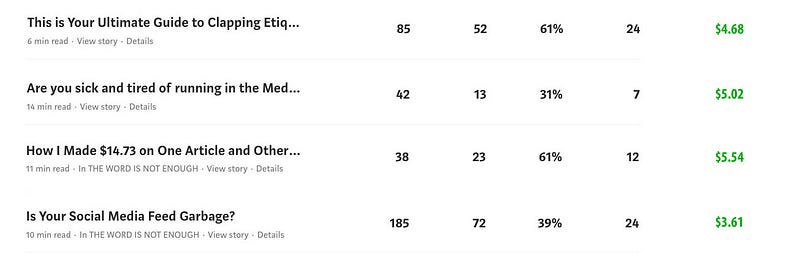
If we divide the money made by an article by the number of fans who are paid subscribers (with the green arc above and below the person’s avatar), the quotient yielded is the value per fan (VPF).
But the highest paid articles above had the fewest fans.
2. Is compensation powered by your monthly number of reads?
Again, if the number of reads determined compensation, we wouldn’t have the wide variance between Don Simkovich, MA, — who reported making $2 for an article that had 300 reads — and the article I wrote that amassed these sad stats:

One thing we can say is that a person who rarely claps is your most valuable fan.
Treasure those one-clappers. They might be your most valuable fans! (Or they could really be crapping on you.)
On that Apple Anti-Trust article, one of the two fans had only clapped for three articles over the entire month.
3. Does reader engagement mean anything?
Most of my articles are full of highlights and many receive a large number of positive comments.
“Is Your Social Media Feed Garbage?” had 17 responses, and the Ultimate Guide to Clapping had 13 responses. And yet they made the least money and had the lowest VPF.
There is no indication that the number of comments and highlights increases compensation.
4. Are there any other metrics left to test?
The one characteristic shared by the articles that made the most money last month was a high number of quotes and citations used.
I’m going to look at that variable in the articles I write moving forward.
5. Does curation have any correlation with compensation?
While we assume curated articles will get larger numbers of readers and fans, here is an article that performed much better than the Apple Anti-Trust article, but made less money:

While studying the curation process, I read an interesting article by Pen Magnet.
He opened up my eyes about the extent to which programming and AI could reduce the chance of lesser known writers to have their articles curated:
“Simply put, it works on pre-decided factors that human curators think were vital in popularity of certain number of articles.” — Pen Magnet
He listed the characteristics of historically popular articles and proposed the existence of a curation bot that could use search criteria beyond the imagination of non-programmers.
Then he suggested that a bot could be perfected one day that would be bad for writers and worse for writing:
…it ends up experimenting with current content instead of evaluating it. It kills uniqueness.A lot of good content might be simply lost because it failed to resemble to anything popular that was previously published.
Based on his idea of a bot that could screen thousands of articles each day before showing a smaller selection to the human team, I think we have a better chance to succeed if Medium adopts Roz Warren’s idea of using Corgis as curators.

His article made me think that AI could easily determine decisions far more important than curation.
6. Is it possible that Medium adjusts its compensation for each article based on subject matter?
If programmers could predetermine “high-quality” content to speed up the curation screening process, why couldn’t they use these same concepts to alter compensation?
In the article “Artificial Intelligence: Do stupid things faster with more energy!” the author made this point:
“Technology is a lever that scales the wishes of human decision-makers.” — Cassie Kozyrkov
Medium’s top priority is to make the largest profit possible. AI would make the implementation of that desire far more efficient.
With this new perspective, Medium’s priorities seem clear:
- Determine those subjects which attract the most paid subscriptions.
- Make it more difficult to find less “successful” writers who don’t write about the desired subjects.
- Eliminate the ease of using tags to discourage readers from searching for subjects that don’t increase Medium’s profits.
That pretty much sums up the changes to Medium’s feed and its search functions.
7. Could Medium’s paywall disproportionately reward the most popular writers?
Why wouldn’t Medium incentivize their most successful writers to continue to write those articles?
We already have a feed that excludes the vast majority of lesser-known writers, so readers won’t waste claps and dilute the payout to the successful writers.
Here are Medium’s reported earning stats as reported by Casey Botticello:
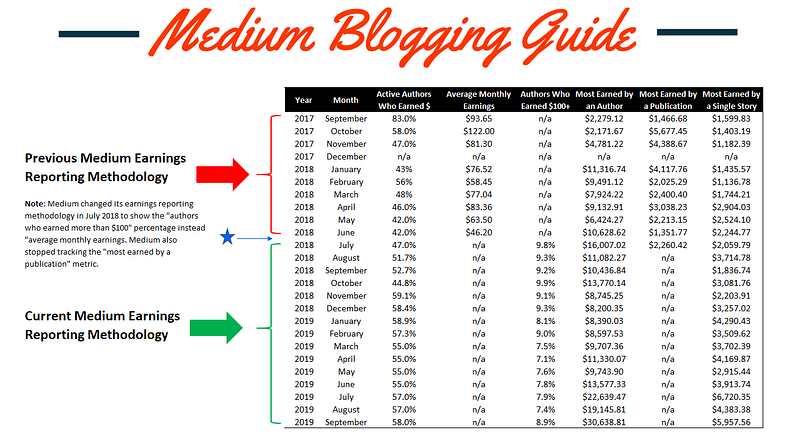
In September 2018, the most money earned by an author was $10,436.
In September of 2019, the most money earned by an author was $30,638.
What’s wrong with this picture?
While art is subjective, it’s a stretch to think the highest paid author writes 300 times better than all those people in the top 8.9% (or anyone else, for that matter, who can speak English, type and use a spell checker).
And I doubt if that highest paid author is writing at a level that equals or exceeds people whose books are on the NY Times Bestseller list.
Finally, allow me to express my doubts that Medium’s highest paid writer in September of 2019 is worth twice as much as the authors who win the Pulitzer Prize each year.
Medium’s lack of transparency gives us no way to judge the quality of the most popular authors.
But there’s way too much circumstantial evidence not to entertain the possibility that the system has been rigged far beyond our imagination.
The only way we’ll find out is if enough people are willing to share information on an article, its stats, tags and the amount it makes.
8. Do you have any good news to share?
I wrote in my last exploration of writing on Medium the belief that my efforts to become a better writer, seemed to have paid off:
I was shocked to see my income for this last week increased by 212% over the total for the previous three weeks.
My monthly stats more than doubled the previous month in views and fans and represented a 173% increase in reads.
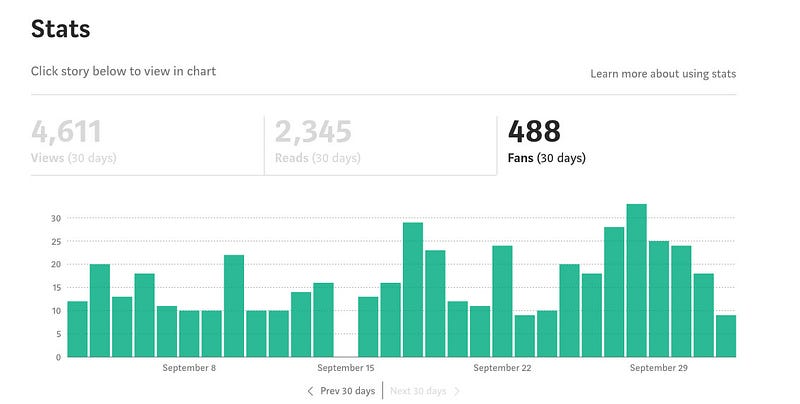
While my read rate has always been over 50%, this area needs work according to Linda Caroll’s “The Most Important Number in Your Medium Stats Isn’t What You Think.”
However, article length does affect read rates.
All the articles she shared with high read rates (over 75%) were three minutes or less in length.
Here are the average read rates for different types of articles I wrote over the last two months:
- Haikus (1 min): 94.7%
- Song Mash Ups (2 min): 56.4%
- 500-Word Rants (3 min): 70%
- Humor (3–5 min): 49.1% (could it be all that cynicism?)
Longer articles on more serious subjects might have made more money, but the read rates were lower, averaging 30–40%.
This month had a fan per read ratio of over 20%, one of my best months, suggesting some improvement in reader engagement.
That’s the good news.
The bad news is that none of my newest articles got much traction, even though I wrote on similar subjects. I spent a huge amount of time on a fun article about the NFL as described by Beatles songs, but so far the results are flat (pun intended).
By spending all my time on that massive article, I didn’t write as many short posts, and ended the month with a VPF of only 12¢.
But there’s always a bright side. The month before, my VPF was 8.4¢, so that’s almost a 50% increase!

Have a great weekend, and enjoy writing. It’s far more comfy than trying to climb Mount Everest.
Here’s to better writing.
SOURCES:
¹Conrad Anker, an Everest summiteer, found Mallory’s remains on May 1, 1999, and explains why he thinks Mallory never did reach the peak.
²There have been 11,000 summit attempts between 1922 and 2006, with a 29% success rate.
³In 2018, there were a record 802 summits. The place is turning into Disneyland.
³Robin Haynes Fisher wrote in a captioned instagram post on May 19 of this year: “I am hopeful to avoid the crowds on summit day and it seems like a number of teams are pushing to summit on the 21st.
“With a single route to the summit, delays caused by overcrowding could prove fatal so I am hopeful my decision to go for the 25th will mean fewer people. Unless of course everyone else plays the same waiting game.”
A somber thought the next time you’re stuck in traffic.

