
You Don’t Need to Learn Prompt Engineering to Write a Better Prompt
I’ll share with you some tricks so you don’t need to spend ages writing the best prompts anymore.

Recently, I asked my 1,000+ subscribers whether they use ChatGPT. Close to 49% said no, close to 33% said sometimes, and the remaining 18% use it most often.
When I asked the 49% + 33% what the reason was, I got some interesting answers.
Most of them said they don’t know how to use ChatGPT perfectly.
The other said the process is tedious since they have to write the perfect prompt to get the desired response.
I agree — writing better prompts does need time, and it’s become annoying to keep trying in a bunch of different ways just to get a better result.
That’s why I wrote a book called “The Ultimate Guide to ChatGPT” to help you use ChatGPT like an expert.
But let’s be real, it should be the opposite — you write a simple prompt and you get your desired response.
And that’s possible.
In this post, I’ll share with you some tricks so you don’t need to spend ages writing the best prompts anymore.
Excited? Let’s get into it.
1. Write a more specific prompt in simple English
Let me tell you, there are a number of different techniques out there like Chain of Thought Prompting, Zero Shot Chain of Thought, and many more.
There are concepts like Prompt Injection, Prompt Leaking, Jailbreaking, and more buzzing around too.
And if you take the time to learn all these useful techniques, sure, you might get some better responses from AI chatbots.
But let’s be real here — it’s a freaking tedious process.
Even after mastering all that stuff, you still need to keep rephrasing and tweaking your prompts in different ways just to squeeze out slightly improved results.
What a pain.
What’s the solution then? Write your prompts in specific, human-like plain English.
If you’ve followed me, you know I’ve been knee-deep in using large language models for over a year now.
And from that experience, I’ve learned that if you write a clear, precise prompt in simple English to an AI chatbot like Claude, you’ll most probably get the desired response you want without any fuss.
Here’s an example.
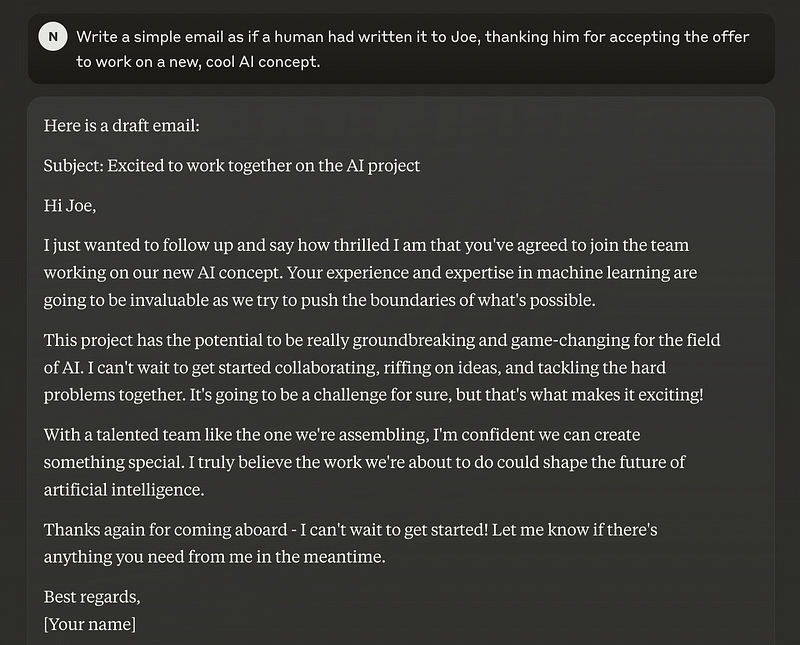
As you can see, I just wrote a specific prompt in simple English, and it helped me get my desired response without any fancy techniques.
Similarly, for more than 80% of your tasks, you simply need to write a specific prompt in plain, human-like English like that, and you’ll get the response you want.
But why am I suggesting Claude over ChatGPT?
Well, even when you instruct ChatGPT to write more like a human, it still comes across sounding, you know, robotically AI-like.
With Claude though, when you feed it clear, natural language prompts, the responses just flow in a much more natural, human-friendly way.
Don’t get me wrong, ChatGPT is crazy impressive tech.
But if you want AI-generated content that sounds like it came from an actual person rather than a AI chatbot, Claude is where it’s at.
2. One prompt for all
The earlier example was simply to complete most of your tedious work within seconds thanks to AI chatbot.
But you need more than that.
And that’s where, I want to share with you a single prompt that will help you complete most of your tasks.
Actually, it’s been over a year, and I have been using this prompt for everything.
The prompt is “I want you to act as a world-class [profession name] with decades of experience in [what he/she does]. I will ask you for output, and you have to give me unique, expertly written work.”
Suppose, I want to write an informative post, I will update the above prompt to act as a writer.
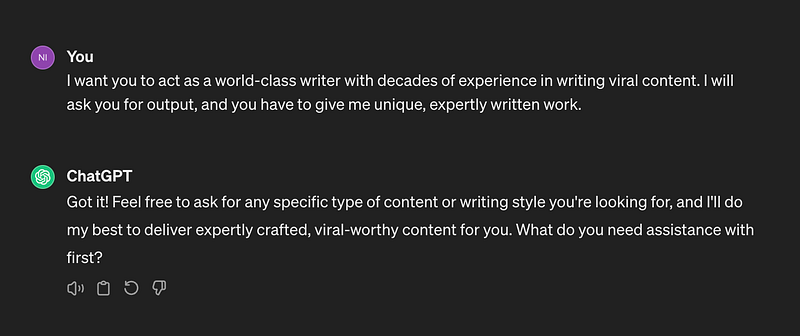
After this, you can write the topic and generate your desired output.
The same way, you can update the above prompt to IT Expert, Wealth Manager, Investor, and more, and ask it to provide the response.
It’s that easy.
3. Generating prompts directly from the AI chatbots
Let’s be honest, most of us are not prompt engineers, and it becomes a lot harder to learn all the prompts shared by some creators on the internet.
What’s the solution? Ask the AI chatbots.
Here’s how.
Suppose I want to generate a specific post that looks like it is written by a human. So, I will ask ChatGPT to give me a prompt.
Here’s the prompt for that:
Can you write me a prompt that can help me write the best post about a particular topic that looks like a human has written it?
Here’s an example.
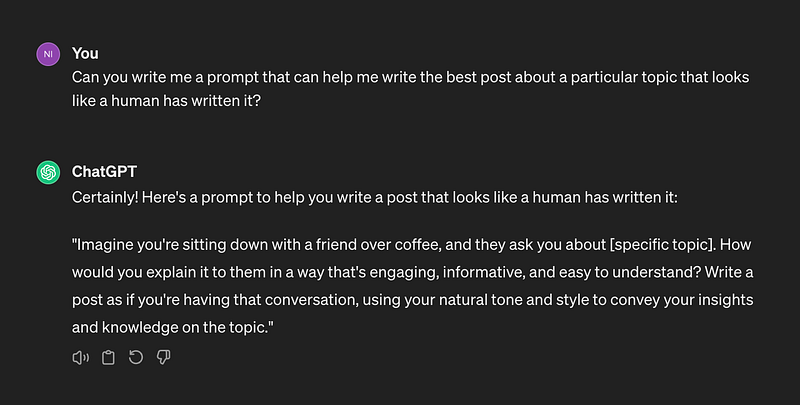
As you can see, I got a better prompt from ChatGPT for my needs.
Similarly, you can ask ChatGPT for a prompt based on the task you want to accomplish.
What next?
So far, we have seen some simple yet useful ways we can command ChatGPT to provide us with our preferred answer without using any prompt engineering techniques.
These techniques are for those who want to get started with ChatGPT and get their preferred response without learning too much about prompt engineering techniques.
Sure, as you progress, you can learn prompt engineering techniques from a number of websites.
I recommend a website called Learn Prompting; inside this website, there is a docs section where you can find almost everything about prompt engineering.
The above website is not sponsored or affiliated; I just want to share it with you.
Also, just to let you know, I often read some of the best prompts on the internet, and that’s what I save in a specific Notion page.
Finally, I’ve written a simple book titled “The Ultimate Guide to ChatGPT” to assist you in using ChatGPT like a pro.
Hope you like it.
That’s it — thanks.
Don’t forget to subscribe to me on Substack for a thrilling dive into AI, tech wizardry, money hacks, side-hustle secrets, and beyond. Your adventure awaits.


