You Don’t Have to Innovate From Scratch
Instead, put two existing things together in a new way.
Developing innovative products and business models is no walk in the park for entrepreneurs. Finding the right source of a breakthrough innovation appears to be somewhat unpredictable. When companies want to consciously initiate innovations, many use conventional and not always effective creativity techniques.
Who doesn’t know the classic tools that are supposed to ignite creative ideas in people? Brainstorming is probably the best-known intuitive method to find solutions to a problem or create innovative products.
Smart people sitting in a meeting room in front of a blank sheet of paper are asked to write down their spontaneous ideas on a topic. Entirely based on intuition and without any judgment — there are no limits to the imagination. A whole map of creative outpourings emerges within a short time, including countless bubbles and arrows.
Undoubtedly, brainstorming led to many original ideas in the business world. However, methods like these are primarily based on a spontaneous impulse — they are just a snapshot of ideas. They are somewhat like gambling. Either you hit the jackpot immediately, or you leave the game empty-handed.
There are several other creativity techniques that led to groundbreaking innovations in various sectors. They stimulate the out-of-the-box mindset in people right from the start. The approach is systematic and analytical.
These creativity methods are based on the assumption that there is already a ready pool of relevant knowledge available. You just don’t know about it yet. So, it is crucial to take a closer look at similar problems people or nature have solved so far. That means you need to go beyond your research area and seek solutions in an unrelated field of science or industry.
So, you don’t always have to reinvent the wheel. You might find the answer to your question somewhere else. Just go the extra mile.
1. Biomimicry — learning from mother nature
Biomimicry or Biomimetics is the study of nature and understanding the principles of natural phenomena. People seek inspiration in nature’s genius models, systems, and elements to solve complex problems in human life.
As you know, living beings, such as animals, plants, and microorganisms, adapted to a permanently changing environment during evolution. So, they have perfectly figured out how to survive the greatest challenges on this planet over millions of years. Compared to them, humans have been here for only a few seconds.
It’s actually worth learning from nature, right?
Biomimicry has been practiced throughout history. Leonardo da Vinci first studied the anatomy and flight of birds with the utmost precision. He dreamt of “flying machines” throughout his entire life. A couple of centuries later, in 1903, the Wright Brothers also derived inspiration from a flying pigeon and invented the first airplane.
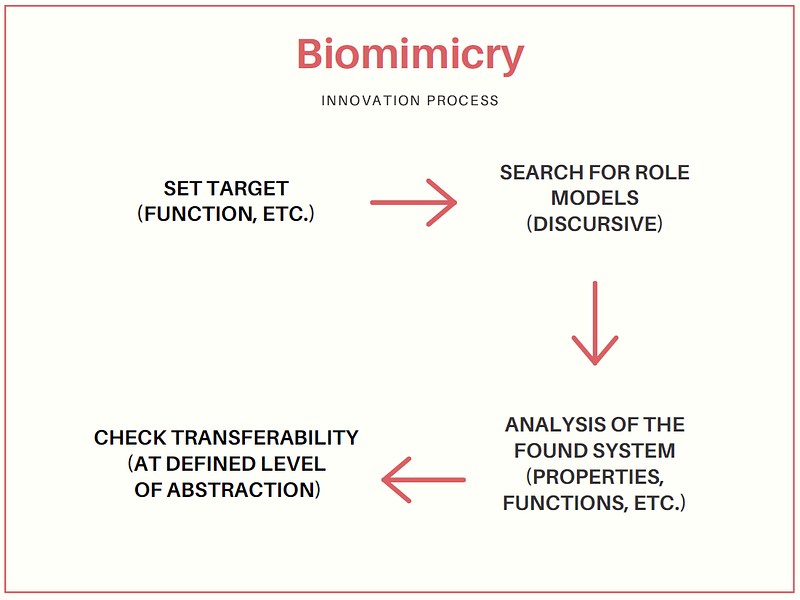
Another example of how biomimicry lay the foundation of innovations is the kingfisher and the Shinkansen train. The kingfisher inspired the development of a high-speed train in Japan, the Shinkansen.
Moving at speeds of over 300 km per hour would have made this train a source of unbearable noise pollution. But engineers drew inspiration from the kingfisher’s beak shape to design the train. With the use of its long beak, the kingfisher can move in the air and water and approaches its prey, barely making any splash or noise.


2. TRIZ
TRIZ is the Russian acronym for teoriya resheniya izobretatelskikh zadatch and means “theory of inventive problem solving”. The methodology was developed by Genrich Saulowitsch Altschuller and Rafael Borissowitsch Shapiro in the 1950s.
The TRIZ method is based on the following assumption:
Someone has, sometime, somewhere, somehow solved the problem!
The problem is that available solution principles often remain unknown due to an insufficient knowledge transfer between different fields of science. If problems were analyzed and abstracted more often, the right solution would probably be found in another area.
Therefore, examining a large number of patent specifications helps discover generally valid innovative principles and or even “laws” of inventing.
One innovation that emerged from TRIZ is a new method to split diamond crystals along their natural fractures without causing additional damage. As traditional cutting methods included manual splitting, the crystals got unwanted additional fractures.
Therefore, the innovators asked themselves:
How are solids split or separated in other sectors?
They finally found several existing patents on this problem in other scientific fields:
- Separation of stem and seeds from the pepper by applying overpressure
- Shelling cedar nuts by applying overpressure
- Shelling sunflower seeds by applying overpressure
Hence, the common denominator was the application of pressure.
So, this procedure was applied to diamond crystals. The crystals were enclosed in airtight containers and exposed to high pressure. Then the pressure was instantly released. Finally, the air expanded in the fractures, and the crystals broke precisely.
Problem solved.
3. Morphological analysis
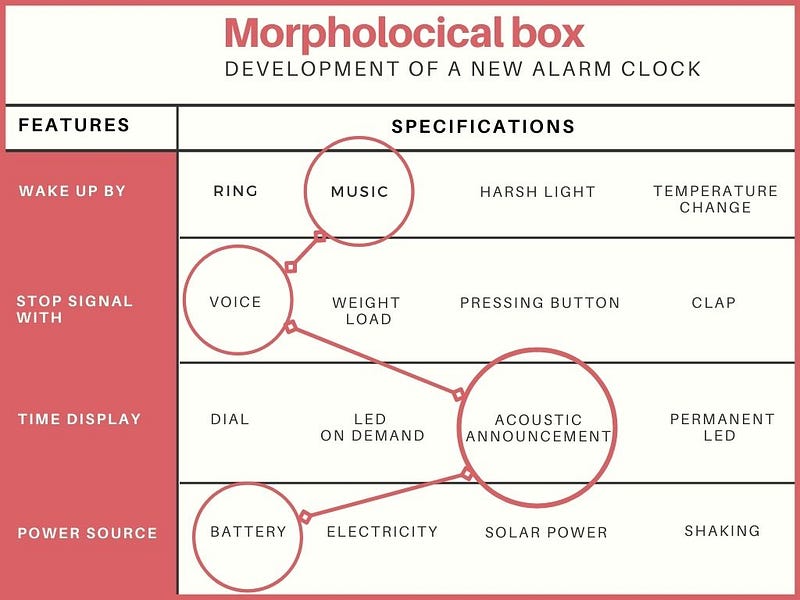
The Morphological analysis is another creativity method to approach complex tasks. It breaks down the product or the problem into features and lists possible specifications. Combining the specifications in multiple ways may lead to surprising results and innovative product ideas.
A multidimensional matrix is used for this purpose.
Let’s recap
To develop groundbreaking innovations, you don’t necessarily have to start from scratch and look for completely undiscovered phenomena. You shouldn’t wait for inspiration from heaven either. The art is to be capable of thinking out-of-the-box.
Biomimicry, TRIZ, and morphological analysis are some methods to encourage entrepreneurs to leave their familiar territory and find inspiration in a seemingly odd industry or field of science. Combining two existing things from unrelated fields may be the perfect match, and the key to your innovative product.
“We cannot solve a problem by using the same kind of thinking we used when we created them.”
Albert Einstein
Thanks for reading.