
You Control Your Most Precious Resource So Fight For It
Start by eliminating excuses and time wasters and you’re on your way.

If Bill Gates, Mark Cuban, and Oprah Winfrey can make time on their calendars for competing priorities, then the rest of us can, too. People that are poor at managing their time love to use the same excuse when it comes to pursuing what they truly want.
“I don’t have the time.”
No, no, no!
You do. I do. The busiest and most successful people in the world have the time. We’re all allotted 24 hours per day. Despite many responsibilities, so much of how we spend our time comes down to desire. So while you’re juggling that job at The Home Depot, hear me out for a second: You need to become better at scheduling your time and being more selfish about how you spend it.
Perhaps then you’ll find that you have all the time you need to do the things you love.
Competing Priorities
The greatest strides we make in our careers and personal ventures are when we also have the most responsibilities on our plate. It seems counter-intuitive, does it not? How could we accomplish so much “on the side” when we have a job, children, family obligations, and other stresses to deal with?
Competing priorities, by nature, help make our minds more competitive. Competition leads to precise decision-making, which leads to a better allocation of our time. For example, right after my first son was born, I still worked my 9–5 job, coached high school basketball, and began writing my first book. None of these things negatively affected my ability to be a loving, responsible father to my son.
The key, I found, was creating powerful habits and following up on those every day with a routine. And it won’t happen overnight. Habits take time. As the McGraw Center for Teaching and Learning at Princeton University says:
“It takes 30 days to create a habit, but good habits make your life easier. With good habits in place you don’t have to make as many hard decisions, thus you are less likely to make unproductive ones such as talking yourself out of doing what you had planned.”
You may be grinding in your job as a marketing associate, dreaming of one day launching a media strategy company that helps female entrepreneurs better brand themselves. No matter your circumstances, this is a call to ask yourself:
What priorities will I choose? Will I back those up with habits and a routine, and will I be patient in building them into my day?
No matter how much we convince ourselves that we don’t, we can’t hide from the fact that we do have the time to do the things we want to do. I never said it was easy, and you will need to decide, particularly if it’s a side hustle, which extracurricular venture you will pour your time and resources into.
Constants and Variables
Before I proceed further and you tell me that I’m crazy, allow me to clarify — there is a big difference between constants and variables. If you add your personal ambitions on top of constants — things like a steady job and family responsibilities — your chances of success are much greater than if you add responsibilities on top of variables like other passions, health concerns, or money problems.
Those things change. While job and family situations can change over time, they’re much more likely to be constant in the short-term. We can plan our lives around these things.
Make sense?
Scheduling
I made the active choice to give speaking, writing and executive coaching my full-time attention a couple years ago. That meant sacrificing a full-time job with more security. The point is, you will have to make sacrifices. But you should never, ever sacrifice what you love to do most. So, let’s take a closer look at your daily schedule. Let’s see if we can find the time!
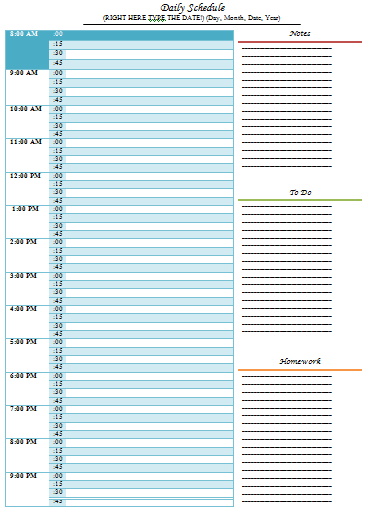
Here’s a perfectly mediocre daily planner! You even have a margin for “To-Do” items and Notes! Let’s use this as an example. Feel free to follow along and download a spreadsheet or use your own.
Your day may begin before 8 am, like mine, so let’s start at 6 am. Plot out your daily activities. Then, move to the next day in your calendar and the next and so on, plotting out your daily activities until you’ve completed your weekly calendar.
Begin with the constants — the necessities like a job, family responsibilities, commuting time and meals. These should take up significant blocks of time on your daily calendar.
Next, focus on filling in the space in between those major pillars of time with extracurricular activities or hobbies. That may involve going for a run, playing soccer with friends or working out at the gym. Of course, that also involves time with your family and friends, or things like going on a date or meeting someone for coffee.
But before you get carried away, here is where it’s important to buckle down and make YOU your critical focus. This is a true paradigm shift.
Look at your updated calendar. I’m willing to bet that even with 7–8 hours of sleep, an 8–9-hour workday and 3–4 hours of family responsibilities (time with loved ones, dinner, etc.) you can still find 2–3 hours per day to work on things that will make you happier. Even if it’s only two hours! That is where the battle is won or lost.
You can use the other two hours to Snapchat, text with your friends or catch up on your favorite Netflix show. But for two hours, you will feel much more fulfilled and accomplished by focusing on your “side hustle” or dream that you hope to someday turn into your full-time job.
Fight for Your Time and Protect Your Calendar!
When I was working in lower Manhattan, I had a 45-minute train ride from the suburbs and then a 15-minute subway ride from Penn Station. For that combined hour, I read books and wrote thousands of words that became the pages and chapters of my book, The Value of You. I did the same thing on the way home, while also dedicating 90 minutes each evening to writing.
Don’t have a public transportation commute? Then buy an audiobook and listen to that for motivation, inspiration or edification. Start waking up 30 minutes earlier than you’re used to waking up. Spend that time in meditation, prayer or journal writing. You’ll be amazed at the thoughts and ideas that pop into your mind. One or some may lead to your brand new business plan or branding strategy.
You have to fight to find your time but it’s not nearly as difficult as you think. Erich Dierdorff writes in HBR that it often comes down to three particular skills in terms of success or failure in time management:
“Awareness: thinking realistically about your time by understanding it is a limited resource.
Arrangement: designing and organizing your goals, plans, schedules, and tasks to effectively use time.
Adaptation: monitoring your use of time while performing activities, including adjusting to interruptions or changing priorities.”
You can have your family, day job and household responsibilities if you’re willing to get organized. Scheduling your time is imperative! This is awareness. You’ll work more intelligently and passionately during the free time you have because you’ll realize its value. Designing your schedule is about arrangement.
Then, like any great software engineer, know how to test and change where needed. That’s adaptability.
Concluding Thoughts
The successful management of your time could be the value of millions of dollars in future income. It may be thousands of extra hours in time that you invest in your business, doing what you really love, as opposed to working in a desk job or service-industry role putting big bucks in someone else’s pocket.
Start by saying you do have the time. Look at your competing priorities, create a routine and get in the habit of sticking to it. Be willing to revisit and adapt as needed. It’s not as complicated as you think and the rewards are endless.