
You Can’t Outsource Healing
Taking responsibility for your life can transform your life completely
For most of my life, I thought I was doing the right thing, always putting others ahead of myself, just as I had been taught. I was 38 when my life finally imploded — leaving my heart broken, my body crumbling, and my mind so blurry I could barely stay awake. This article is about some of the critical lessons I learned on my healing journey towards health and happiness.
People are living longer than ever before in human history, and yet we are also more unwell than ever before.
According to the World Health Organisation, 76% of all deaths are predicted to be caused by chronic non-communicable diseases (NCDs), and this figure is expected to increase to 86% over the next 15 years.
The term NCDs refers to a group of conditions that are not mainly caused by an acute infection, result in long-term health consequences, and often create a need for long-term treatment and care. These conditions include cancers, cardiovascular disease, diabetes and chronic lung illnesses.
— The Pan American Health Organization (PAHO)
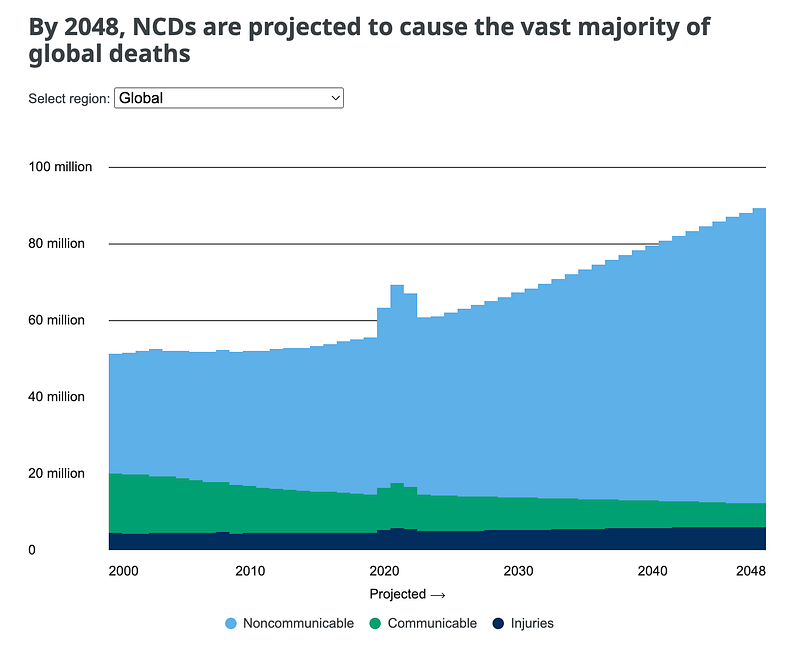
Given that technology has grown exponentially over the past few decades and has been a key factor in advancing modern medicine, should illness not be decreasing instead of increasing?
The interesting thing about the statistics above is that the NCDs are chronic, which means they persist for a long time or constantly reoccur.
It’s Not My Fault
I can’t tell you the amount of times I’ve heard people blame external sources for their misfortune — I used to be one of them.
I have bad genes. I don’t have time. I can’t afford it. They did this to me. I didn’t have a choice. Do any of these sound familiar?
I was always very health conscious. My mother was diagnosed with Multiple Sclerosis (MS) when I was born, so I had a front-row seat to what it looks like to lose one's physical health and the toll it takes not just on the affected person but all those close to them.
But then, about 10 years ago, I started to get sick — chronically.
I began to lose my ability to focus for long periods of time. I was permanently exhausted. My eyesight began to deteriorate. I had a seizure. I had emergency back surgery for a herniated disc that almost left me paralysed. One year later, I felt the problem returning. I became weaker and weaker. I felt anxious all the time. And nobody could explain to me why.
I went to see countless doctors and practitioners looking for answers. It was frustrating and disheartening, to say the least.
Eventually, I hit my low point. It was shortly after my six-year rollercoaster relationship ended. And that’s when I realised that if I wanted something different, I had to do something different.
What happened to me was not my fault, but it was my responsibility to do something about it now.
Taking Responsibility
At first, I did what most people do:
- Read a bunch of books — many on narcissism and toxic relationships
- Bought some self-help courses
- Went to therapy
- Worked with a personal trainer
- Climbed Mount Kilimanjaro (ok, maybe not everybody does this, but I love a good hike!)
All of these were helpful, even essential, to a point. But ultimately, my progress stalled because I was still looking outside of myself for answers.
Along the way, I came across a quote from Jim Quick, the well-known brain coach, podcaster, writer, and entrepreneur.
You are a thermostat, not a thermometer. A thermostat sets the temperature and the environment rises. A thermometer measures the outside environment.
— Jim Kwik
I realised that my external symptoms — my physical health and my unhappy life — were a reflection of my internal health — my thoughts and emotions.
So, for the first time in my life, I started to look within instead of without for answers. And that is what taking responsibility means.
Responsibility = an ability to respond
This approach led me to try things like Rapid Transformation Therapy, Ayahuasca, and other plant-based psychedelics.
My journey back to health was long, but the process not only reversed my physical symptoms, it transformed my life.
All my physical symptoms subsided, and I regained my strength. I began forming healthy relationships — they started to give me energy instead of draining my energy. I gained clarity about what I stand for, what I want, and who I want to be.
And from my journey back to physical wellness, here are three key things I’ve learned:
- Our psychology affects our physiology and vice versa.
- I am enough.
- You can’t outsource your health.
Let’s dive in…
1. Our psychology affects our physiology and vice versa
The mind-body connection is real, I have no doubt.
Louise Hay, best-selling author and speaker, has written about this subject extensively. She’s well known for her affirmations, each of which corresponds to a particular ailment and/or body part.
Here are some examples from her book You Can Heal Your Life:
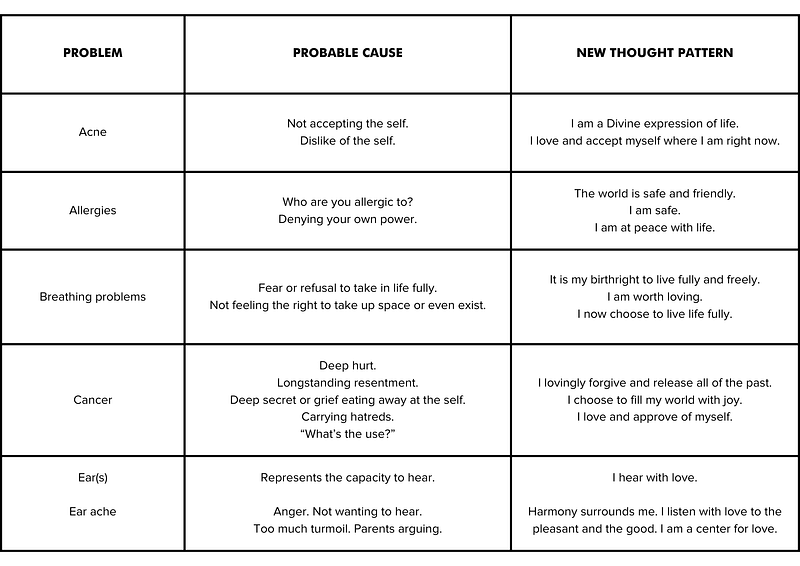
Do you see how the probable cause corresponds to the problem?
If you think and feel you are ugly, your skin reflects this in the form of acne.
If you think and feel you are unworthy of taking up space in this world, your lungs reflect this in the form of an inability to take in enough air.
Every thought you think causes an emotional response and a physical reaction.
— Marisa Peer
On the flip side, when we feel physically fit and strong, we naturally have more energy, improved ability to focus, and increased self-confidence.
It is also suggested that physical activity can increase the production of your brain’s feel-good neurotransmitters, called endorphins.
2. I am enough
Through my healing journey and then through my studies of Rapid Transformation Therapy and hypnotherapy, it seems clear that underlying all ailments people suffer from lies a deep-seated belief that “I am not enough”.
When we don’t feel enough, we need “more” from somewhere else.
Addictions are a prime example of this — drugs, alcohol, cigarettes, food, sugar, gambling, sex, and love — all forms of codependent/toxic relationships.
It wasn’t until I travelled down this road that I realised how codependent all my relationships were and, therefore, toxic to varying degrees.
The moment I realised that nothing was as it seemed was devastating. My entire reality shattered. But once I moved through the grief, I could begin to see things and people for what and who they really were instead of what I had always seen them as.
Why was my reality so distorted? Because we learn what we live, and we live what we learn.
95% of how we operate stems from our subconscious. That operating system is mostly formed in early childhood, according to the widely accepted Freudian theory that the first six years of life are the most important determinants of one’s personality.
As such, the environment we grow up in is critical, and when we don’t receive the love, care, affection, safety, security, and other basic needs met, we form beliefs about ourselves as to why this is.
I am not lovable. I am unworthy. I am different. And underlying all of them: I am not enough.
It’s a survival instinct because, as children, we are dependent on our caretakers. By the time we get to adulthood and become independent, these beliefs and corresponding behaviours are so ingrained that, in most cases, we aren’t even aware they are there.
Once again — mind-body connection.
It’s why we so often cannot explain our own behaviour. We know something or someone is bad for us, yet we do it anyway or stay in unhealthy relationships.
Ignorance is a blissful side effect of pain. And change is often uncomfortable and hard. As humans, we are hard-wired to dislike it.
No matter how bad a situation is, it’s often so much easier to stay than to leave.
Why? Because it’s predictable. We know what we’re getting. No matter how bad. And that is easier than facing the unknown.
Why? Because that taps into our deep-seated fear of being alone. Our fear of rejection. Fear of abandonment.
And that’s what keeps us co-dependent. It’s one of the hardest bonds to break, but the most important if we want to live a loving, fulfilling life on our terms.
And that starts with understanding, accepting, and believing that “You are enough.”
3. You can’t outsource your health
I know it’s easier to blame external factors and expect others to make your life better. #askmehowiknow
“My partner is wrong and should change.” “I am overworked, and my boss should adjust my workload.” “It’s the doctor’s responsibility to fix my health issues.”
But if that is your approach, I can just about guarantee that you will never feel the way you want to feel, and your health will suffer — chronically.
It is nobody else’s job or responsibility to heal you. YOU are responsible for your life.
Inner work. Nutrition. Movement. All are 100% within your control.
To be clear, this is not an anti-doctor or modern medicine campaign. When I needed back surgery, I needed a doctor, not a nutritionist. What I’m advocating is preventive care.
Before anyone else can make you feel the feelings you seek, you need to be able to give yourself those feelings.
Values. Boundaries. Self-love and care. All are 100% within your control.
And to clarify here, that does not mean that nobody else can love you until you love yourself. Of course, they can. But you will never truly feel the way you want to feel until you feel that way about yourself first.
At this stage, many of you might think, say, and even believe that you love yourself. However, do your actions reflect this?
I always thought I loved and respected myself, yet my last toxic relationship lasted 6 years! Staying in such a detrimental situation and continuously trying to ‘fix’ things are not the actions of someone who loves and respects themself.
What I have learned is that our health and relationships are a reflection of the relationship we have with ourselves.
It’s about progress, not perfection
Depending on the quality of your life right now, you may or may not be able to tackle all of the above. That’s OK. Rome wasn’t built in a day.
And if you’re lost on how to start, follow me on Instagram for daily info, tips, and inspiration on all of the topics listed.
The most important thing is to start. The action builds confidence.
If nothing else, start with these three little words: “I am enough.” Say them every day, anywhere, everywhere. The mind learns by repetition.


