avatarDouglas Rushkoff

Summary

The text argues that a balance between autonomy and interdependency is essential for a healthy society, as emphasizing either individualism or conformity can lead to desocialization.

Abstract

The article "You Can Only Stand Out in a Crowd" from Douglas Rushkoff's book "Team Human" emphasizes the delicate balance required for effective socialization, which is contingent upon both autonomy and interdependency. It posits that societal shifts towards extreme individualism, often disguised as freedom, can lead to a breakdown of the social fabric, as individuals become atomized and competitive without genuine autonomy. Conversely, a society that enforces conformity, while seemingly mitigating individualism, can also be desocializing by promoting obedience to a single authority, stifling social variation and fluidity. The text suggests that both individualism and conformity are tactics to control populations by undermining innate social mechanisms, advocating instead for a social model that values both personal uniqueness and collective cohesion.

Opinions

  • The author believes that an overemphasis on individualism, driven by professional or personal gain, can lead to antisocial behavior and a loss of true autonomy.
  • Rushkoff argues that conformity, while it may suppress individualism, is not a truly social state as it relies on obedience to a higher authority and lacks diversity and adaptability.
  • The text conveys the opinion that both individualism and conformity are desocializing forces that separate people and compromise the balance necessary for a thriving society.
  • The author suggests that the current societal structures, whether they promote individual competition or enforced uniformity, are designed to control people rather than foster genuine social connections.
  • Rushkoff implies that a healthy social environment is one that encourages both personal expression and mutual interdependence, allowing for a dynamic and resilient community.

You Can Only Stand Out in a Crowd

Why autonomy depends on interdependency
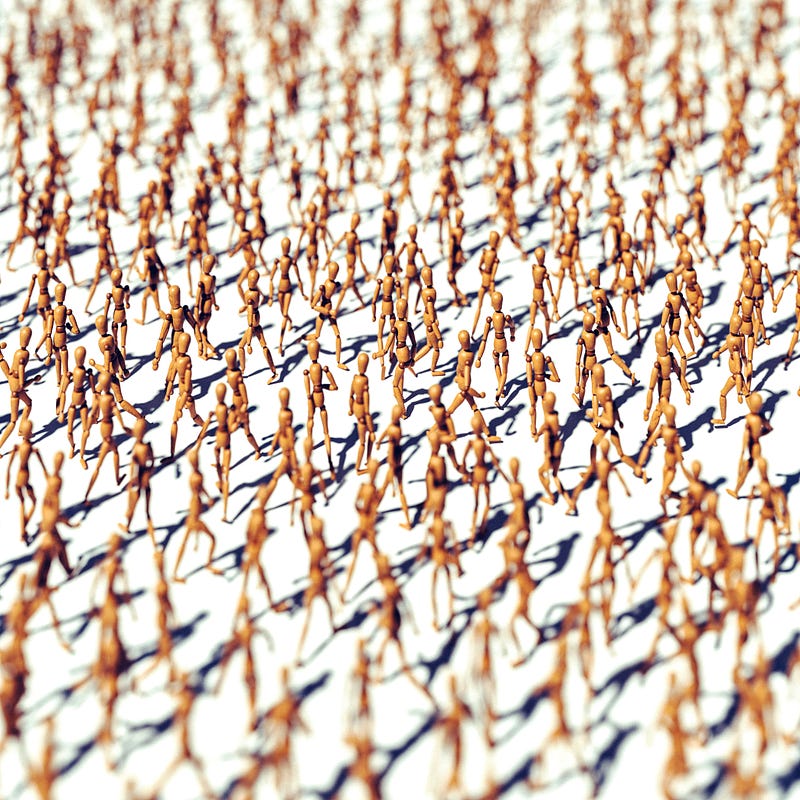
Photo: Doug Armand/Getty Images

It doesn’t take much to tilt a healthy social landscape toward an individualist or repressive one. A scarcity of resources, a hostile neighboring tribe, a warlord looking for power, an elite seeking to maintain its authority, or a corporation pursuing a monopoly all foster antisocial environments and behaviors.

Socialization depends on both autonomy and interdependency; emphasizing one at the expense of the other compromises the balance.

For example, one desocializing strategy is to emphasize individualism. The social group is broken down into atomized individuals who fight for their right to fulfillment via professional advancement or personal consumption. This system is often sold to us as freedom. Those competing individuals never find true autonomy, however, because they lack the social fabric in which to exercise it.

Another path to desocialization emphasizes conformity. People don’t need to compete because they are all the same. Such a system mitigates strident individualism, but it does so through obedience — often to a supreme ruler or monopoly party. Conformity is not truly social, however, because people are looking up for direction rather than to one another. There’s no variation, mutation, or social fluidity, so conformity ends up being just as desocializing as individualism.

Both approaches depend on separating people from one another and undermining our evolved social mechanisms in order to control us.

This is section 16 of the new book Team Human by Douglas Rushkoff, which is being serialized weekly on Medium. Read the previous section here and the following section here.
From Team Human by Douglas Rushkoff. Copyright © 2019 by Douglas Rushkoff. Used with permission of the publisher, W.W. Norton & Company, Inc. All rights reserved.
Evolution
Brain
Psychology
Science
Book Excerpt
Recommended from ReadMedium